
Does the Precor Acquisition Make Peloton a Buy?
The stock of Peloton Interactive (NASDAQ: PTON) soared after the maker of high-end home fitness equipment announced it was buying smaller rival Precor for $420 million. Investors bet that Peloton would gain entry into the commercial market of hotels, spas, and fitness clubs that was largely closed off to it before.
Yet unlike the home fitness industry, which became enormously popular during the COVID-19 pandemic, the commercial fitness market was severely damaged, and many gyms and fitness clubs went out of business.
So is Peloton's purchase of Precor as good as it seems? Let's find out.
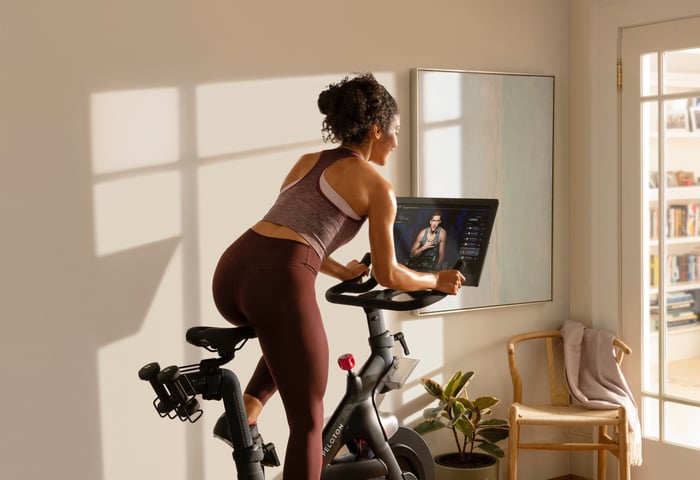
Image source: Peloton Interactive.
Waiting on relief
Arguably the biggest benefit of the Precor acquisition is that it gives Peloton access to 625,000 square feet of U.S. manufacturing space, along with in-house tooling and fabrication, product development, and quality-assurance capabilities.
Peloton's products are made by third-party contract manufacturers throughout Asia, primarily in Taiwan. Bringing at least some of its manufacturing into the U.S. will allow Peloton to ship home fitness equipment to its customers sooner. Shipment delays have been among the biggest problems facing Peloton during what otherwise should be a boom period.
CEO John Foley pointed out during the company's fiscal first-quarterearnings conference callin November that Peloton was incurring significant expenses related to shipment delays. He noted product wait times were affected by port congestion, periodic warehouse closures because of the pandemic, forest fires on the West Coast, and hurricanes, which caused the company to reschedule many deliveries. The delays have caused growing numbers of customers to cancel their orders.
A wedge issue
That gives rivals like Nautilus (NYSE: NLS) and others a chance to steal customers and market share. Nautilus saw its revenue surge over 150% in the same three-month period, allowing it to report net profits of $33.8 million, compared to an $8.8 million loss the year before.
Nautilus also benefited because its products are notably more affordable than those of Peloton, which has tried to make its equipment more accessible by producing a treadmill and stationary bike in the low-$2,000 range. In comparison, Nautilus' most expensive treadmill is around $1,300.
But the real hooks for most well-heeled consumers buying a Peloton bike or treadmill are the connected classes it offers while using the equipment, and even there Peloton has lowered the cost of a subscription.
A new way for Peloton to train
The Precor acquisition also gives Peloton a buffer against the eventual return to normalcy that ought to follow COVID-19 vaccines being widely distributed. Because, like new year's resolutions for weight loss that are quickly abandoned, many consumers who purchased home fitness equipment during the lockdowns will return to their preferred workout venue.
No doubt quite a number will keep up with their new at-home regimen, but others have already bounced back to their routines as gyms and spas reopened, and others will gradually return.
A big world outside
U.S. gyms are a $44 billion opportunity compared to $4 billion for the home fitness market. Even accounting for the damage wrought on the industry by the pandemic, it's a much more dynamic market for Peloton.
Precor gives Peloton the ability to offer these out-of-home venues more than just stationary bikes and treadmills, and at the same time could allow it to introduce to the home fitness market Precor's lineup of adaptive motion trainers and elliptical machines, as well as design a complete portfolio of products.
Still, the International Health, Racquet & Sportsclub Association says as many as 25% of all gyms could permanently close because of the pandemic, minimizing the reach Precor provides.
Feeling fit
Buying Precor looks like a good fit for Peloton, though it might not result in immediate benefits beyond helping it resolve its shipment delays.
This is a tie-up whose real benefit is the long-term gain down the road, much like exercise itself: You don't see a transformation right away, but only over time.
Peloton Interactive should see similar results once this deal closes, making its stock a buy now, particularly on any weakness seen.
10 stocks we like better than Peloton Interactive
When investing geniuses David and Tom Gardner have a stock tip, it can pay to listen. After all, the newsletter they have run for over a decade, Motley Fool Stock Advisor, has tripled the market.*
David and Tom just revealed what they believe are the ten best stocks for investors to buy right now... and Peloton Interactive wasn't one of them! That's right -- they think these 10 stocks are even better buys.
*Stock Advisor returns as of November 20, 2020
Rich Duprey has no position in any of the stocks mentioned. The Motley Fool owns shares of and recommends Peloton Interactive. The Motley Fool has a disclosure policy.
