Despite Walk Back, Navarro's Comments Are Worrying. Why the Big Bounce, And What Does It Mean for Investors?

Relief rallies are strange things. A decline of the major indices on bad news is perfectly understandable, logically unavoidable even. But "Not as bad as I thought it was" should really only take you back to where you began, not markedly higher. And yet yesterday evening, after Dow futures dropped over 400 points on an offhand comment by Peter Navarro, a top White House official, futures rebounded double that when he denied meaning what he actually said.
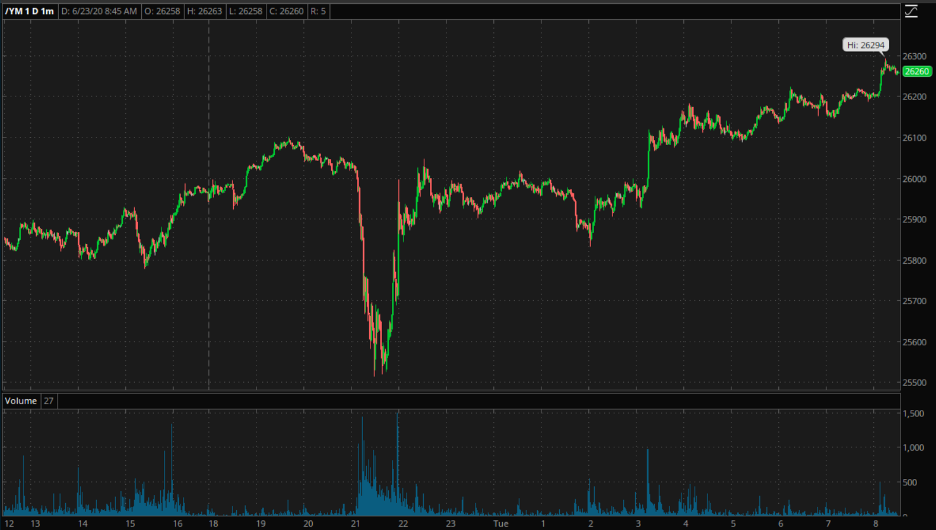
When taken at face value, the words of Navarro are quite clear in their meaning. On Fox News, he was asked about the trade deal with China, a question that ended with the words "is that over?"
He replied, "It's over."
I don’t know about you, but to me that seems unambiguous, despite what Navarro said later as he backtracked those comments. It doesn't help that his "clarification" came after his comment tanked the market, an unforgivable sin in an election-focused White House.
That more than anything is why Navarro quickly challenged the interpretation and meaning of his words. Apparently, "It’s over" doesn’t mean "It’s over." It means it's far from over. Never stronger, in fact!
Look, clearly, the deal is not actually "over" at this point. If it were the President wouldn’t have immediately tweeted out that it was not, nor would Navarro have scrambled to attempt to change the meaning of common words. It is likely that the response to the original question was a bit of wishful thinking from the White House trade advisor, who is known to distrust China and is wary of any deal with them. However, the fact that he felt he could say them at all, and the market's reaction to his "correction," both tell us something.
The context that Navarro claimed was missing from his comment as reported doesn’t make things better, but it does make it a bit clearer. The comment, he claimed was not about the deal itself, but about the trust the administration had for Beijing and President Xi. That, he went on to explain, was destroyed by the Chinese authorities’ failure to accurately report the rise of the coronavirus. So, the deal is intact for now, but apparently nobody thinks the Chinese are going to stick to it.
That distrust is mutual too. At a press briefing, the Chinese Foreign Minister said of Navarro, “He consistently lies and has no honesty and trustworthiness.”
That hardly inspires confidence going forward.
Certainly, none of the above seems like a cause for an 800-point bounce, resulting in a net 400-point gain in Dow futures from before we were told the deal was over. Either there are some real problems with the trade deal or neither the Chinese foreign minister nor the principal White House trade advisor has any idea what is going on. Put another way, either the deal will be dead soon, or both sides are chaotic and dysfunctional. Whichever it is, the future is anything but bright.
So why are we higher than yesterday’s close this morning?
It is because people are looking for excuses to buy.
Early in this rally, I said it was driven by FOMO, and that is still the case. There is a lot of money still sitting on the sidelines, and each time it looks as if a big drop is coming, the market reverses immediately. Hence, we end up higher than before the bad news on a denial, even though the original story has some truth to it and is a legitimate cause for worry.
If that makes you uneasy, you are not alone. However, as all traders find out at some point, momentum beats logic every time. As long as investors are looking for reasons to buy, the market will continue to go up, even in a dire economy, and with serious risks to the China trade deal. Also, there is a chance that reality adjusts to current speculation, not the other way around, and that by the time the momentum fades, the pace of gains slows to allow the economy to catch up. In that case, the big correction many are expecting may never even come at all.
So, what are investors to do?
The only thing you can do for now is to stay long but hold off with any extra cash. There is no point in selling when every dip results in the market moving higher, but I am wary of buying those dips. I would rather keep some cash on hand in case reality intrudes at some point. It is essentially a neutral strategy, but the Navarro saga shows that logic is secondary at the moment, and that means that neutral is the right gear to be in.
The views and opinions expressed herein are the views and opinions of the author and do not necessarily reflect those of Nasdaq, Inc.

Martin Tillier
Martin Tillier spent years working in the Foreign Exchange market, which required an in-depth understanding of both the world’s markets and psychology and techniques of traders. In 2002, Martin left the markets, moved to the U.S., and opened a successful wine store, but the lure of the financial world proved too strong, leading Martin to join a major firm as financial advisor.
Read Martin's Bio