
Casey's General Stores: 3 Takeaways
It's a good time to be catering to hungry drivers. Casey's General Stores (NASDAQ: CASY) just reported strong sales growth through late January as traffic jumped at its fuel pumps and inside its stores.
Sure, the convenience store retailer's results were lifted by unusually weak year-ago metrics due to the pandemic. But Casey's success in areas like breakfast, pizza, and fuel sales suggests solid returns for investors going forward.
Let's dive right in.
Sales trends
Casey's breaks its growth into two categories: fuel and store sales. Both were strong into early 2022. Gas sales in particular jumped as more people are driving compared to a year ago.
Casey's sold 6% more fuel while also benefiting from higher prices. Management said they struck the right balance between volume and pricing so that profitability rose steadily without sacrificing much in the way of customer traffic.

Image source: Getty Images.
The news was even better within stores, where revenue rose 8% to mark a good acceleration from the prior quarter's 6% increase. Casey's continued attracting diners with its pizza menu, but its recent push into breakfast sandwiches was the real standout. Revenue in the competitive breakfast hours jumped 17%. "I am extremely proud of how the Casey's team generated record third quarter earnings," CEO Darren Rebelez said in a press release.
Rising costs
Most of the profit performance was impressive, but there were signs of strain. Casey's boosted margins on fuel and raised prices to reflect rising costs on key food inputs. Those hikes weren't enough to fully offset inflation, though, and in-store profitability fell to 39.4% from 39.6% a year ago.
Casey's also felt pressure from its recent acquisition of the Pilot convenience store brand, and from rising labor costs. Altogether, pre-tax earnings in the past nine months are up just slightly, to $368 million, or 3.9% of sales, compared to $354 million, or 5.6% of sales, a year earlier.
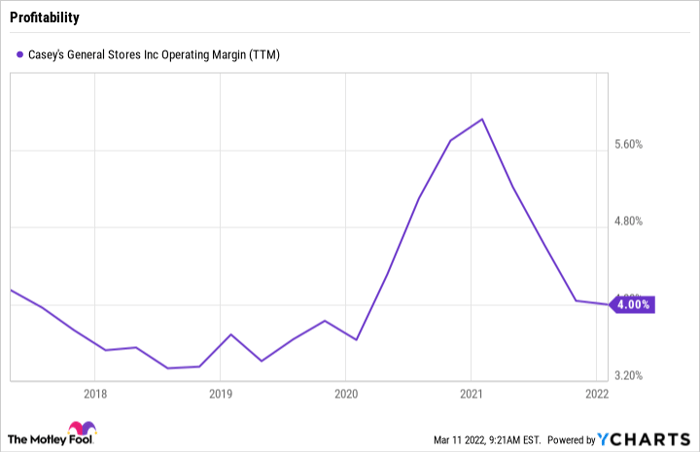
CASY Operating Margin (TTM) data by YCharts
Executives described the performance as strong given a tough cost environment and the omicron variant's surge during most of the period.
Looking ahead
Management is going full speed ahead with its growth strategy, which relies on building out the company's store footprint while attracting more customers at existing locations. Casey's plans to add 225 locations in fiscal 2022, which ends in late April.
The short-term sales outlook didn't change and is still calling for a mid-single-digit boost in comparable-store sales. Expenses are still on track to modestly outpace revenue, too, leading to a small step backwards on profitability.
Investors might not be thrilled to see Casey's margins falling at a time when customer traffic is so strong. But the drop appears to be driven by temporary factors like inflation and recent store acquisitions. As a result, shareholders might see evidence of a margin rebound when the retailer issues its new fiscal year forecast in May.
10 stocks we like better than Caseys General Stores
When our award-winning analyst team has a stock tip, it can pay to listen. After all, the newsletter they have run for over a decade, Motley Fool Stock Advisor, has tripled the market.*
They just revealed what they believe are the ten best stocks for investors to buy right now... and Caseys General Stores wasn't one of them! That's right -- they think these 10 stocks are even better buys.
*Stock Advisor returns as of March 3, 2022
Demitri Kalogeropoulos has no position in any of the stocks mentioned. The Motley Fool recommends Caseys General Stores. The Motley Fool has a disclosure policy.
