
OppFi’s OPFI customer-centric approach serves as its paramount differentiator within the alternative lending platform market. While most players vie for market share, OppFi’s priority toward customer experience, trust and financial inclusion sets it apart.
OPFI’s bank-partner model is a key enabler of this customer-centric approach. This model targets the population that falls in the Fair Issac Corporation score range below the 650 mark, wherein traditional lending options get blurry. Hence, this practice allows the company to broaden its reach across the United States, ensuring a significant number of underserved consumers can access credit.
OppFi’s ability to serve customers is greatly improved by its advanced AI and machine learning models. In the first quarter of 2025, OPFI saw its auto-approval rate rise to 79% from 73% in the same quarter last year. This demonstrates an efficient application process, reducing friction and allowing qualified borrowers to access funds quickly. Besides effective cost management, the increasing auto-approval rate indicates faster decisions and a smoother experience for customers.
The tangible results from the customer-first strategy are evident in OPFI’s astounding customer satisfaction ratings. As of the first quarter of 2025, OPFI’s OppLoans had a 4.7/5.0-star rating on Trustpilot from more than 4,900 reviews, making the company one of the top consumer-related financial platforms online. Per Better Business Bureau, the company is rated A+, bolstering OppFi’s credibility and commitment to resolving customer issues.
OppFi’s Net Promoter Score (NPS) is 78, signifying a highly loyal consumer base willing to advocate for its brand. These numbers collectively demonstrate OPFI’s commitment to transparency, simplified installment loans and features including same-day funding. It translates directly into customer loyalty and reputation, which serves the company well in distinguishing itself within the underserved population.
With the U.S. alternative lending platform market anticipated to grow, seeing a CAGR of 25.4% from 2025 to 2030, OPFI has positioned itself on the back of its elite customer-centric approach to enjoy a headstart in the race to capture a greater market share.
OPFI’s Price Performance, Valuation & Estimates
The stock has skyrocketed 297.4% in the past year, significantly outperforming its competitors, PayPal Holdings PYPL and Paysafe Limited PSFE, and the industry as a whole. The industry has rallied 28.1%. PayPal Holdings has gained 28.6%, while Paysafe Limited has declined 26.8% in the same period.
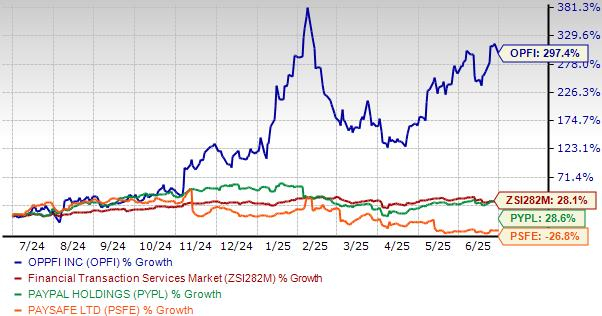 Image Source: Zacks Investment Research
From a valuation standpoint, OPFI trades at a forward price-to-earnings ratio of 10.62, lower than the industry’s 22.84. PayPal and Paysafe trade at 13.86 and 4.95, respectively.
P/E - F12M
 Image Source: Zacks Investment Research
OPFI and Paysafe have a Value Score of A, whereas PayPal has a Value Score of B.
The Zacks Consensus Estimate for OppFi’s earnings for 2025 is pegged at $2.38 per share, suggesting 11.2% year-over-year growth.
 Image Source: Zacks Investment Research
OPFI currently flaunts a Zacks Rank #1 (Strong Buy). You can see the complete list of today’s Zacks #1 Rank stocks here.
Only $1 to See All Zacks' Buys and Sells
We're not kidding.
Several years ago, we shocked our members by offering them 30-day access to all our picks for the total sum of only $1. No obligation to spend another cent.
Thousands have taken advantage of this opportunity. Thousands did not - they thought there must be a catch. Yes, we do have a reason. We want you to get acquainted with our portfolio services like Surprise Trader, Stocks Under $10, Technology Innovators,and more, that closed 256 positions with double- and triple-digit gains in 2024 alone.
See Stocks Now >>PayPal Holdings, Inc. (PYPL) : Free Stock Analysis Report
Paysafe Limited (PSFE) : Free Stock Analysis Report
OppFi Inc. (OPFI) : Free Stock Analysis Report
This article originally published on Zacks Investment Research (zacks.com).
The views and opinions expressed herein are the views and opinions of the author and do not necessarily reflect those of Nasdaq, Inc.

