
BlackRock’s BLK rapid rise to dominance in the cryptocurrency ETF market has reshaped the landscape of digital-asset investing. Since the approval of spot Bitcoin ETFs in January 2024, the firm’s flagship product, the iShares Bitcoin Trust (IBIT), has surged ahead to become the company’s leading revenue generator, outperforming several of its long-established equity and fixed-income funds. This was disclosed by Cristiano Castro, director of business development at BlackRock Brazil, at the Blockchain Conference in Sao Paulo, as reported by CoinDesk.
Castro described the surge in BLK’s Bitcoin ETFs as an unexpected but significant development, noting that combined allocations in products like the U.S.-based IBIT and Brazil’s IBIT39 have nearly reached $100 billion. He said the team was optimistic at launch but did not anticipate growth of this magnitude.
IBIT’s massive inflows (fastest to reach $70 billion in assets) reflect a major shift in investor behavior. Traditional market participants, including hedge funds, wealth managers and corporate treasuries, are increasingly seeking regulated exposure to Bitcoin through vehicles that offer transparency, liquidity and ease of access. BlackRock’s reputation, combined with its distribution network, provided an immediate advantage. As a result, the fund has consistently recorded billions in net inflows, securing a commanding share of the market since the launch, despite recent Bitcoin price volatility.
The revenues generated from the ETFs are primarily driven by BLK’s asset growth and management fees. While the fee structure remains competitive, the sheer volume of assets under management (AUM) has propelled IBIT ahead of many of the company’s established products in terms of profitability. As of Sept. 30, 2025, its AUM under digital assets was $104 billion, signaling a broader acceptance of cryptocurrencies within diversified portfolios.
As Bitcoin continues to solidify its role as an alternative store of value, BlackRock’s leadership in the ETF space may set the tone for the next era of crypto-driven financial innovation. The company’s performance suggests that digital-asset investment products are no longer a niche; they are becoming central to global asset-management strategies. The company is the first asset manager to surpass $13 trillion in AUM, reaching a record $13.46 trillion as of Sept. 30, 2025.
BlackRock’s Price Performance & Zacks Rank
Shares of BlackRock have gained 7.1% over the past six months against the industry’s decline of 5.8%.
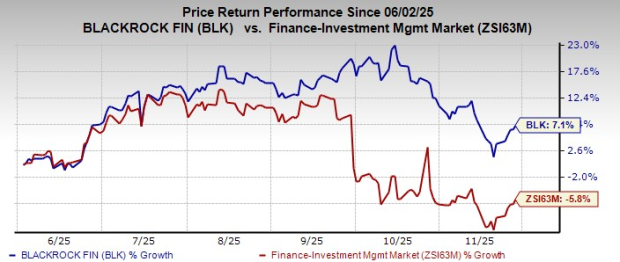
Image Source: Zacks Investment Research
At present, BLK carries a Zacks Rank #3 (Hold).
BLK’s Peers Worth a Look
Some of BlackRock’s peers, including Invesco IVZ and T. Rowe Price TROW, are worth betting on. Both sport a Zacks Rank #1 (Strong Buy). You can see the complete list of today’s Zacks #1 Rank stocks here.
Over the past month, the Zacks Consensus Estimate for IVZ’s 2025 earnings has been revised 2.1% upward to $1.95. The figure implies an increase of 14% from the prior year.
Over the past 30 days, the Zacks Consensus Estimate for TROW’s 2025 earnings has been revised 4.9% higher to $9.75. The figure implies a rise of 4.5% on a year-over-year basis.
Zacks Names #1 Semiconductor Stock
This under-the-radar company specializes in semiconductor products that titans like NVIDIA don't build. It's uniquely positioned to take advantage of the next growth stage of this market. And it's just beginning to enter the spotlight, which is exactly where you want to be.
With strong earnings growth and an expanding customer base, it's positioned to feed the rampant demand for Artificial Intelligence, Machine Learning, and Internet of Things. Global semiconductor manufacturing is projected to explode from $452 billion in 2021 to $971 billion by 2028.
See This Stock Now for Free >>BlackRock (BLK) : Free Stock Analysis Report
T. Rowe Price Group, Inc. (TROW) : Free Stock Analysis Report
Invesco Ltd. (IVZ) : Free Stock Analysis Report
This article originally published on Zacks Investment Research (zacks.com).
The views and opinions expressed herein are the views and opinions of the author and do not necessarily reflect those of Nasdaq, Inc.

