
BHP Group Limited BHP and Vale S.A. VALE are among the world’s largest iron ore producers and diversified miners, making them competitors in the global metals and mining sector. Both companies are positioned to benefit as infrastructure investment picks up worldwide and long-term demand grows for steel, copper, lithium, nickel and other minerals essential for clean energy technologies. BHP has a market capitalization of around $203 billion, while VALE has a market capitalization of $73 billion.
For investors interested in this space, let's analyze which stock is better positioned for upside, BHP or Vale. A closer look at their fundamentals, growth drivers and key risks can offer clarity.
The Case for BHP
BHP produced 62.8 Mt of iron ore in the third quarter of fiscal 2026 (ended March 31, 2026), up 2% year over year. Production at Western Australia Iron Ore (WAIO) was a record 60.9 Mt (69.8 Mt on a 100% basis). For fiscal 2026, BHP continues to expect iron ore production of 258-269 Mt. WAIO’s output is likely to be 251-262 Mt (284-296 Mt on a 100% basis).
WAIO has been the lowest-cost iron ore producer globally for more than four years. Over the medium term, WAIO production is expected to exceed 305 Mt annually, supported by expanded rail operation capacity unlocked by RTP1 and the Western Ridge Crusher Project. BHP is investing in a sixth car dumper and related infrastructure at Port Hedland. Going forward, growth in world steel production spurred by urbanization will fuel demand for iron ore and help sustain prices, which bodes well for BHP.
Copper production was 476.8 kt in the quarter, a 7% decline year over year as lower output at Escondida, Pampa Norte and Carajás offset improved results at Copper South Australia and Antamina. BHP guides copper output in fiscal 2026 to be at the upper half of its prior stated range of 1,900-2,000 kt.
BHP has been reshaping its portfolio toward commodities such as copper and potash, allocating nearly 70% of its medium-term capital expenditure to these areas. This strategy positions the company to benefit from decarbonization, electrification, population growth and rising living standards in emerging markets.
In March, the company submitted the Environmental Impact Declaration (DIA) permit for the Escondida New Concentrator to replace the aging Los Colorados plant. Resolution Copper, a joint venture between Rio Tinto (55% and operator) and BHP (45%), completed a land exchange in Arizona, United States. They can now advance further resource data collection and initiate early underground development at the Resolution Copper project, one of the largest untapped, high-grade copper resources in the world. The company has copper projects under execution and a pipeline that could deliver around 2 Mtpa of attributable copper production by the 2030s.
BHP is also advancing the Jansen Stage 1 potash project, a large-scale, low-cost, high-grade resource with a mine life exceeding 100 years. It is expected to produce 4.15 million tons of potash annually, starting mid-2027. Stage 2 of the project is expected to deliver its first production in fiscal 2031 and add 4.36 million tons annually. These investments will position BHP as a major global producer of potash by the end of the decade.
The Case for Vale
Vale’s iron ore production for the first quarter of 2026 (ended March 31, 2026) was 69.7 Mt, a 3% year-over-year increase. This performance was driven by record output at the S11D and Brucutu plant, as well as the ramp-up of the Capanema and VGR1 projects. Pellet production was up 13.7% year over year to 8.2 Mt, driven by improved performance at the Tubarão pelletizing plants.
The company maintains its iron ore guidance at 335-345 Mt for 2026. It is expected to reach 360 Mt by 2030. The Vargem Grande 1 (VGR1) project and the Capanema Maximization project are expected to play a key role in attaining these targets. Other approved projects are Compact Crushing at S11D and Serra Sul.
Vale is also investing heavily in the base metals business to benefit from the global energy transition. The company’s capex plans for the business are $1.6 billion in 2026 and $2 billion from 2027 onward.
Copper production was up 12.5% year over year to 102 kt in the first quarter of 2026. Record output at Salobo and Sossego, as well as improved performance at Voisey's Bay polymetallic mines, led to the year-over-year improvement. Nickel production for the quarter was 49.3 kt, up 12.3% year over year. This reflected the full-quarter contribution of Onça Puma's second furnace and stable output at Voisey's Bay underground mines ramp-up.
In 2026, Vale's copper production is expected to be between 350 kt and 380 kt, and reach 420-500 kt by 2030 and 700 kt by 2035. The Bacaba project will extend the life of the Sossego Mining Complex, contributing an average annual copper output of 50 ktpy over an eight-year mine life. Production is expected to start in the first half of 2028. Other projects, such as Salobo Coarse Particle Flotation (CPF), Alemão and Cristalino, will increase Vale’s copper production capacity.
Vale recently signed an agreement with Glencore Canada (Glencore) to jointly evaluate a potential brownfield copper development project at their adjacent properties in the Sudbury Basin, with an expected start-up in 2030. Vale plans to hit 700 kt levels by 2035, primarily through the accelerated development of assets in the North and South hubs in the Carajás region.
For 2026, Vale expects its nickel production to be between 175 kt and 200 kt, reflecting replenishment projects in Canada, exposure to Pomalaa and Morowali, and the start-up of the second furnace at Onça Puma. For 2030, nickel production is anticipated at 210-250 kt, with input from projects such as Thompson Ultramafics, Sorowako HPAL, partnership projects and offtake.
How do Estimates Compare for BHP & VALE?
The Zacks Consensus Estimate for BHP’s fiscal 2026 earnings indicates a year-over-year rise of 32.7%. The estimate for earnings for fiscal 2027 reflects a 1% drop.
The Zacks Consensus Estimate for Vale’s 2026 earnings of $2.08 per share indicates year-over-year growth of 14.3%. The consensus estimate for Vale’s 2027 earnings is $2.19 per share, which projects a 5.5% rise.
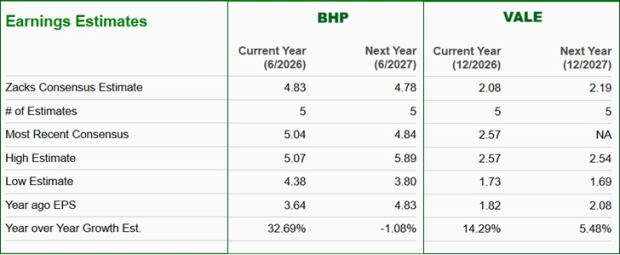
Image Source: Zacks Investment Research
Both the earnings estimates for fiscal 2026 and fiscal 2027 for BHP have moved up over the past 60 days. While the EPS estimates for Vale for fiscal 2026 have been revised downward in the past 60 days, the same for fiscal 2027 has moved up.
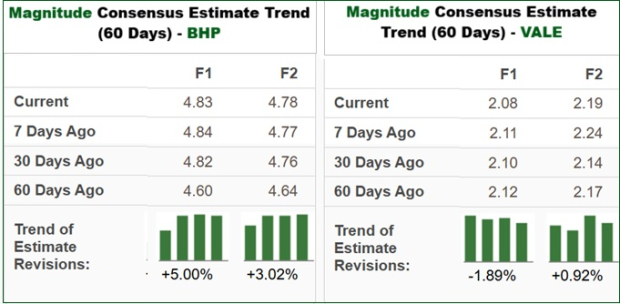
Image Source: Zacks Investment Research
BHP Group & Vale: Price Performance & Valuation
In a year, BHP stock has appreciated 64.9%, lagging Vale, which has gained 78.9%.
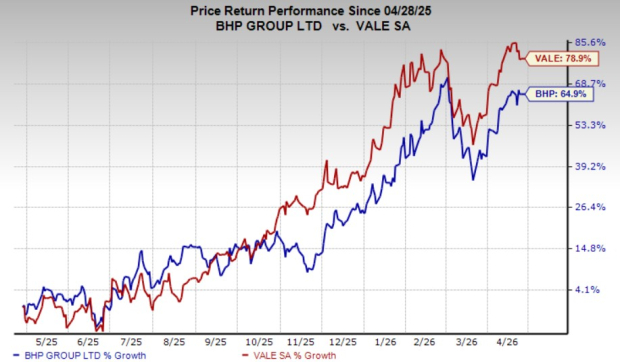
Image Source: Zacks Investment Research
BHP is trading at a forward price-to-sales multiple of 3.75X, while VALE’s forward sales multiple sits at 1.90X.
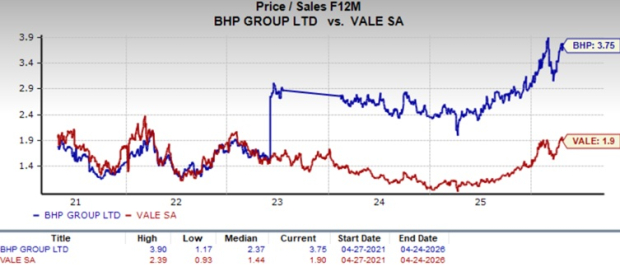
Image Source: Zacks Investment Research
VALE’s return on equity of 20.16% is higher than BHP’s 17.72%. This reflects Vale’s efficient use of shareholder funds in generating profits.
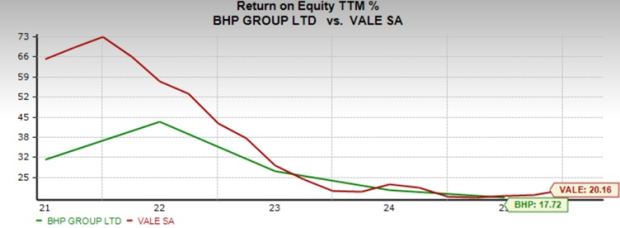
Image Source: Zacks Investment Research
BHP or VALE: Which is a Better Pick?
BHP and Vale are both well-positioned for durable long-term growth, backed by resilient iron ore operations as well as a growing focus on future-facing materials. Both stocks currently carry a Zacks Rank #3 (Hold), which makes choosing one difficult. Given its attractive valuation, a stronger price performance and positive earnings expectation for this year as well as the next, along with a higher ROE, Vale currently has the edge.
You can see the complete list of today’s Zacks #1 Rank (Strong Buy) stocks here.
Radical New Technology Could Hand Investors Huge Gains
Quantum Computing is the next technological revolution, and it could be even more advanced than AI.
While some believed the technology was years away, it is already present and moving fast. Large hyperscalers, such as Microsoft, Google, Amazon, Oracle, and even Meta and Tesla, are scrambling to integrate quantum computing into their infrastructure.
Senior Stock Strategist Kevin Cook reveals 7 carefully selected stocks poised to dominate the quantum computing landscape in his report, Beyond AI: The Quantum Leap in Computing Power.
Kevin was among the early experts who recognized NVIDIA's enormous potential back in 2016. Now, he has keyed in on what could be "the next big thing" in quantum computing supremacy. Today, you have a rare chance to position your portfolio at the forefront of this opportunity.
See Top Quantum Stocks Now >>BHP Group Limited Sponsored ADR (BHP) : Free Stock Analysis Report
VALE S.A. (VALE) : Free Stock Analysis Report
This article originally published on Zacks Investment Research (zacks.com).
The views and opinions expressed herein are the views and opinions of the author and do not necessarily reflect those of Nasdaq, Inc.

