
Artificial intelligence (AI) is a game changer for many tech stocks, driving share prices to incredible highs. Two businesses benefiting from the AI fervor are Advanced Micro Devices (NASDAQ: AMD), or AMD, and Super Micro Computer (NASDAQ: SMCI), commonly known as Supermicro.
Both saw insatiable customer demand for their AI-related products over the past year, causing outsized share price gains. AMD stock went from a 52-week low of $93.12 in 2023 to a high of $227.30 in March. Meanwhile, Supermicro shares surged to a 52-week high of $1,229 in March from a low of $226.59 last year.
With the the broader stock market's recent sell-off, AMD and Supermicro are currently well below their highs. This creates an opportunity to pick up shares, but which of these AI-related stocks is the better buy?
AMD's AI-powered sales surge
AMD's business transformed substantially over the past year. This is thanks to its role as the maker of semiconductor chips critical to the computational power of AI algorithms.
In 2023, each of the four segments of its operations contributed 20% or more to the company's revenue for the year. In 2024, things look dramatically different.
The semiconductor giant's data center business, which sells AI-optimized chips to cloud computing companies, now produces nearly half of its revenue. For instance, this division generated $2.8 billion of AMD's $5.8 billion in Q2 sales, as data center revenue increased 115% year over year.
Its AI chips for the PC market are also selling well. This segment saw Q2 sales jump by 49% year over year to $1.5 billion. However, other parts of AMD's business declined.
Its chips for the gaming industry as well as its embedded products, used in industries such as automotive, experienced a cyclical downturn as customer demand in these areas waned. The gaming segment's revenue dropped 59% to $648 million compared to 2023's $1.6 billion, while embedded sales were down 41% year over year to $861 million.
AMD management anticipates the embedded business will rebound in the second half of this year. This adds to AMD's AI-driven sales growth, resulting in Q3 revenue forecast to reach around $6.7 billion, a double-digit increase over 2023's $5.8 billion.
Supermicro's success in the AI ecosystem
While AMD provides the chips used in hardware such as computer servers, Supermicro produces the servers themselves, as well as storage solutions to house the data needed by AI to execute tasks.
The central role played by Supermicro's products in the AI ecosystem is a key reason its sales skyrocketed 143% year over year to $5.3 billion in its fiscal fourth quarter, ended June 30. In fact, its Q4 revenue was more than the $5.2 billion Supermicro generated in all of 2022.
The company touts its "building blocks" architecture as a competitive differentiator. Supermicro's products are modular, enabling the company to quickly create customizations to meet a customer's needs. This approach helped Supermicro grow revenue more than 5 times faster than the industry average over the past year, according to the company.
Its amazing revenue growth translated into strong financials. Supermicro's net income reached $352.7 million in Q4, up from $193.6 million in fiscal 2023. This propelled its diluted earnings per share (EPS) to $5.51 in Q4 compared to $3.43 in the previous year, the latest in a multiyear history of steadily rising EPS.
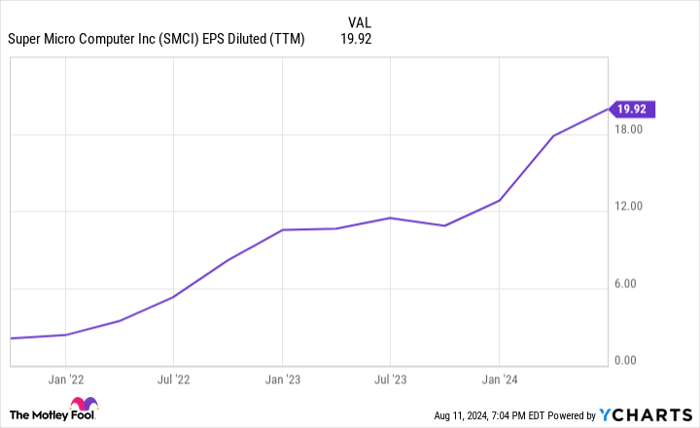
Data by YCharts.
In addition, the company exited its 2024 fiscal year with an excellent balance sheet. Total assets were $9.9 billion versus total liabilities of $4.5 billion. Q4 cash and equivalents were $1.7 billion.
Thanks to the company's success and incredible stock price rise over the past year, Supermicro announced a 10-for-1 stock split, which will take place Oct. 1.
Choosing between AMD and Super Micro Computer stock
Deciding whether to invest in AMD or Supermicro is difficult. Both benefit from the tailwind of the AI market's growth, and the pair are viewed favorably by Wall Street.
The consensus among Wall Street analysts is a buy rating for AMD stock with a median share price of $190. The consensus for Supermicro shares is an overweight rating with a median price of $693.
Ideally, you can own both stocks. But if you had to choose just one, Supermicro edges out AMD. A key factor is valuation.
Although both stocks are down from 52-week highs, Supermicro looks like the better value when evaluating them based on the price-to-earnings ratio (P/E ratio), a widely used metric to assess valuation.
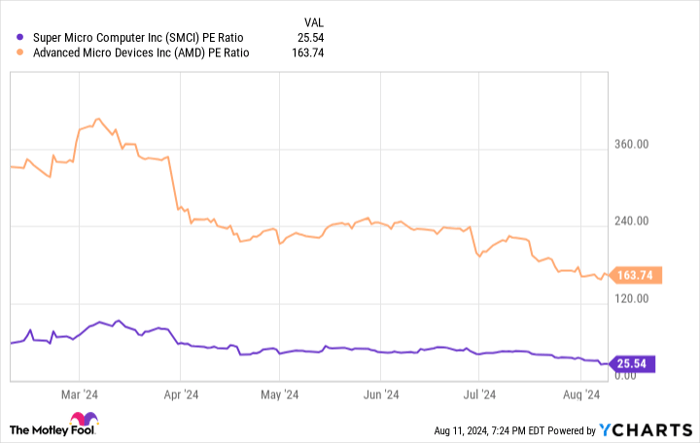
Data by YCharts.
AMD's P/E ratio is over 6 times greater than Supermicro's P/E multiple of 25.5. And actually, AMD's shares are more expensive than those of its major rival, Nvidia, which has a P/E ratio of 61.3 at the time of this writing. Given Nvidia dominates the market for AI-optimized chips, it lends further credence to AMD shares being overpriced.
Taking this into consideration with Supermicro's jaw-dropping sales growth, strong financials, steadily rising EPS, and successful product strategy, between these two AI stocks, Supermicro is the better AI investment right now.
Should you invest $1,000 in Super Micro Computer right now?
Before you buy stock in Super Micro Computer, consider this:
The Motley Fool Stock Advisor analyst team just identified what they believe are the 10 best stocks for investors to buy now… and Super Micro Computer wasn’t one of them. The 10 stocks that made the cut could produce monster returns in the coming years.
Consider when Nvidia made this list on April 15, 2005... if you invested $1,000 at the time of our recommendation, you’d have $723,545!*
Stock Advisor provides investors with an easy-to-follow blueprint for success, including guidance on building a portfolio, regular updates from analysts, and two new stock picks each month. The Stock Advisor service has more than quadrupled the return of S&P 500 since 2002*.
*Stock Advisor returns as of August 12, 2024
Robert Izquierdo has positions in Advanced Micro Devices and Nvidia. The Motley Fool has positions in and recommends Advanced Micro Devices and Nvidia. The Motley Fool has a disclosure policy.
The views and opinions expressed herein are the views and opinions of the author and do not necessarily reflect those of Nasdaq, Inc.

