
It is hard to get excited after looking at John Wiley & Sons' (NYSE:JW.A) recent performance, when its stock has declined 8.1% over the past month. However, stock prices are usually driven by a company’s financials over the long term, which in this case look pretty respectable. Particularly, we will be paying attention to John Wiley & Sons' ROE today.
Return on equity or ROE is an important factor to be considered by a shareholder because it tells them how effectively their capital is being reinvested. In simpler terms, it measures the profitability of a company in relation to shareholder's equity.
How Is ROE Calculated?
The formula for return on equity is:
Return on Equity = Net Profit (from continuing operations) ÷ Shareholders' Equity
So, based on the above formula, the ROE for John Wiley & Sons is:
12% = US$133m ÷ US$1.1b (Based on the trailing twelve months to October 2021).
The 'return' is the profit over the last twelve months. That means that for every $1 worth of shareholders' equity, the company generated $0.12 in profit.
What Has ROE Got To Do With Earnings Growth?
So far, we've learned that ROE is a measure of a company's profitability. Depending on how much of these profits the company reinvests or "retains", and how effectively it does so, we are then able to assess a company’s earnings growth potential. Assuming everything else remains unchanged, the higher the ROE and profit retention, the higher the growth rate of a company compared to companies that don't necessarily bear these characteristics.
John Wiley & Sons' Earnings Growth And 12% ROE
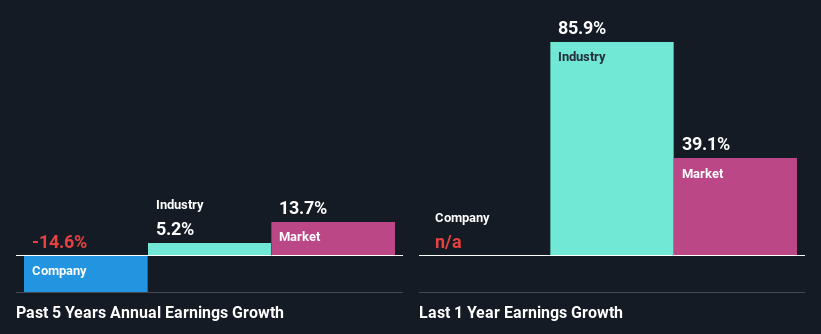
To begin with, John Wiley & Sons seems to have a respectable ROE. Be that as it may, the company's ROE is still quite lower than the industry average of 15%. Further research shows that John Wiley & Sons' net income has shrunk at a rate of 15% over the last five years. Bear in mind, the company does have a high ROE. It is just that the industry ROE is higher. Therefore, the shrinking earnings could be the result of other factors. For example, it could be that the company has a high payout ratio or the business has allocated capital poorly, for instance.
However, when we compared John Wiley & Sons' growth with the industry we found that while the company's earnings have been shrinking, the industry has seen an earnings growth of 5.2% in the same period. This is quite worrisome.
The basis for attaching value to a company is, to a great extent, tied to its earnings growth. It’s important for an investor to know whether the market has priced in the company's expected earnings growth (or decline). Doing so will help them establish if the stock's future looks promising or ominous. One good indicator of expected earnings growth is the P/E ratio which determines the price the market is willing to pay for a stock based on its earnings prospects. So, you may want to check if John Wiley & Sons is trading on a high P/E or a low P/E, relative to its industry.
Is John Wiley & Sons Efficiently Re-investing Its Profits?
Looking at its three-year median payout ratio of 47% (or a retention ratio of 53%) which is pretty normal, John Wiley & Sons' declining earnings is rather baffling as one would expect to see a fair bit of growth when a company is retaining a good portion of its profits. So there could be some other explanations in that regard. For instance, the company's business may be deteriorating.
Moreover, John Wiley & Sons has been paying dividends for at least ten years or more suggesting that management must have perceived that the shareholders prefer dividends over earnings growth. Existing analyst estimates suggest that the company's future payout ratio is expected to drop to 32% over the next three years. The fact that the company's ROE is expected to rise to 20% over the same period is explained by the drop in the payout ratio.
Summary
In total, it does look like John Wiley & Sons has some positive aspects to its business. Yet, the low earnings growth is a bit concerning, especially given that the company has a respectable rate of return and is reinvesting a huge portion of its profits. By the looks of it, there could be some other factors, not necessarily in control of the business, that's preventing growth. That being so, the latest industry analyst forecasts show that the analysts are expecting to see a huge improvement in the company's earnings growth rate. Are these analysts expectations based on the broad expectations for the industry, or on the company's fundamentals? Click here to be taken to our analyst's forecasts page for the company.
Have feedback on this article? Concerned about the content? Get in touch with us directly. Alternatively, email editorial-team (at) simplywallst.com.
This article by Simply Wall St is general in nature. We provide commentary based on historical data and analyst forecasts only using an unbiased methodology and our articles are not intended to be financial advice. It does not constitute a recommendation to buy or sell any stock, and does not take account of your objectives, or your financial situation. We aim to bring you long-term focused analysis driven by fundamental data. Note that our analysis may not factor in the latest price-sensitive company announcements or qualitative material. Simply Wall St has no position in any stocks mentioned.
The views and opinions expressed herein are the views and opinions of the author and do not necessarily reflect those of Nasdaq, Inc.

