
Airline Stocks to Watch as the Government Shutdown Ends
Airline stocks have been pleasantly resilient, with many seeing a nice spike as the 43-day and longest government shutdown in American history comes to an end.
This makes it a worthy topic of which airline stocks could have more upside and which may still face a setback with the government shutdown causing widespread flight cancellations, delays, staffing shortages, and declining passenger bookings.
Standouts in a Weak Industry
The growth prospects for foreign airline stocks have stood out as their American counterparts faced heightened micro issues, and their international operations should certainly strengthen as flight schedules to the U.S. normalize.
Although the Zacks Transportation-Airline Industry is currently in the bottom 25% of over 240 Zacks industries, LATAM Airlines Group LTM and International Consolidated Airlines Group ICAGY have been two of the notable outperformers.
Year to date, LTM has very impressive gains of +65% with LATAM considered Latin America’s leading airline. Serving as the holding company for British Airways, ICAGY is up nearly +40% in 2025 and is hovering near a 52-week high of $11 a share.
Vastly outperforming the Zacks-Transportation Airline Market’s YTD return of +6%, LTM is sporting a Zacks Rank #2 (Buy), with ICAGY landing a Zacks Rank #3 (Hold).

Image Source: Zacks Investment Research
Domestic Airline Stocks to Consider
Thanks to a favorable trend of earnings estimate revisions, SkyWest SKYW joins LATAM Airlines as the only other stock in the Zacks Transportation-Airline Industry with a buy rating.
Offering high-quality regional service primarily in the Midwestern and Western United States, FY25 EPS estimates have spiked 4% for SkyWest in the last 30 days, from $9.95 to $10.33. Plus, FY26 EPS revisions are up 7% in the last month from $10.33 to $11.08.
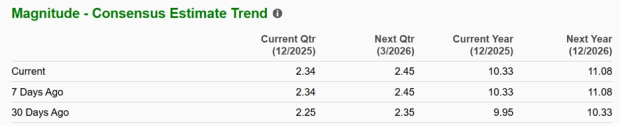
Image Source: Zacks Investment Research
Similarly, United Airlines UAL and Delta Air Lines DAL have appealing EPS growth prospects as two of the most profitable domestic airliners. Both land a Zacks Rank #3 (Hold), although a buy rating could be on the way as their EPS revisions are resiliently higher as well.
While the lofty revenue targets for the major airliners could be more severely impacted by flight disruptions, United and Delta are the leaders in international capacity and profitability margins. UAL and DAL are also attractively valued, trading roughly on par with the industry average of 10X forward earnings and less than 1X forward sales.
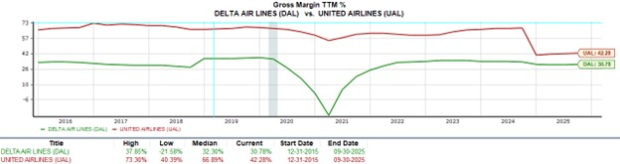
Image Source: Zacks Investment Research
Airline Stocks the Zacks Rank Suggests to Avoid
At the moment, there are six stocks in the Transportation-Airline Industry with a Zacks Rank #4 (Sell) and two stocks with a Zacks Rank #5 (Strong Sell) based on a weaker earnings revision trend.
Notably, the two strong sell stocks include Alaska Air Group ALK and Sun Country Airlines SNCY, a Minnesota-based low-cost carrier that offers flights across the U.S, Latin America, and the Caribbean.
#1 Semiconductor Stock to Buy (Not NVDA)
The incredible demand for data is fueling the market's next digital gold rush. As data centers continue to be built and constantly upgraded, the companies that provide the hardware for these behemoths will become the NVIDIAs of tomorrow.
One under-the-radar chipmaker is uniquely positioned to take advantage of the next growth stage of this market. It specializes in semiconductor products that titans like NVIDIA don't build. It's just beginning to enter the spotlight, which is exactly where you want to be.
See This Stock Now for Free >>Delta Air Lines, Inc. (DAL) : Free Stock Analysis Report
United Airlines Holdings Inc (UAL) : Free Stock Analysis Report
SkyWest, Inc. (SKYW) : Free Stock Analysis Report
LATAM Airlines Group S.A. (LTM) : Free Stock Analysis Report
International Consolidated Airlines Group SA (ICAGY) : Free Stock Analysis Report
Alaska Air Group, Inc. (ALK) : Free Stock Analysis Report
Sun Country Airlines Holdings, Inc. (SNCY) : Free Stock Analysis Report
This article originally published on Zacks Investment Research (zacks.com).
