
Investors seeking to diversify their portfolios and manage risk often turn to fixed income investments, with bond and fixed income exchange-traded funds (ETFs) emerging as popular choices.
What is Fixed Income
Fixed income is a broad investment category encompassing various debt securities that pay a fixed interest or coupon rate to investors. While the terms "bond" and "fixed income" are often used interchangeably, it's crucial to recognize that bonds constitute a specific category within the broader spectrum of fixed income securities.
“It is important to note that fixed income is not an equivalent for bonds,” says Marco Santanche, a multi-asset strategist and author of the newsletter Quant Evolution. “While the latter are a subset of the former, we can still see other securities returning regular, fixed payments: even mortgages might fall into this category.”
Read More: An Introduction to Asset Allocation
Bonds are generally the most common instrument, and probably one of the most accessible to retail traders. The assets under management allocated to bonds are much higher than other asset classes, excluding equities (see ETF database).
Are Bonds Truly Safe?
It's important to dispel the common misconception that bonds and fixed income investments are inherently safe.
According to Santanche, “The perceived safety is misleading because these investments are susceptible to various risk factors, contributing to volatility and price fluctuations. Factors such as liquidity, credit crises, and inflation significantly impact the prices of bonds and fixed income securities.”
While fixed-income instruments do offer consistent payments (net of defaults and counterparty risk), it is crucial to recognize that their safety may be overstated.
Why Invest In Bonds
While interest rates had been close to zero for most of the past 20 years, monetary tightening by the Fed and other central banks has driven yields up to an attractive level. Even government bonds have been yielding 4-5% in recent years, and as a result, investors have been flocking to fixed income ETFs to scoop up high yields.
Read More: Fixed Income ETFs: A Deep Dive
According to Financial Times, fixed income ETFs listed across the US and Europe attracted a record $235 billion of net inflows in the first three quarters of 2023, up from $169 billion in the same period in 2022. “This reflects the investment appetite in fixed income ETFs, given that the asset class is offering the highest yields in a generation,” says Santanche.
Fixed Income ETFs: Introduction
In terms of ETFs, we can slice the universe from many different angles:
Issuer type: Bonds can be issued by sovereign entities, corporates, or municipalities. In terms of ETFs, we can also observe broad market ETFs, covering both sovereigns and corporates.
Geography: we can also split into different bond categories by geography, including continents, countries, or regions (e.g. Central Europe, Asia Pacific, etc.).
Time to maturity: it is also common to subset according to the remaining life of the bonds, usually in buckets like 1-5 year, 1-10 year, etc.
Credit quality: we can also classify the bonds according to their credit risk. Usually, this means high-yield and investment-grade bonds.
Read More: Factor Investing: A Deep Dive
Security type: even if we remain in the bond subdomain, we have many possibilities, including inflation-linked securities, mortgage-backed securities, floating vs fixed-rate bonds, etc.
9 Bond ETFs To Consider
Below is a list of 9 bond ETFs that Santanche curated for consideration:
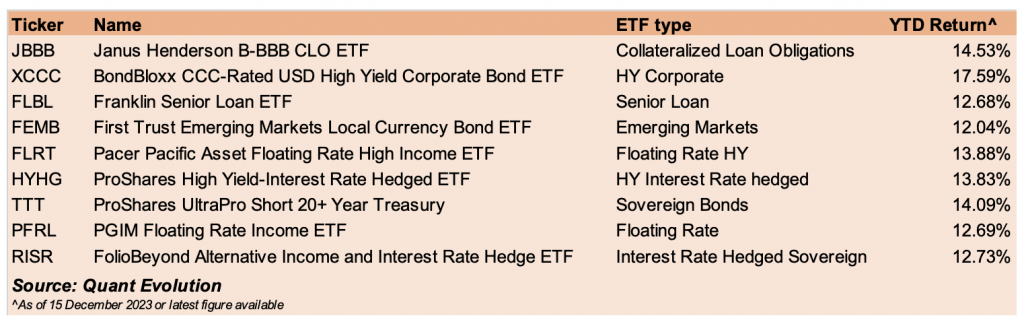
JBBB: Janus Henderson B-BBB CLO ETF provides floating rate exposure to CLOs rated from B to BBB and seeks to deliver investors access to securities with low default risk, low correlations to traditional fixed income asset classes and yield potential.
XCCC: The BondBloxx CCC-Rated USD High Yield Corporate Bond ETF seeks to track the investment results of the ICE CCC US Cash Pay High Yield Constrained Index, which consists of U.S. dollar-denominated CCC (or its equivalent) fixed rate, high yield corporate bonds.
FLBL: Franklin Senior Loan ETF is an actively managed fund that invests at least 80% of its net assets in senior loans and investments that provide exposure to senior loans. It targets investors who seek to manage interest rate risk through an actively managed portfolio of floating rate loans.
FEMB: First Trust Emerging Markets Local Currency Bond ETF that invests at least 80% of its net assets (including investment borrowings) in bonds, notes and bills issued or guaranteed by issuers in emerging market countries that are denominated in the local currency of the issuer.
FLRT: Pacer Pacific Asset Floating Rate High Income ETF seeks to provide a high level of current income by investing primarily in floating-rate loans of non-investment-grade companies, which can serve as both an income driver and a hedge against rising interest rates.
HYHG: ProShares High Yield-Interest Rate Hedged ETF seeks investment results that track the performance of the FTSE High Yield (Treasury Rate-Hedged) Index. The index is comprised of (a) long positions in USD-denominated high yield corporate bonds and (b) short positions in U.S. Treasury notes or bonds of approximate equivalent duration.
TTT: ProShares UltraPro Short 20+ Year Treasury seeks daily investment results, before fees and expenses, that correspond to three times the inverse (-3x) of the daily performance of the ICE U.S. Treasury 20+ Year Bond Index. The strategy of the ETF is to profit from a market decline and to help hedge against an expected decline.
PFRL: PGIM Floating Rate Income ETF invests primarily in senior floating rate loans. The ETF targets investors seeking to enhance diversification away from traditional fixed income asset classes.
RISR: FolioBeyond Alternative Income and Interest Rate Hedge ETF is an actively managed exchange-traded fund (ETF) that invests primarily in interest-only mortgage-backed securities and U.S. Treasury bonds. The ETF targets investors who are seeking a diversifier for an existing fixed income portfolio regardless of one’s views on rates. It also aims to be a hedge for a fixed income allocation for those concerned about rising rates and who seek to shorten a portfolio’s duration without selling existing positions.
The views and opinions expressed herein are the views and opinions of the author and do not necessarily reflect those of Nasdaq, Inc.

