
Investing doesn't have to be complicated. Getting rich slowly is as simple as buying and holding high-quality stocks in companies with durable and growing businesses. That means even stocks in value sectors like Consumer goods can be a gold mine for long-term investors.
The best consumer brands have stood the test of time, making shareholders wealthy for decades. No, past results don't guarantee future returns, but it's also important not to fix things that aren't broken.
Here are five blue chip consumer-goods stocks with a long runway for steady and reliable investment returns. I call these the easy wealth builders.
1. Coca-Cola: Buffett has held this stock since 1988
Coca-Cola (NYSE: KO) is one of the world's largest beverage companies. It sells countless soda, water, juice, and coffee products worldwide, to a market of more than 8 billion people.
Coca-Cola thrives on world-class distribution that places its products in just about every store, vending machine, or restaurant you encounter. That's produced decades of profitable growth, with the company turning 22% of its sales into free cash flow.
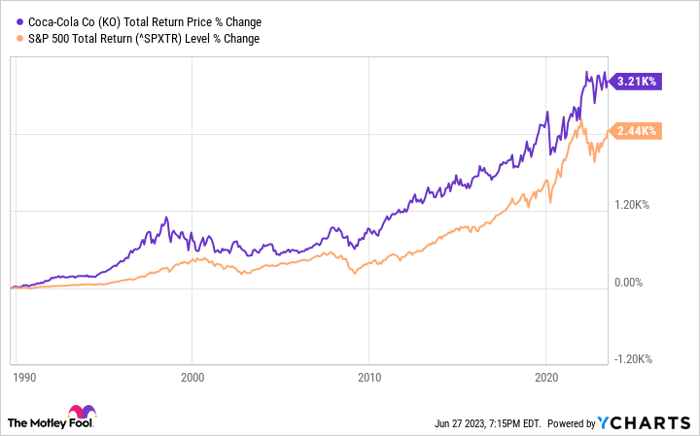
KO total return price data by YCharts.
Management shares these profits with stockholders through an ever-increasing dividend that has been paid and raised for 61 consecutive years. Warren Buffett's Berkshire Hathaway owns 9.2% of the company and receives $736 million in yearly dividend income. Buying and holding Coca-Cola has proved a very successful investment idea, and there's no reason it can't continue.
2. Altria: A durable 8.5% dividend yield
Wall Street has soured on tobacco giant Altria Group (NYSE: MO) in recent years as fewer people smoke, but there could be an opportunity here as a contrarian investment idea.
Tobacco is historically a very lucrative business model, producing arguably the world's greatest investment returns over the years. While fewer people buy cigarettes as the years pass, Altria has slowly increased prices to continue growing its operating income.
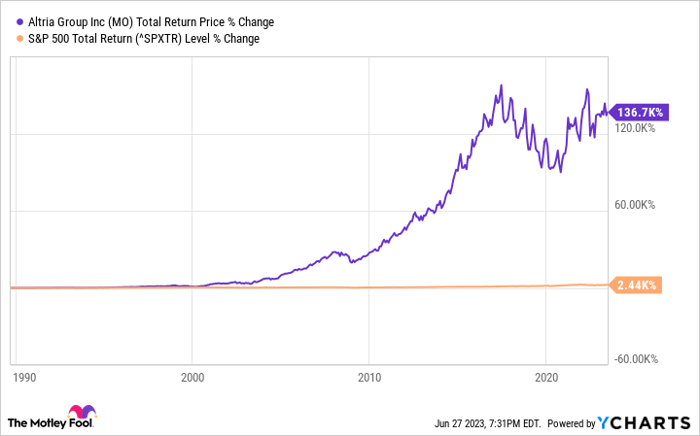
MO total return price data by YCharts.
Analysts expect Altria to grow earnings per share (EPS) by an average of 4% annually, and the dividend's payout ratio is somewhat high but manageable at 83% because the business requires minimal investment to maintain itself.
The company is growing new products like oral nicotine and electronic cigarettes and owns 10% of Anheuser-Busch InBev, which gives Altria flexibility to continue generating income for long-term investors, who can bank on that generous 8.5% dividend yield.
3. Costco: Consumers pay to shop here
Costco Wholesale (NASDAQ: COST) is a big-box retailer that sells memberships to customers for access to the store's bulk-quantity goods and deals. Costco has built its brand into a household name, famous for its $1.50 beef hot dog and soda meal, which has been priced that way to lure in shoppers since 1985.
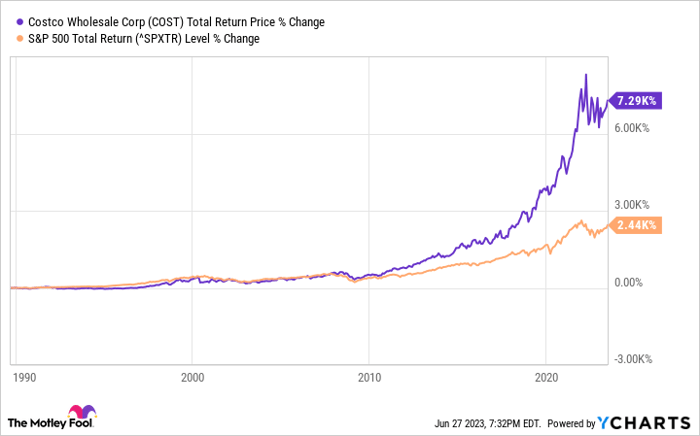
COST total return price data by YCharts.
The consumer drives the American economy, and shoppers' beloved relationship with Costo should continue bringing traffic to the company's stores. Analysts believe profits will grow at a high-single-digit pace over the next three to five years, another example of a simple but effective business model.
Warren Buffett's right-hand man, Charlie Munger, is a massive fan of the stock. He sits on the company's board of directors to this day.
4. Amazon: A trillion-dollar company with room to grow
E-commerce giant Amazon (NASDAQ: AMZN) rose from the dot-com bubble in the early 2000s to become one of the world's largest companies today. Understandably, the stock generated massive investment returns in the process.
Even with all of Amazon's success already, more juice could still be squeezed out of it over the coming years. The company dominates U.S. e-commerce with a 37.8% market share; with online sales estimated to grow by 50% by 2027, Amazon should directly benefit.
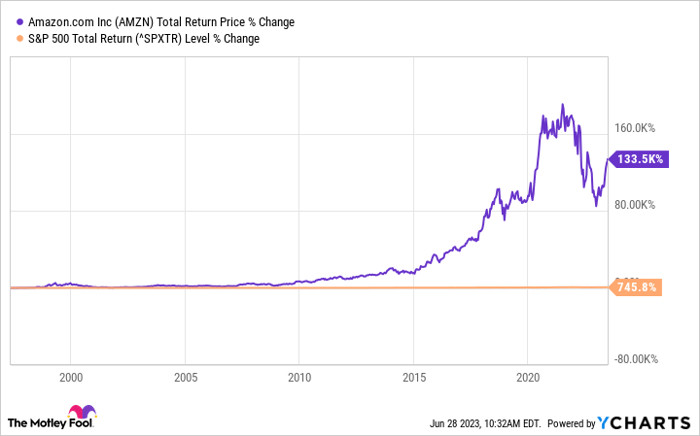
AMZN total return price data by YCharts.
Throw in the company's smaller but growing business segments like cloud platform Amazon Web Services, Amazon Prime, and advertising, and investors could benefit from holding the stock in their portfolios for the foreseeable future. Analysts are looking for more than 30% annual earnings growth from Amazon over the next three to five years.
5. AutoZone: Selling parts for billions of vehicles
AutoZone (NYSE: AZO) is a specialty retailer that sells auto parts in the United States, Mexico, and Brazil. There are more than 290 million vehicles on the road in America, and they are lasting longer than ever. The average car's life span was 9.6 years in 2002, but that increased to 12.1 years as of 2021.
New cars are getting increasingly expensive, which only means more repairs and maintenance for existing vehicles, a good sign for AutoZone's business.
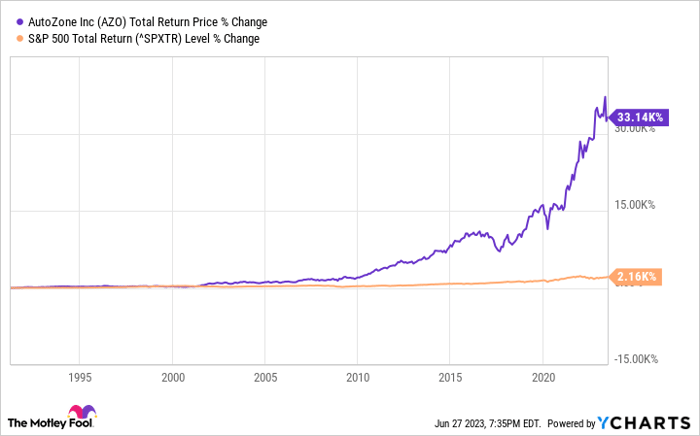
AZO total return price data by YCharts.
But AutoZone's outperformance as an investment has come from a combination of operational excellence and continual share repurchases. The company generated a minimum 37% return on invested capital over the past decade and has spent its profits to lower outstanding shares by 47% during that time. It's a repeatable recipe for success that could continue boosting shareholders' portfolios.
10 stocks we like better than Coca-Cola
When our analyst team has a stock tip, it can pay to listen. After all, the newsletter they have run for over a decade, Motley Fool Stock Advisor, has tripled the market.*
They just revealed what they believe are the ten best stocks for investors to buy right now... and Coca-Cola wasn't one of them! That's right -- they think these 10 stocks are even better buys.
*Stock Advisor returns as of June 26, 2023
John Mackey, former CEO of Whole Foods Market, an Amazon subsidiary, is a member of The Motley Fool's board of directors. Justin Pope has no position in any of the stocks mentioned. The Motley Fool has positions in and recommends Amazon.com, Berkshire Hathaway, and Costco Wholesale. The Motley Fool recommends the following options: long January 2024 $47.50 calls on Coca-Cola. The Motley Fool has a disclosure policy.
The views and opinions expressed herein are the views and opinions of the author and do not necessarily reflect those of Nasdaq, Inc.

