
5 Reasons Chinese Equities Have Bottomed
The COVID-19 Pandemic, a real estate crisis, and a slow economy have led to dramatic underperformance for Chinese equities over the past few years. For example, over the past five years, the iShares China Large-Cap ETF (FXI) (an ETF that allows investors to gain exposure to a broad range of large-cap Chinese stocks) has nearly been cut in half, while the S&P 500 is up more than 80% over the same period!
However, despite the poor performance in Chinese equities lately, it’s always worth keeping them on your radar due to their innate ability to trend well once they turn. For example, the KraneShares CSI China Internet ETF (KWEB), which tracks the performance of a basket of Chinese internet and e-commerce companies, doubled from April 2020 to February 2021.
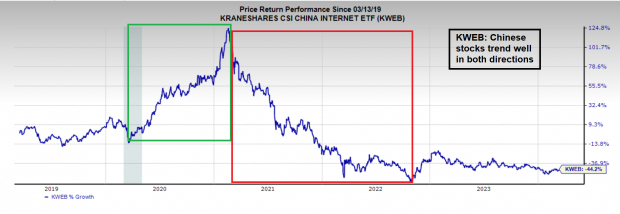
Image Source: Zacks Investment Research
Below are five reasons Chinese stocks have bottomed including:
FXI Inverse Head & Shoulder Pattern
The FXI ETF is probably the best proxy U.S.-based investors use to measure China. Currently, FXI is breaking out of a textbook inverse head-and-shoulders pattern. Inverse head-and-shoulders patterns are considered bullish and are one of the most reliable indications of a potential trend reversal from a downtrend to an uptrend.
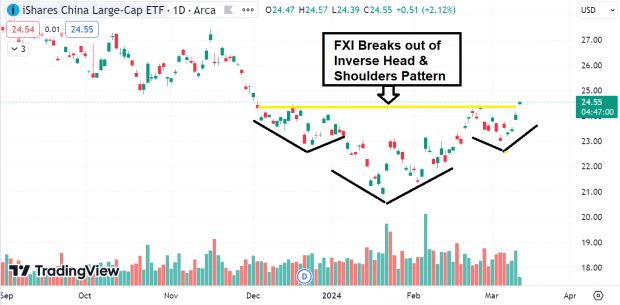
Image Source: TradingView
Earnings Surprises & Turnarounds
Chinese internet companies like JD. Com (JD) and Bilibili (BILI) are up more than 20% over the past few sessions after reporting solidearnings. BILI grew EPS 78% year-over-year and its fundamental picture is turning around rapidly.
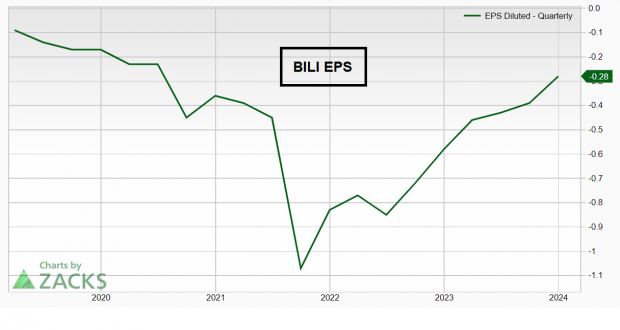
Image Source: Zacks Investment Research
Bad News Priced In?
Historically, equity markets have bottomed out on poor news. Between the potential banning of TikTok, the ailing Chinese real estate market, and sluggish growth, the worst may be behind the Chinese economy. Remember, U.S. equities bottomed after inflation levels hit the highest levels in more than 40 years.
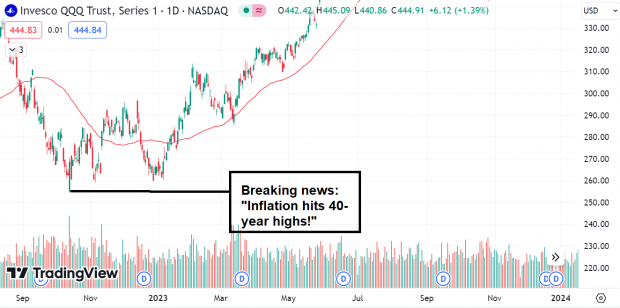
Image Source: TradingView
Joining the AI Revolution
Last week, the Chinese government announced it is raising $27 billion for a semiconductor fund aimed at driving technologies such as artificial intelligence. AI-related stocks and their exploding earnings have been an integral part of the bull market in the U.S. and has the chance to do the same for China.
Insider Buying
Alibaba (BABA) is China’s e-commerce juggernaut. Recently, the company announced a $25 billion increase in share buybacks and over $200 million in insider purchases by CEO and founder Jack Ma and other insiders. The massive purchases show confidence in the Chinese economy and suggest that the lows are likely in for the stock.
Bottom Line
Despite recent challenges such as the COVID-19 pandemic, a real estate crisis, and a sluggish economy leading to a significant underperformance in Chinese equities over the past few years, there are indications that the Chinese market may be bottoming out.
Zacks Names "Single Best Pick to Double"
From thousands of stocks, 5 Zacks experts each have chosen their favorite to skyrocket +100% or more in months to come. From those 5, Director of Research Sheraz Mian hand-picks one to have the most explosive upside of all.
It’s credited with a “watershed medical breakthrough” and is developing a bustling pipeline of other projects that could make a world of difference for patients suffering from diseases involving the liver, lungs, and blood. This is a timely investment that you can catch while it emerges from its bear market lows.
It could rival or surpass other recent Stocks Set to Double like Boston Beer Company which shot up +143.0% in little more than 9 months and NVIDIA which boomed +175.9% in one year.
Free: See Our Top Stock And 4 Runners UpiShares China Large-Cap ETF (FXI): ETF Research Reports
JD.com, Inc. (JD) : Free Stock Analysis Report
Alibaba Group Holding Limited (BABA) : Free Stock Analysis Report
KraneShares CSI China Internet ETF (KWEB): ETF Research Reports
Bilibili Inc. Sponsored ADR (BILI) : Free Stock Analysis Report
