
Key Points
Taiwan Semiconductor and Micron are leading chip fabricators.
Nvidia and Broadcom are seeing huge demand for their processors.
- 10 stocks we like better than Taiwan Semiconductor Manufacturing ›
Enormous sums of money have already been spent on artificial intelligence (AI) computing infrastructure, and by all projections, there's much more such spending to come. A lot of it is being spent on data centers, which house the computing units that power AI training and inference. One widely cited study by McKinsey & Company predicts the build-out will require nearly $7 trillion in capital expenditures by 2030. That estimate was published last year at this time; the real number could wind up higher.
There are several companies primed to benefit from this build-out, and four of them look like great investments now.
Will AI create the world's first trillionaire? Our team just released a report on the one little-known company, called an "Indispensable Monopoly" providing the critical technology Nvidia and Intel both need. Continue »

Image source: Getty Images.
Taiwan Semiconductor Manufacturing
Taiwan Semiconductor Manufacturing (NYSE: TSM) is an obvious beneficiary. It's the world's leading logic chip fabricator and has a massive client base that depends on its foundry capabilities. Two of its major clients are Apple (NASDAQ: AAPL) and Nvidia (NASDAQ: NVDA), both of which don't actually produce any chips themselves; they design them.
Some of Nvidia's competitors are also TSMC clients, which means that Taiwan Semiconductor is one of the ultimate neutral ways to play the AI build-out. As long as there is increased AI spending, chances are quite high that TSMC will benefit from it, as it will likely be producing the chips that go inside whichever computing units happen to be the most popular at any given time.
With management guiding for a 25% compound annual growth rate (CAGR) from 2024 to 2029, it's a solid investment pick.
Nvidia
Nvidia (NASDAQ: NVDA) has become the largest company in the world thanks to massive demand for AI computing power, and that demand is only getting stronger. It seems odd to say that a company with a $5 trillion market cap can be nearly doubling its revenue each quarter, but Nvidia is approaching that. After decelerating last year, its revenue growth started to accelerate again last quarter.
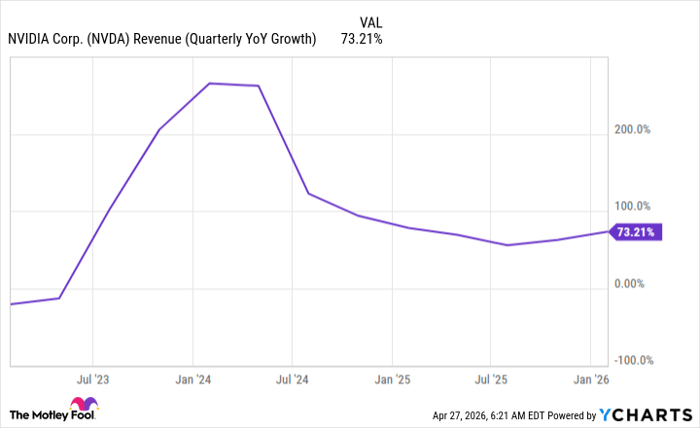
NVDA Revenue (Quarterly YoY Growth) data by YCharts.
For the first quarter, analysts expect 79% revenue growth. For Q2, that same group projects 85% growth. That showcases that Nvidia is not only thriving from the AI build-out, but also gaining ground. The massive data center build-out opportunity is just getting started, and Nvidia stock will be a top way for retail investors to capitalize on it.
Broadcom
As I alluded to above, there are other AI chip designers that utilize TSMC's services. Broadcom (NASDAQ: AVGO) is one of them, but it's approaching the market from a different angle than Nvidia. Instead of making broad-purpose computing chips and selling them to a wide array of buyers, Broadcom is partnering directly with AI hyperscalers to design custom chips that are tailored for the precise types of workloads they'll be used for. Doing that often provides better cost performance than an Nvidia GPU.
This is leading to substantial growth for Broadcom; sales from its AI semiconductor division rose by 106% to $8.4 billion last quarter. By the end of 2027, this division is expected to be producing more than $100 billion annually -- a major acceleration. Broadcom is challenging Nvidia's dominance in the AI chip market, and its stock will likely be a major winner along the way.
Micron
Micron Technology (NASDAQ: MU) is both a chip designer like Nvidia and a fabricator like Taiwan Semiconductor. However, it isn't producing logic chips. Instead, it specializes in memory chips, in particular, high-bandwidth memory chips. These are incredibly important in the AI computing world, as they allow the processors to quickly access the large volumes of information they require in order to perform their computations. Demand for memory chips is so high now that Micron estimates it will only be able to meet half to two-thirds of its medium-term demand. That has allowed it and its peers to raise memory prices dramatically, which is why its earnings have soared recently.
The need for memory will grow as more computing chips are produced, which puts Micron on a similar growth trajectory to the others chip companies mentioned. This makes Micron a clear beneficiary of the AI build-out, and its stock may still have a ton of room to run.
Should you buy stock in Taiwan Semiconductor Manufacturing right now?
Before you buy stock in Taiwan Semiconductor Manufacturing, consider this:
The Motley Fool Stock Advisor analyst team just identified what they believe are the 10 best stocks for investors to buy now… and Taiwan Semiconductor Manufacturing wasn’t one of them. The 10 stocks that made the cut could produce monster returns in the coming years.
Consider when Netflix made this list on December 17, 2004... if you invested $1,000 at the time of our recommendation, you’d have $497,606!* Or when Nvidia made this list on April 15, 2005... if you invested $1,000 at the time of our recommendation, you’d have $1,306,846!*
Now, it’s worth noting Stock Advisor’s total average return is 985% — a market-crushing outperformance compared to 200% for the S&P 500. Don't miss the latest top 10 list, available with Stock Advisor, and join an investing community built by individual investors for individual investors.
*Stock Advisor returns as of April 29, 2026.
Keithen Drury has positions in Broadcom, Nvidia, and Taiwan Semiconductor Manufacturing. The Motley Fool has positions in and recommends Apple, Broadcom, Micron Technology, Nvidia, and Taiwan Semiconductor Manufacturing. The Motley Fool has a disclosure policy.
The views and opinions expressed herein are the views and opinions of the author and do not necessarily reflect those of Nasdaq, Inc.

