
3 Major Changes You Must Understand Before Your Next RMD Is Due
Key Points
RMDs are the government’s way of getting the taxes owed on pre-tax contributions to retirement accounts.
If you don’t want to keep track of due dates, consider automated withdrawals.
- The $23,760 Social Security bonus most retirees completely overlook ›
No matter how independent you are, rules are a way of life. From infancy on, you're expected to do everything according to one set of rules or another.
By the time you're in your 70s, however, you must stick to the rules surrounding required minimum distributions (RMDs), the amount of money you must withdraw each year from certain retirement accounts. These accounts include:
Will AI create the world's first trillionaire? Our team just released a report on the one little-known company, called an "Indispensable Monopoly" providing the critical technology Nvidia and Intel both need. Continue »
- 401(k) plans
- 403(b) plans
- 457(b) plans
- Traditional IRAs
- SEP IRAs
- SIMPLE IRAs
- SARSEPs
- Profit-sharing plans
- Other defined contribution plans
- Inherited IRAs
If you have savings in any of these plans, it's vital you know the rules and when they apply. For example, here are three ways RMDs were tweaked under the SECURE Act 2.0.
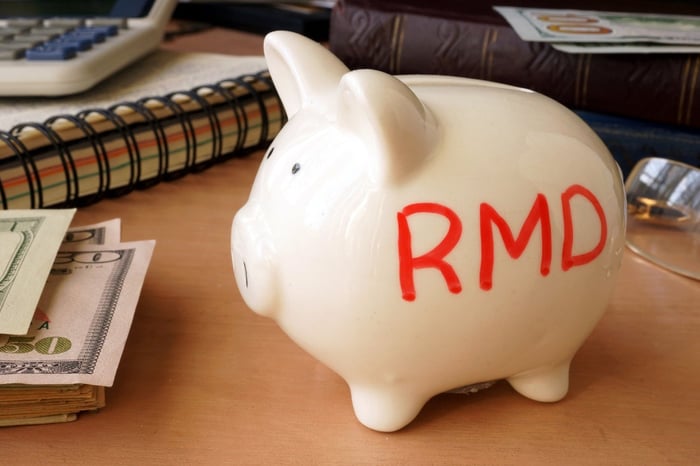
Image source: Getty Images.
1. A little more time to grow
RMDs have evolved over time to land where they are today. Here's where they stand:
- If you were born prior to 1951, you'll experience no change.
- If you were born between 1951 and 1959, you must begin taking RMDs the year in which you turn 73.
- If you were born in 1960 or later, the RMD age is 75.
Pushing the RMD age back may be good for you. If you don't need your RMDs to pay everyday bills, it gives your money more time to grow in your retirement account. Still, it's important to keep the age at which you'll be required to take RMDs straight so you're not hit with a penalty (more on that in a moment).
Note: You can choose to delay your first RMD until April 1 of the year after you turn 73 (or 75 if you were born in 1960 or later). However, give it some serious thought before making that decision. If you wait until the following year to take your RMD, you must still take one by Dec. 31 of that year. That amounts to two RMDs in one year and could impact your tax bracket and how much you pay for Medicare Parts B and D.
2. Penalties have been reduced
If you fail to withdraw your RMD in full by the due date, any amount not withdrawn may be subject to an excise tax of 25%. While that's definitely steep, the penalty was 50% before SECURE 2.0.
For example, if you're supposed to withdraw $20,000 but forget, your penalty could be as much as $5,000. If you correct the issue within two years, the excise tax will be reduced to 10%. And if your failure to take an RMD was due to circumstances outside your control -- like hospitalization or a natural disaster -- the IRS may waive the penalty.
3. A new exemption
At one time, RMD rules regarding Roth 401(k)s and 403(b)s required annual withdrawals. That's no longer the case, and Roth 401(k)s and 403(b)s are now treated more like Roth IRAs, with no RMDs required.
If keeping a close eye on your calendar isn't your idea of fun, consider automating withdrawals through the party that manages your account.
The $23,760 Social Security bonus most retirees completely overlook
If you're like most Americans, you're a few years (or more) behind on your retirement savings. But a handful of little-known "Social Security secrets" could help ensure a boost in your retirement income.
One easy trick could pay you as much as $23,760 more... each year! Once you learn how to maximize your Social Security benefits, we think you could retire confidently with the peace of mind we're all after. Join Stock Advisor to learn more about these strategies.
View the "Social Security secrets" »
The Motley Fool has a disclosure policy.
