
2 Bear Call Spread Trade Ideas For This Thursday
A bear call spread is a type of vertical spread, meaning that two options within the same expiry month are being traded.
One call option is being sold, which generates a credit for the trader. Another call option is bought to provide protection against an adverse move.
The sold call is always closer to the stock price than the bought call.
As the name suggests, this trade does best when the stock declines after the trade is open.
However, there can be many cases where this trade can make a profit if the stock stays flat and even if it rises slightly.
Bear call spreads are risk defined trades. There are no naked options here, so they can be traded in retirement accounts such as an IRA.
Traders should have a bearish outlook on the stock and ideally look to enter when the stock has a high implied volatility rank.
Two stocks came up on my screens today as possible bear call spread candidates.
D.R. Horton (DHI) dropped below the 50-day moving average today and put in a nasty bearish candle.
I’m willing to be the stock will not get back above the 50-day moving average in the near term.
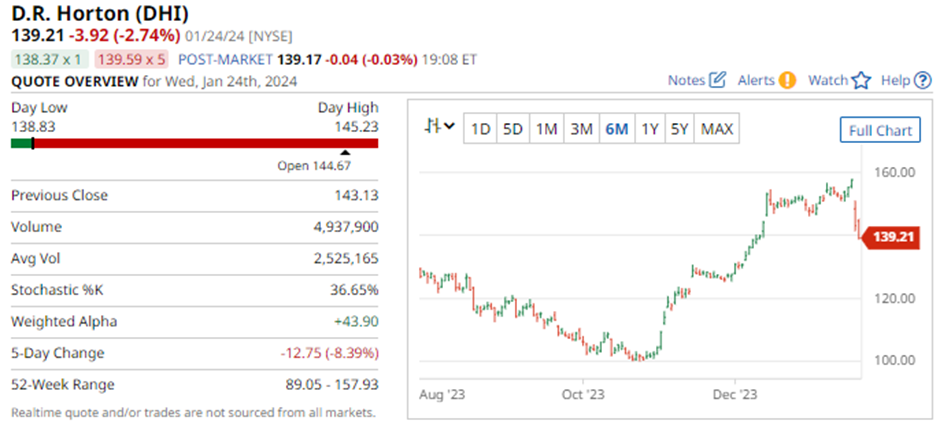
D.R. Horton, Inc. is one of the leading national homebuilders, primarily engaged in the construction and sale of single-family houses both in the entry-level and move-up markets.
D.R. Horton's operations are spread across markets in states in the East, Midwest, Southeast, South Central, Southwest and West regions of the United States.
Its houses are sold under the brand names D.R. Horton - America's Builder, Emerald Homes, Express Homes and Freedom Homes.
D.R. Horton operates through three segments: Homebuilding, Forestar, Financial Services and Rental.
Let’s look at how a bear call spread trade might be set up on DHI stock.
DHI Bear Call Spread: March $140 – $145 Bear Call Spread
As a reminder, A bear call spread is a defined risk option strategy that profits if the stock closes below the short strike at expiry.
To execute a bear call spread an investor would sell an out-of-the-money call and then buy a further out-of-the-money call.
This bear call spread trade was found using the bear call spread screener and involves selling the March expiry $140 strike call and buying the $145 strike call.
Selling this spread results in a credit of around $0.190 or $190 per contract. That is also the maximum possible gain on the trade. The maximum potential loss can be calculated by taking the spread width, less the premium received and multiplying by 100. That give us:
5 – 1.90 x 100 = $310.
If we take the maximum gain divided by the maximum loss, we see the trade has a return potential of 61.29%.
The spread will achieve the maximum profit if DHI closes below $140 on March 15, in which case the entire spread would expire worthless allowing the premium seller to keep the $190 option premium.
The maximum loss will occur if DHI closes above $145 on March 15, which would see the premium seller lose $310 on the trade.
The breakeven point for the bear call Spread is $141.90 which is calculated as $140 plus the $1.90 option premium per contract.
Let’s look at another idea, this time on Kimberly Clark (KMB) which was another stock that came up on my bearish scans.
KMB Bear Call Spread: February $120 – $123 Bear Call Spread
This bear call spread trade involves using the February expiration on KMB and selling the $120-$123 call spread.
Selling this spread results in a credit of around $0.55 or $55 per contract. That is also the maximum possible gain on the trade. The maximum potential loss can be calculated by taking the spread width, less the premium received and multiplying by 100. That give us:
3 – 0.55 x 100 = $245.
If we take the maximum gain divided by the maximum loss, we see the trade has a return potential of 22.45%.
The spread will achieve the maximum profit if KMB closes below $120 on February 16, in which case the entire spread would expire worthless allowing the premium seller to keep the $55 option premium.
The maximum loss will occur if KMB closes above $123 on February 16, which would see the premium seller lose $245 on the trade.
The breakeven point for the Bear call Spread is $120.55 which is calculated as $120 plus the $0.55 option premium per contract.
Mitigating Risk
With any option trade, it’s important to have a plan in place on how you will manage the trade if it moves against you.
For the DHI bear call spread, I would set a stop loss if the value of the spread rose from $1.90 to $3.80.
For the KMB trade, I would set a stop loss if the value of the spread rose from $0.55 to $1.10.
Please remember that options are risky, and investors can lose 100% of their investment. This article is for education purposes only and not a trade recommendation. Remember to always do your own due diligence and consult your financial advisor before making any investment decisions.
More Stock Market News from Barchart
- S&P 500 and Nasdaq 100 Post Record Highs on Strong Tech Earnings
- The Best Bank Stock to Buy Nobody in America Knows About
- This Dividend Energy Stock Has 32% Upside Potential
- 2 Warren Buffett Stocks Analysts Expect to Rally 18% or More
On the date of publication, Gavin McMaster did not have (either directly or indirectly) positions in any of the securities mentioned in this article. All information and data in this article is solely for informational purposes. For more information please view the Barchart Disclosure Policy here.
