
10x Genomics TXG recently unveiled Atera, a next-generation in situ spatial biology platform designed to deliver whole-transcriptome analysis with single-cell sensitivity at scale. Unveiled at the American Association for Cancer Research Annual Meeting 2026, the launch highlights TXG’s continued push to advance how researchers study complex biological systems within intact tissue environments.
The new platform aims to overcome long-standing tradeoffs in spatial biology, positioning TXG to tap into growing demand across translational research and drug discovery. Early adoption by leading research institutions and service providers signals strong interest, reinforcing the company’s innovation-driven growth narrative and long-term opportunity in high-throughput spatial analysis.
Likely Trend of TXG Stock Following the News
Shares of TXG have gained 3.3% since the announcement of the launch. In the year-to-date period, shares of the company gained 59.9% against the industry’s 19.1% decline. The S&P 500 increased 4.2% in the same time frame.
The Atera launch can meaningfully strengthen 10x Genomics’ long-term business by expanding its total addressable market and deepening its moat in spatial biology. By eliminating tradeoffs between scale, sensitivity and gene coverage, Atera positions TXG as a go-to platform for large-scale, high-resolution studies, attracting biopharma, academic and clinical customers. This should drive higher instrument placements, recurring consumables revenue and growing adoption of its cloud-based analysis ecosystem. Over time, stronger integration into drug discovery workflows and large consortium projects could enhance visibility, create sticky customer relationships and support durable revenue growth.
TXG currently has a market capitalization of $3.33 billion.
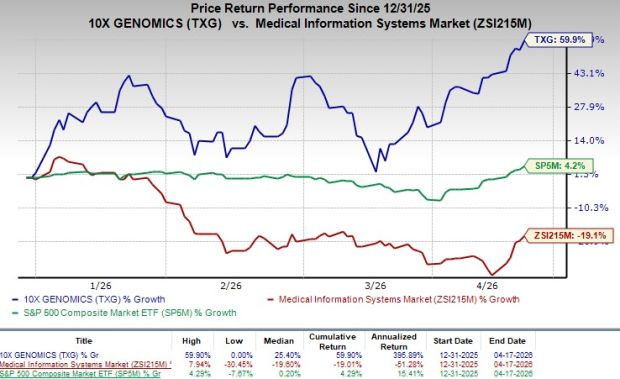
Image Source: Zacks Investment Research
More on the News
From a technology and infrastructure standpoint, Atera reflects a ground-up redesign of spatial analysis, integrating advances across chemistry, hardware and software to remove longstanding limitations. To complement the platform, TXG is introducing a new cloud-based analysis solution that enables secure data storage, visualization and GPU-accelerated processing, significantly reducing time from raw data to insight.
Researchers can maintain full control over workflows through flexible deployment options, including cloud and on-premise environments. Additionally, the company has launched Catalyst Research Services, allowing customers to directly submit samples for analysis, with flexible access models aimed at broadening adoption as Atera moves into commercial availability.
The platform also builds on 10x Genomics existing spatial biology ecosystem, particularly its Xenium solution, while expanding into large-scale data-driven applications. Bioptimus, a France-based AI biotech company, has partnered with 10x Genomics to develop one of the world’s largest spatial datasets under the STELA initiative to power its M-Optimus platform. The program will initially utilize Xenium, with plans to transition to Atera in 2027 as throughput scales. Management emphasized that Atera’s integrated system design significantly expands the scope of biological questions that can be addressed, positioning it as a key enabler of next-generation research and AI-driven drug discovery.
Adoption momentum is already taking shape among global service providers. Macrogen, along with its U.S. subsidiary Psomagen, has committed to deploying multiple Atera systems, becoming the first global service provider to adopt the platform. This investment reflects increasing demand for high-throughput, uncompromised spatial analysis in biopharma and translational research, positioning Macrogen to support large-scale programs and reinforcing early commercial traction for Atera.
Favorable Industry Prospect for TXG
Per a report by Custom Market Insights, the global spatial biology market size is estimated at $1.48 billion in 2026 and is anticipated to reach $7.24 billion by 2035, expanding at a CAGR of 19.2% from 2026 to 2035.
Growth in spatial biology is driven by the rising demand for single-cell and tissue-level insights to better understand complex diseases like cancer. Expanding use in drug discovery, precision medicine and AI-driven research, along with advances in high-throughput sequencing technologies, is accelerating market adoption.
A Recent Development by TXG
In February, 10x Genomics announced that the PharosAI consortium, comprising four leading UK institutions, will leverage its Xenium platform to build one of the world’s most comprehensive multimodal cancer datasets. It will be backed by 18.9 million Euros in UK government funding, along with support from charities and industry partners, to power AI-driven models aimed at enabling earlier diagnosis, precision therapies and faster drug discovery.
TXG’s Zacks Rank & Other Key Picks
Currently, TXG sports a Zacks Rank #1 (Strong Buy).
Some other top-ranked stocks from the broader medical space are Phibro Animal Health PAHC, GE HealthCare Technologies GEHC and Cardinal Health CAH.
Phibro Animal Health, currently sporting a Zacks Rank #1, reported second-quarter fiscal 2026 adjusted earnings per share (EPS) of 87 cents, which surpassed the Zacks Consensus Estimate by 27.1%. Revenues of $373.9 million beat the Zacks Consensus Estimate by 4.7%. You can see the complete list of today’s Zacks #1 Rank stocks here.
PAHC has an estimated long-term earnings growth rate of 21.5% compared with the industry’s 12% rise. The company’s earnings beat estimates in the trailing four quarters, the average surprise being 20.1%.
GE HealthCare Technologies, currently carrying a Zacks Rank #2 (Buy), reported fourth-quarter 2025 adjusted EPS of $1.44, which surpassed the Zacks Consensus Estimate by 0.7%. Revenues of $5.7 billion beat the Zacks Consensus Estimate by 1.9%.
GEHC has an estimated long-term earnings growth rate of 9.1% compared with the industry’s 12% rise. The company beat earnings estimates in the trailing four quarters, the average surprise being 7.5%.
Cardinal Health, currently carrying a Zacks Rank #2, reported a second-quarter fiscal 2026 adjusted EPS of $2.63, which surpassed the Zacks Consensus Estimate by 10%. Revenues of $65.6 billion beat the Zacks Consensus Estimate by 0.9%.
CAH has an estimated long-term earnings growth rate of 15% compared with the industry’s 9.3% rise. The company’s earnings beat estimates in the trailing four quarters, the average surprise being 9.3%.
Radical New Technology Could Hand Investors Huge Gains
Quantum Computing is the next technological revolution, and it could be even more advanced than AI.
While some believed the technology was years away, it is already present and moving fast. Large hyperscalers, such as Microsoft, Google, Amazon, Oracle, and even Meta and Tesla, are scrambling to integrate quantum computing into their infrastructure.
Senior Stock Strategist Kevin Cook reveals 7 carefully selected stocks poised to dominate the quantum computing landscape in his report, Beyond AI: The Quantum Leap in Computing Power.
Kevin was among the early experts who recognized NVIDIA's enormous potential back in 2016. Now, he has keyed in on what could be "the next big thing" in quantum computing supremacy. Today, you have a rare chance to position your portfolio at the forefront of this opportunity.
See Top Quantum Stocks Now >>Cardinal Health, Inc. (CAH) : Free Stock Analysis Report
Phibro Animal Health Corporation (PAHC) : Free Stock Analysis Report
10x Genomics (TXG) : Free Stock Analysis Report
GE HealthCare Technologies Inc. (GEHC) : Free Stock Analysis Report
This article originally published on Zacks Investment Research (zacks.com).
The views and opinions expressed herein are the views and opinions of the author and do not necessarily reflect those of Nasdaq, Inc.

