
Should You Buy Amazon Now or Wait Until After the Stock Split?
Investors seem to love stock splits even though there is no direct effect on the stock's value. After all, what's not to love? Splits are fun, exciting and offer a distraction from the daily rush offinancial news There is often tremendous movement in the stock price around the announcement date and the split date, which in turn affects investors' profits. Amazon (NASDAQ: AMZN) is one company preparing for a blockbuster 20-for-1 split in June.
But when is the best time for interested investors to buy Amazon stock: before or after the split? To find out, it can be helpful to examine historical stock movements around recent splits and take a deep dive into Amazon's current challenges and successes. Let's look at some key factors heading into the company's first-quarter 2022 earnings release on April 28.
E-commerce headwinds likely continue
2021 brought a share of challenges to Amazon, and many of these hurdles will likely continue in 2022. Labor was one such challenge. Hiring was extremely tight last year in large part due to the effects of the pandemic and its economic and social fallout. The company absorbed billions of dollars in additional operating costs through increased wages, sign-on bonuses, and COVID-19 mitigation measures.
In a sense, this is just the nature of the beast for a corporation with hundreds of thousands of employees. The good news is that the company did not shy away from this investment or attempt to cut staffing or salaries in order to get its way out of a bind. Investing in employees could pay future dividends through productivity and stability.
Supply chain challenges tied to ongoing coronavirus variants also presented major issues for the e-commerce giant. These logistical delays and dilemmas added more costs to Amazon's bottom line. Add inflation to the mix, and it's no surprise that the company's North American and international segments posted net operating losses in the fourth quarter of 2021, even despite rising net sales.
It's likely that these macroeconomic headwinds will persist in 2022 and continue to cause headaches. Luckily for shareholders, Amazon has a couple of aces up its sleeve.

Image source: Getty Images.
AWS and advertising shine
Amazon's diverse mix of businesses has been the company's saving grace when dealing with the aforementioned problems.
Amazon Web Services (AWS), for instance, has largely carried the day and still has a tremendous runway. The cloud computing market is snowballing due to increased adoption and more-significant cloud infrastructure needs. AWS's net sales reached $62.2 billion in 2021, representing 37% year-over-year growth. Amazon is the clear leader in this space with about a 33% market share as of the fourth quarter of 2021.
Digital advertising has grown to be a force as well -- so much so that Amazon broke out the numbers in more detail during a recent earnings report. Advertising service sales reached $31.2 billion in 2021, up 146% from the $12.6 billion in 2019. This is a revenue stream to watch during the upcoming report.
Is it better to buy before or after a stock split?
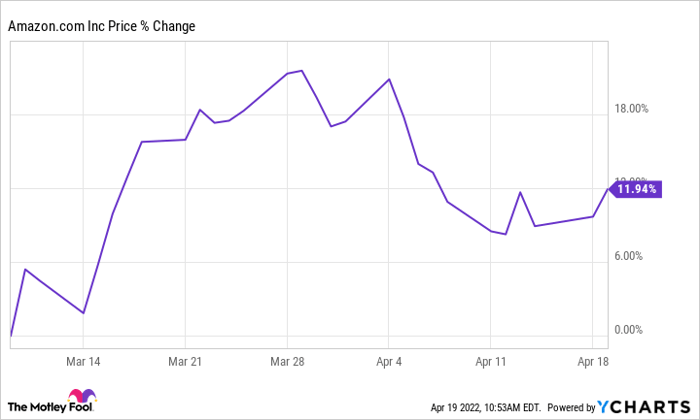
Amazon stock has gained over 10% since the split was announced on March 9, as shown below. The chart shows an immediate positive effect on shares. This could continue in the lead-up to the June split, with earnings also weighing in.
AMZN data by YCharts.
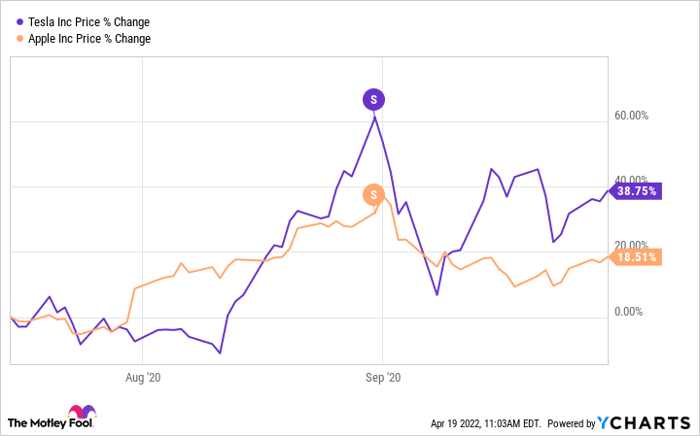
Since Amazon has not split in over 20 years, recent examples of how recent splits impacted the stock prices of other major tech companies will offer helpful indicators to inform investor timing. Tesla (NASDAQ: TSLA) and Apple (NASDAQ: AAPL) had stock splits in 2020, and both followed a very similar pattern. These are cogent comparisons to Amazon as each is highly successful and has a large following of retail investors.
TSLA data by YCharts. S = split date.
As seen in the chart above, both Apple and Tesla stock experienced gains ahead of the split date which dropped off as the event passed. Tesla's rise was much more pronounced, but the pattern is clear. Of course, this does not mean that Amazon will follow the same pattern.
The factors discussed above could outweigh the emotional trading surrounding the split. But history does tend to repeat itself -- even in the stock market. Patient investors are often rewarded.
10 stocks we like better than Amazon
When our award-winning analyst team has a stock tip, it can pay to listen. After all, the newsletter they have run for over a decade, Motley Fool Stock Advisor, has tripled the market.*
They just revealed what they believe are the ten best stocks for investors to buy right now... and Amazon wasn't one of them! That's right -- they think these 10 stocks are even better buys.
*Stock Advisor returns as of April 7, 2022
John Mackey, CEO of Whole Foods Market, an Amazon subsidiary, is a member of The Motley Fool's board of directors. Bradley Guichard owns Amazon and Apple. The Motley Fool owns and recommends Amazon, Apple, and Tesla. The Motley Fool recommends the following options: long March 2023 $120 calls on Apple and short March 2023 $130 calls on Apple. The Motley Fool has a disclosure policy.
