
Will Nvidia Stock Be Worth $2 Trillion by 2025?
With Nvidia's (NASDAQ: NVDA) share price soaring this year, there were already high expectations entering the company's quarterly update for the fiscal third quarter ending Oct. 29. Wall Street has gotten used to the company exceeding its own forecasts, so analysts were anticipating revenue for the quarter to come in at $16.2 billion -- slightly above management's estimate. This would have implied a year-over-year growth rate of 173%.
However, the leading supplier of artificial intelligence (AI) processors continues to show that many investors still underestimate the demand. Wall Street estimates have proven too conservative so far, and Nvidia's latest update blew away expectations again. With Nvidia's market cap (share price times shares outstanding) currently sitting at $1.2 trillion, some investors wonder if Nvidia can double again by 2025.
Nvidia is making billions on AI technology
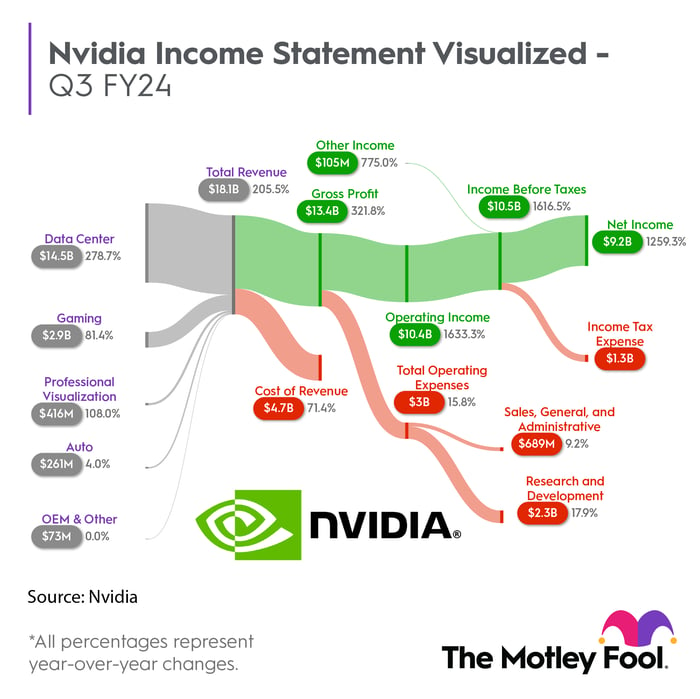
The majority of Nvidia's revenue was driven by AI and data center products. Nvidia's data center revenue surged 279% year over year to $14.5 billion, pushing its total revenue across all segments to $18.1 billion, which grew 206% year over year.
Even more impressive was Nvidia's exploding profitability, where it converted sales into a robust profit of $10 billion in the quarter. That translated to non-GAAP (generally accepted accounting principles) earnings per share of $4.02, representing a year-over-year increase of 593%.
Nvidia founder and CEO Jensen Huang acknowledged the key theme of the quarter: "A new computing era has begun. Companies worldwide are transitioning from general-purpose to accelerated computing and generative AI."
Big tech giants are racing to buy AI chips
The company's exploding growth comes on top of groundbreaking AI applications released over the last year, including OpenAI's ChatGPT and Microsoft's Copilot assistant for Windows, which were built using Nvidia's graphics processing units (GPU) -- the key building block to enable AI training.
Growing demand from AI software developers is playing a big role in Nvidia's growth right now, but management also noted the other half of its data center revenue is coming from cloud service providers, which would include Amazon, Alphabet's Google, and Microsoft.
This highlights a key advantage for Nvidia. There are a lot of headwinds in the economy causing consumers to spend less in some areas. But when much of your revenue is coming from large tech giants that have billions in cash to spend on mission-critical technologies like AI, you can fly above the turbulence.
CFO Colette Kress said, "Demand was strong from all hyperscale [cloud service providers], as well as from a broadening set of GPU-specialized cloud service providers globally that are rapidly growing to address the new market opportunities in AI."
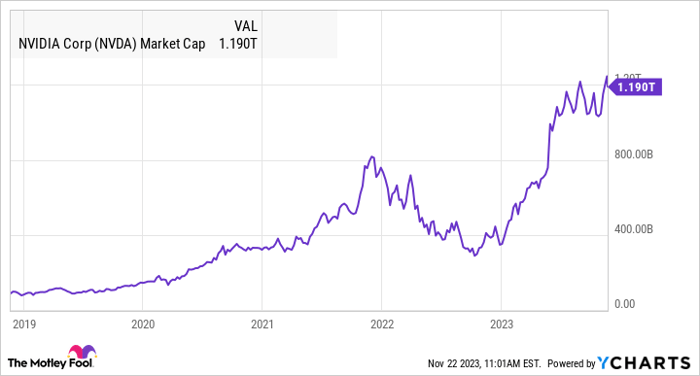
NVDA Market Cap data by YCharts
What will Nvidia be worth in 2025?
We're just at the beginning of the AI era, so Nvidia should see years of strong growth. Spending on AI-centric software is expected to reach $251 billion in 2027, growing 31% per year, according to IDC. Nvidia could grow faster along with that estimate, considering its massive lead in GPU technology.
As for next quarter's outlook, management expects revenue to reach $20 billion, driven by data centers. While that implies a year-over-year increase of 230%, it is a lower growth rate of 10% over the fiscal third quarter, compared to last quarter's sequential increase of 34%. This explains why the stock is down after the report.
This decelerating trend in quarterly growth means that Nvidia's year-over-year revenue growth rate will slow as we move through calendar 2024. With the stock trading at a high P/E of 45 times this year's earnings estimate, investors should expect the stock to experience a significant pullback at some point, although it's difficult to know when. If a correction happens next year, it might derail the stock's chances of doubling again or reaching a $2 trillion market cap.
Still, I wouldn't call Nvidia's valuation too expensive, given the opportunities ahead. Nvidia's P/E based on next year's earnings estimate drops to 29, which is a fair deal for the fast-growing industry leader.
If the company continues to beat estimates and trades around a P/E of 40 this time next year, it may be much closer to breaking the $2 trillion market cap level. The demand is not slowing down for AI chips, but Nvidia will have to keep beating the Street's expectations. That might get challenging to do if the new AI chips from Advanced Micro Devices pull some enterprise spending away from Nvidia.
10 stocks we like better than Nvidia
When our analyst team has a stock tip, it can pay to listen. After all, the newsletter they have run for over a decade, Motley Fool Stock Advisor, has tripled the market.*
They just revealed what they believe are the ten best stocks for investors to buy right now... and Nvidia wasn't one of them! That's right -- they think these 10 stocks are even better buys.
*Stock Advisor returns as of November 20, 2023
John Mackey, former CEO of Whole Foods Market, an Amazon subsidiary, is a member of The Motley Fool’s board of directors. Suzanne Frey, an executive at Alphabet, is a member of The Motley Fool’s board of directors. John Ballard has positions in Advanced Micro Devices, Amazon, and Nvidia. The Motley Fool has positions in and recommends Advanced Micro Devices, Alphabet, Amazon, Microsoft, and Nvidia. The Motley Fool has a disclosure policy.
