
Will Amazon's Crown Jewel Continue to Shine?
Every business has to spend money to expand. It's the reason many investors don't worry about profits until the obvious growth opportunities have been exhausted. Why save a penny today when spending it could yield a dollar down the road?
That's exactly what Amazon (NASDAQ: AMZN) has been doing for decades -- first, as it built an online store and distribution network, and then when it launched Amazon Web Services (AWS). Now, that segment is the crown jewel for investors -- not the brown boxes that decorate seemingly every doorstep. But competition is fierce. That makes every earnings report a potential landmine for shareholders wondering if this will be the quarter Wall Street's faith gets shaken.

Image source: Getty Images.
Still holding the lead
Amazon's rapid growth in e-commerce required it to scale up massively in technology infrastructure. It also had to learn how to optimize its use. Once it did, it decided to sell the service to others.
Today, it's almost impossible to count how many choices AWS gives developers. Managing websites, creating databases, performing analytics, deploying machine learning applications, and setting up security can all be easily managed in the cloud. Amazon was a first mover and still retains the overall lead in market share.
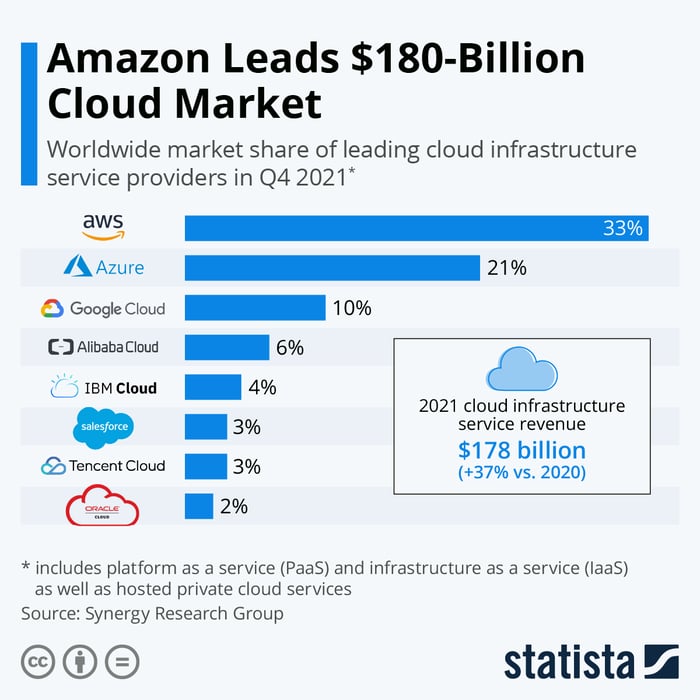
Image source: Statista.
An engine of growth and profits
All parts of the Amazon business are growing. But AWS stands above the others. It may look like it's slowing down, but it has posted four straight quarters of accelerating revenue growth and is up to a $71 billion annual run rate. That's like a company bigger than Ford growing as fast as the price of gas over the past year.
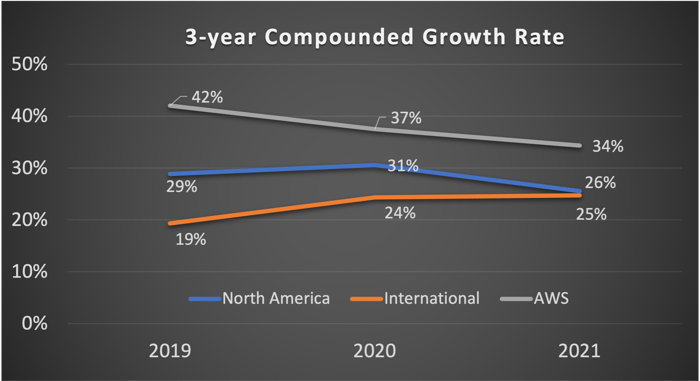
Data source: Amazon. Chart by author.
And that growth is coming from an increasingly large part of the business. AWS made up only 7% of revenue in 2015. Last year it was 13%. It's also a lot more profitable. The international segment loses money each year, although it has flip-flopped on either side of breakeven the past two. Amazon's North American business was a little better, posting an operating margin of 2.6% in 2021. By contrast, the operating margin for AWS was 30%. It's easy to see why Wall Street gets excited about the fastest-growing part of Amazon when it's also 10 times more profitable than the legacy business.
Clash of the titans
But success breeds imitation. And the shift to the cloud has spawned competing offerings from other internet titans, as well as legacy technology companies. The cash flow statement doesn't label where capital expenditures go. But they are a good proxy for the billions being poured into building out cloud infrastructure.
For Amazon, the number also counts the addition of more distribution centers to its fulfillment network. It isn't just leading the market; it appears to be outspending Microsoft (NASDAQ: MSFT) and Alphabet (NASDAQ: GOOG)(NASDAQ: GOOGL) to widen the gap.
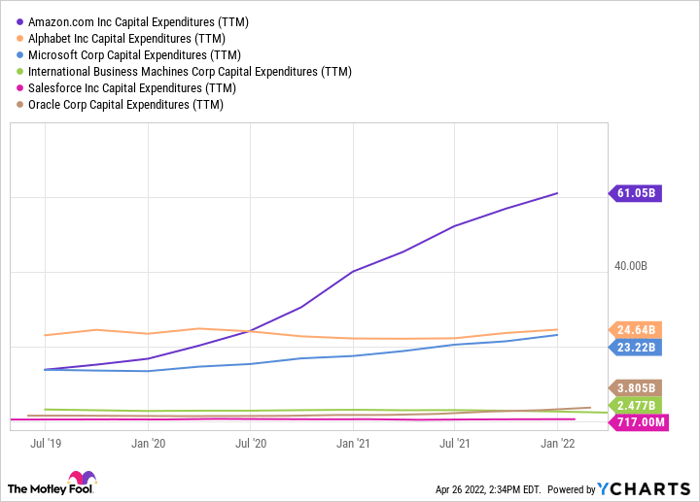
AMZN Capital Expenditures (TTM) data by YCharts
Earnings this week from Alphabet, Microsoft, and Amazon will update the scorecard in the cloud wars. To be clear, there are no losers. Each is building infrastructure that customers will rely on for years -- if not decades -- to come. It's a big reason they are three of the largest companies in the world. But investors will have their calculators ready to crunch the numbers on revenue and growth. Every quarter has the potential to reset valuations if the pecking order appears to be changing. That will remain the case at least until the next huge growth opportunity presents itself.
10 stocks we like better than Amazon
When our award-winning analyst team has a stock tip, it can pay to listen. After all, the newsletter they have run for over a decade, Motley Fool Stock Advisor, has tripled the market.*
They just revealed what they believe are the ten best stocks for investors to buy right now... and Amazon wasn't one of them! That's right -- they think these 10 stocks are even better buys.
*Stock Advisor returns as of April 7, 2022
John Mackey, CEO of Whole Foods Market, an Amazon subsidiary, is a member of The Motley Fool's board of directors. Suzanne Frey, an executive at Alphabet, is a member of The Motley Fool's board of directors. Jason Hawthorne owns Alphabet (C shares) and Microsoft. The Motley Fool owns and recommends Alphabet (A shares), Alphabet (C shares), Amazon, Microsoft, Salesforce.com, and Tencent Holdings. The Motley Fool has a disclosure policy.
