
Why Super Micro Computer Stock Lost 15% in April
April was another volatile month for high-flying AI stock Super Micro Computer (NASDAQ: SMCI) as interest in its fiscal third-quarter earnings report built, but in the end, the stock finished the quarter down 15%, according to S&P Global Market Intelligence.
That pullback was in line with a broader decline in AI stocks, as investors seemed to fear that a bubble was forming in the sector after stocks like Supermicro, as the company is also known, had already skyrocketed.
The major piece of news weighing on the stock was a prediction that its earnings report, which came out after hours on April 30 but didn't move the stock until May 1, would disappoint.
The following chart shows the stock's movements for the month. As you can see, Supermicro trended with the Nasdaq Composite to some extent, but in a much more exaggerated fashion.
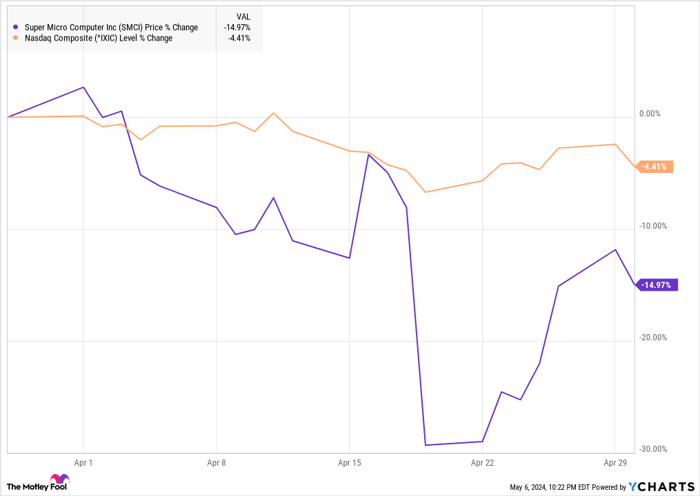
Supermicro lets some air out
Supermicro shares had nearly tripled year to date at one point this year, but negative pressure weighed on stocks in the form of signs that the Federal Reserve wouldn't lower interest rates as expected. In addition, investors seemed to worry that AI stocks were overheated.
Those concerns reached a fever pitch on April 19, when the stock plunged 23% on a seemingly innocuous note that the company didnt reportpreliminary results in its earnings announcement as it had in seven of its past eight quarters.
Wells Fargo said in a note that the company, which makes high-density servers and storage equipment that are especially effective for running AI applications, didn't provide a positive preannouncement, which it saw as a negative.
That note and a broader observation about the lack of a preannouncement sent the stock spiraling, as investors seemed to fear Supermicro's run of dazzling results could come to an end.

Image source: Getty Images.
What happened to Supermicro next
Indeed, investors were disappointed by Supermicro's earnings report when it finally came out. The stock fell 14% on May 1, after the company had recouped most of its losses following the preannouncement observation.
Supermicro delivered a generally strong report, with revenue of $3.85 billion, up 200% from the quarter a year ago, but only 5% sequentially. The result also came up short of the consensus at $3.95 billion.
On the bottom line, adjusted earnings per share jumped from $1.63 to $6.65, which topped estimates at $5.78. Still, the weaker-than-expected revenue result seemed to overshadow. The company did offer strong guidance for the fourth quarter, a sign that this growth story is far from over.
The stock has recouped most of those losses in the few days since then, suggesting that volatility in Supermicro and AI stocks is likely to continue.
Should you invest $1,000 in Super Micro Computer right now?
Before you buy stock in Super Micro Computer, consider this:
The Motley Fool Stock Advisor analyst team just identified what they believe are the 10 best stocks for investors to buy now… and Super Micro Computer wasn’t one of them. The 10 stocks that made the cut could produce monster returns in the coming years.
Consider when Nvidia made this list on April 15, 2005... if you invested $1,000 at the time of our recommendation, you’d have $544,015!*
Stock Advisor provides investors with an easy-to-follow blueprint for success, including guidance on building a portfolio, regular updates from analysts, and two new stock picks each month. The Stock Advisor service has more than quadrupled the return of S&P 500 since 2002*.
*Stock Advisor returns as of May 6, 2024
Jeremy Bowman has no position in any of the stocks mentioned. The Motley Fool has no position in any of the stocks mentioned. The Motley Fool has a disclosure policy.
