
Why Nvidia Should Raise Its Dividend
Nvidia's (NASDAQ: NVDA) dividend yield, an afterthought for most investors, is currently sitting at 0.06%. That is partly due to a stock price that has climbed faster than the company's dividend payments. On that score, the company hasn't increased its dividend in over two years. As the company's profits have climbed on the back of strong demand for advanced graphics chips and data center systems, the dividend payout ratio has dropped to less than 5%.
Here are a few reasons the company should consider returning more income to shareholders.
Nvidia's cash flow and payout history
Nvidia's profit margin improved significantly in recent years as the mix of revenue shifted to data center chips and high-end graphics processing units (GPUs) for gamers that command steep selling prices.
Over the last five years, the company's free cash flow, which is the amount of cash the company can spend on reinvestment in operations, acquisitions, dividends, and share repurchases, climbed 457% to $8.1 billion. That represents a high margin of 30% on $26.9 billion in fiscal 2022 revenue.
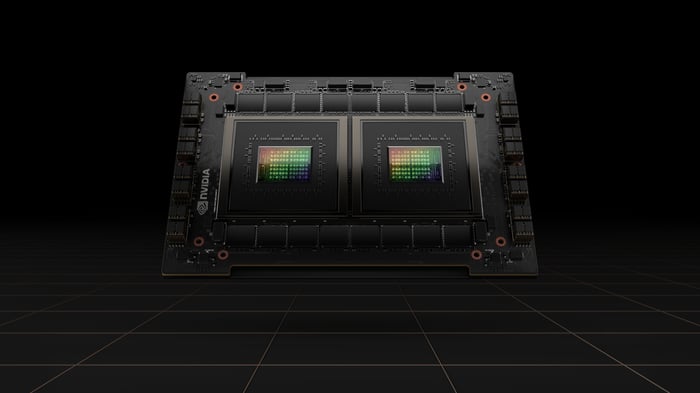
Nvidia's Grace CPU for data centers. Image source: Nvidia.
Management seems to have anticipated the company's fortunes nine years ago. Nvidia initiated its first quarterly dividend of $0.075 per share in fiscal 2012 (ended in January 2013). That year, Nvidia generated $640 million in free cash flow on $4.3 billion in revenue, or a free cash flow margin of about 15%.
But over the last five years, Nvidia's free cash flow has increased more than 400%, while the dividend has only increased 25%. Other companies that design or manufacture chips, such as Apple, Intel, and Broadcom, pay out anywhere from 14% to 58% of their free cash flow in dividends. These companies face just as much competition for their products, yet they far outspend Nvidia in returning cash to shareholders through dividends.
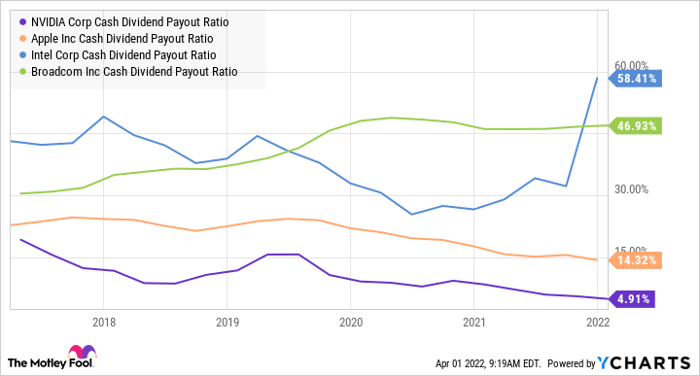
NVDA Cash Dividend Payout Ratio data by YCharts.
Nvidia can afford a higher payout
Nvidia can certainly afford to double its payout to at least 10%. The total spent on dividends last year was $399 million, but Nvidia has spent far more on share repurchases. Since August 2004, management has spent over $7 billion repurchasing shares. After spending $2 billion to repurchase shares in the recent quarter, they currently have another $5 billion left on their share repurchase authorization through the end of December 2022.
The recent $2 billion buyback at these high valuation levels is questionable. Nvidia previously spent $1.6 billion to buy back shares in 2018, when the stock traded at an attractive valuation of around 20 times earnings. Management did not repurchase any shares between 2020 and 2021 as the stock's valuation soared.
So, why did management repurchase shares recently with the stock trading at a nosebleed valuation of 69 times trailing earnings? It would have made more sense from a capital allocation perspective to shift at least some of that cash return to dividends as opposed to buying back shares at these levels.
Furthermore, Nvidia's share repurchases have been completely ineffective in enhancing shareholder returns over the last 18 years. The annual diluted share count has increased 20% over that time, which means the amount spent on buybacks has only partially offset the dilution to shareholders.
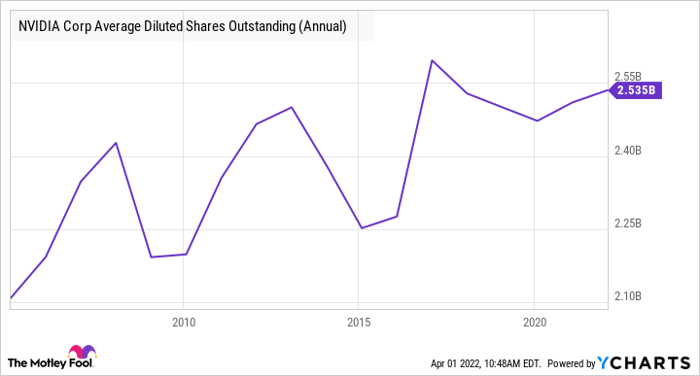
NVDA Average Diluted Shares Outstanding (Annual) data by YCharts.
At the end of January, Nvidia was sitting on a net cash balance of $10.3 billion, and given management's anticipation of further growth in free cash flow, that cash balance should continue to pile up over the long term.
Demand trends in data centers and gaming should continue to lift gross margin and Nvidia's profitability. Management expects new software opportunities with Nvidia AI Enterprise and Nvidia Omniverse will benefit the company's bottom line. "Each one of these software offerings has a multibillion-dollar revenue potential and should contribute positively to our gross margins over time," said CFO Colette Kress at Nvidia's recent investor day.
Given Nvidia's expanding margins and opportunities, Nvidia should reconsider its capital return priorities. If the company is not going to reduce the share count and boost returns to investors with repurchases, it should shift more of its capital returns to dividends.
10 stocks we like better than Nvidia
When our award-winning analyst team has a stock tip, it can pay to listen. After all, the newsletter they have run for over a decade, Motley Fool Stock Advisor, has tripled the market.*
They just revealed what they believe are the ten best stocks for investors to buy right now... and Nvidia wasn't one of them! That's right -- they think these 10 stocks are even better buys.
*Stock Advisor returns as of March 3, 2022
John Ballard owns Intel. The Motley Fool owns and recommends Apple, Intel, and Nvidia. The Motley Fool recommends Broadcom Ltd and recommends the following options: long January 2023 $57.50 calls on Intel, long March 2023 $120 calls on Apple, short January 2023 $57.50 puts on Intel, and short March 2023 $130 calls on Apple. The Motley Fool has a disclosure policy.
