
Why Microsoft Is the Safest Big Tech Stock
Tech giant Microsoft (NASDAQ: MSFT) did not escape last year's tech stock sell-off; however, its 28.7% decline was more than 4 percentage points better than that of the Nasdaq Composite, which fell 33% in 2022.
Not only does Microsoft tend to fall less than the Nasdaq in downturns, but the stock has also handily beat the index over the past 3-, 5-, and 10-year periods.
What's the key to Microsoft's low-risk winning ways? We can find several clues in the revenue breakdown of its most recent earnings release.
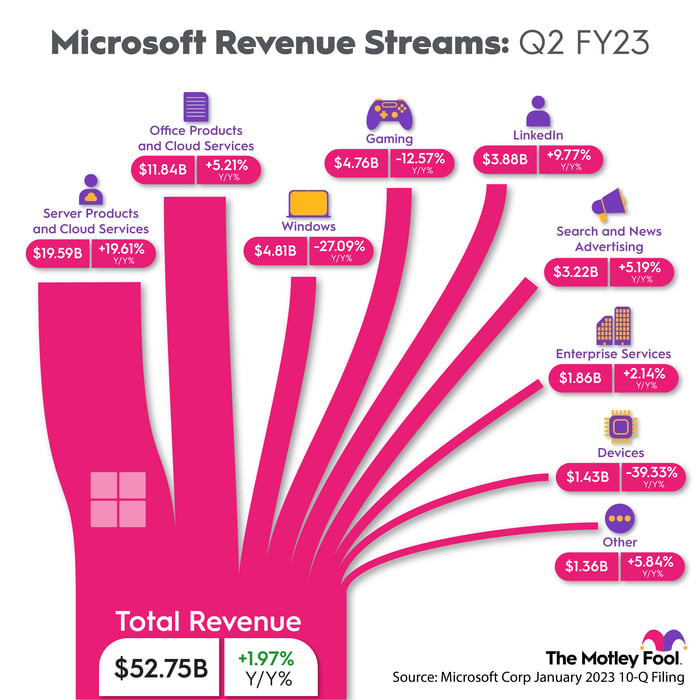
Data source: Microsoft Q2 2023 earnings release.
Diversity across business lines
While Microsoft certainly has some concentration in the high-growth cloud services and server products segment, no single category makes up more than 50% of the business. Furthermore, Microsoft has divisions diversified across both software and hardware as well as both enterprise and consumer products and services.
One can see that the consumer-oriented segments declined last quarter; the postpandemic period has led to a rapid slide in sales of PCs and video games after consumers stocked up during the 2020-2021 period. But on the other hand, the more recurring cloud-oriented enterprise divisions displayed growth despite the economic slowdown in the wake of the Federal Reserve's rapid interest-rate hikes.
The diversity of Microsoft's revenue streams definitely stands out among big tech firms, which generally have one dominant product or service.
And the biggest division is growing the fastest
Another important thing to notice is that Microsoft's largest division is also growing the fastest, with the server products and cloud services division making up 34% of sales while growing 19.6%.
That division contains Microsoft's Azure cloud infrastructure and platform services, which grew 31% last quarter. Although Microsoft and other cloud providers have all forecast a slowdown in the first half of 2023 as customers look to optimize their cloud spending, the cloud infrastructure market is still a great business to be in.
That's because most analysts think we are still in the early to middle innings of the transition from on-premises data centers to the superior cloud model. According to Verified Market Research, the cloud infrastructure market should grow at a mid- to high-teens annualized growth rate through the end of 2030, with Microsoft being one of only a few companies poised to reap those gains.
When a company's largest division is growing the fastest, that should put a floor under its growth rate for the next few years as that division makes up a larger and larger portion of revenue.
And all or most divisions are profitable
Finally, while perhaps not every segment listed above is profitable, most of them certainly are. Microsoft doesn't break out each subdivision's operating income, but it does group them into three large categories: productivity and business processes, intelligent cloud, and more personal computing.
Microsoft does reveal the overall profitability of those three broader categories, and even during last quarter's consumer and PC sales down cycle, Microsoft displayed profits across all three:
|
Microsoft Segment |
Q2 2022 Operating Income |
Q2 2021 Operating Income |
|---|---|---|
|
Productivity and business processes |
$8,175 |
$7,688 |
|
Intelligent cloud |
$8,904 |
$8,323 |
|
More personal computing |
$3,320 |
$6,236 |
Data source: Microsoft December quarterly report. Table by author.
Adding it up
Microsoft's diverse profit streams make it an incredibly resilient business, and its strong position in the cloud computing market should allow those profits to keep growing.
Diversified, rising profits also allow Microsoft to invest in new and exciting innovation such as ChatGPT parent OpenAI, all while returning cash to shareholders via dividends and share repurchases. That killer combo is why Microsoft is the safest of the big tech names today.
10 stocks we like better than Microsoft
When our award-winning analyst team has a stock tip, it can pay to listen. After all, the newsletter they have run for over a decade, Motley Fool Stock Advisor, has tripled the market.*
They just revealed what they believe are the ten best stocks for investors to buy right now... and Microsoft wasn't one of them! That's right -- they think these 10 stocks are even better buys.
*Stock Advisor returns as of January 9, 2023
Billy Duberstein has positions in Microsoft. His clients may own shares of the companies mentioned. The Motley Fool has positions in and recommends Microsoft. The Motley Fool has positions in and recommends Microsoft. The Motley Fool has a disclosure policy.
