Why Do Companies Stay Private Longer?
We’ve written about how the U.S. initial public offering (IPO) market has been changing, with companies staying private longer. That also means most are going public as bigger, more mature, companies.
The data backs this up. Although, the “why” is still being argued over. We previously discussed some of the reasons like the growth in private capital and increase in regulatory requirements.
Companies are staying private longer
The structural shift driving this change started in the early 2000s. Compared to the IPO peak in the late 1990s:
- The share of startups that eventually IPO has fallen from over 25% to just 2%.
- The median age of a company at IPO has doubled.
- Total capital raised by late-stage private startups has tripled.
As a result, older, bigger, better-capitalized companies are coming to the public market — and they're doing so at a very different stage of their lifecycle than companies did a generation ago.
Chart 1 shows this, tracking what happened to companies seven years after their first venture capital (VC) funding round — whether they went public, failed, were acquired, or remained private — by the year they first received funding.
- Just over a quarter (26%) of companies that first received VC funding in 1994 were public within seven years.
- Only 2 % of companies that received their first funding in 2009 had gone public by 2016.
- What’s telling is what didn’t change: Acquisition rates (~25%) and failure rates (~20%–25%) stayed roughly constant throughout. It was just the IPO rate that collapsed.
Chart 1: 50% of companies are still private seven years after their first funding round
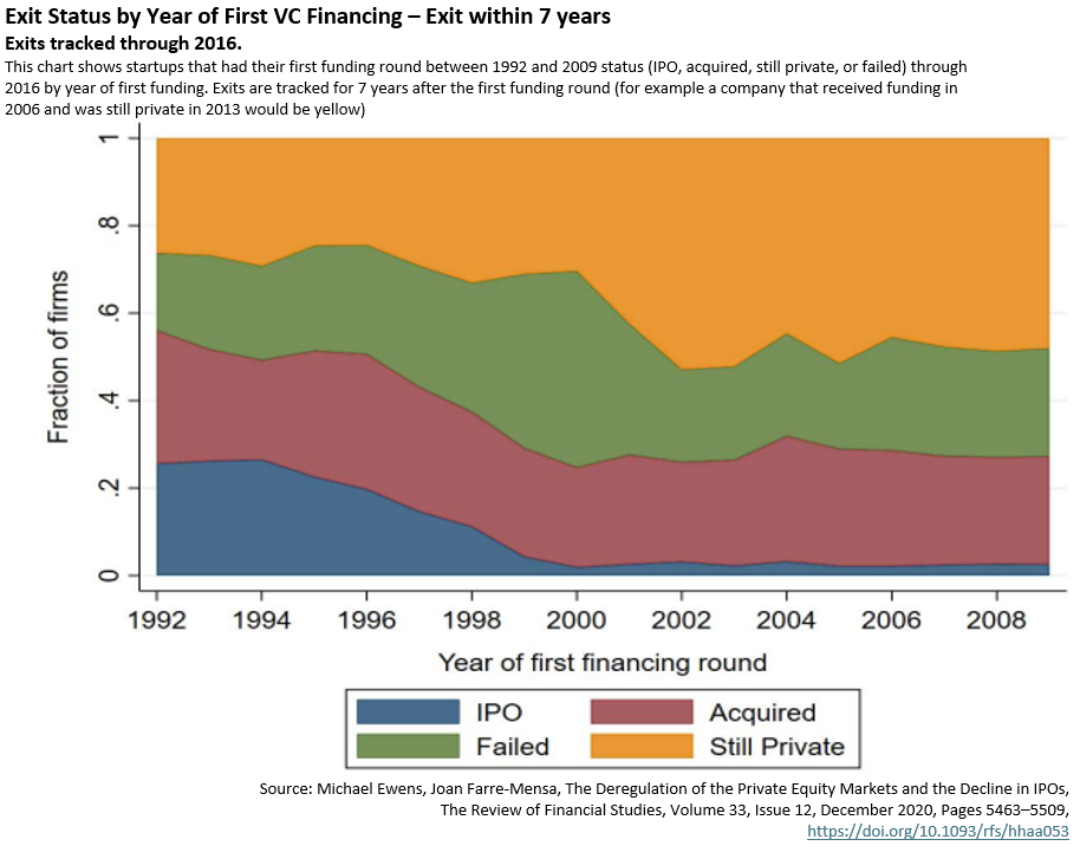
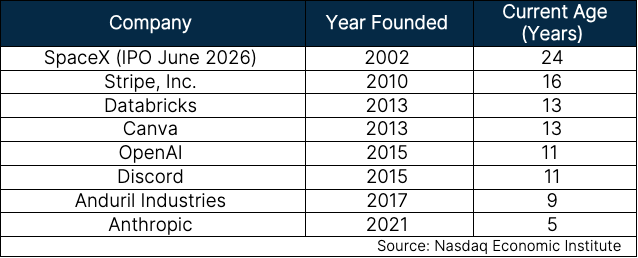
SpaceX is a good example of how this plays out in practice. It received its Series A in 2002 and Series B in 2005 — and had their IPO in 2026. On Chart 1, SpaceX would have been part of the yellow shaded area: private, more than seven years after receiving their first funding.
And it’s far from unique. The table below shows anticipated IPO candidates and just how old they already are; only one is less than seven years old.
Table 1: Anticipated IPO company ages
Executives say liability is the biggest problem
We recently looked at the costs of going public, from the IPO process to reporting afterward.
A recent Bloomberg paper looking at the future of IPOs found that the executives they surveyed said liability and regulatory burdens were the main issues.
Chart 2: What executives think are impeding the IPO process
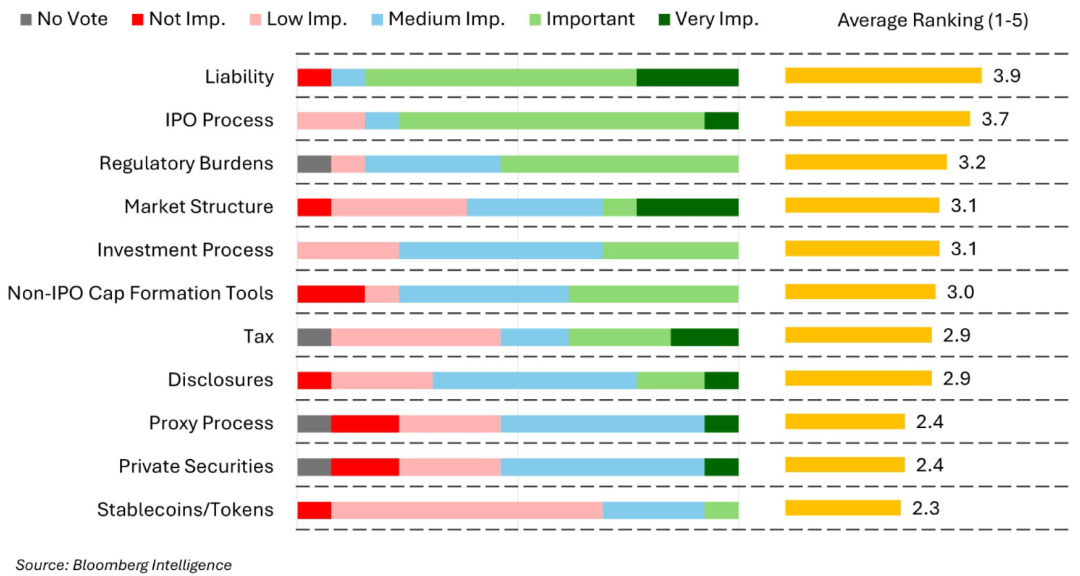
The part of the survey that particularly caught our eye: Market structure ranked as a meaningful concern, but a notable share of respondents said it didn’t matter much to them at all. As we see it, that’s exactly the point: Our job is to get market structure right, so it never has to be a reason a company hesitates to go public.