
Why Amazon Stock Plummeted 24% Last Month
What happened
Amazon (NASDAQ: AMZN) stock sank roughly 23.8% in April, according to data from S&P Global Market Intelligence. The tech giant's share price moved amid bearish market momentum through much of the month and then saw a dramatic sell-off following the publication of its first-quarter earnings results.
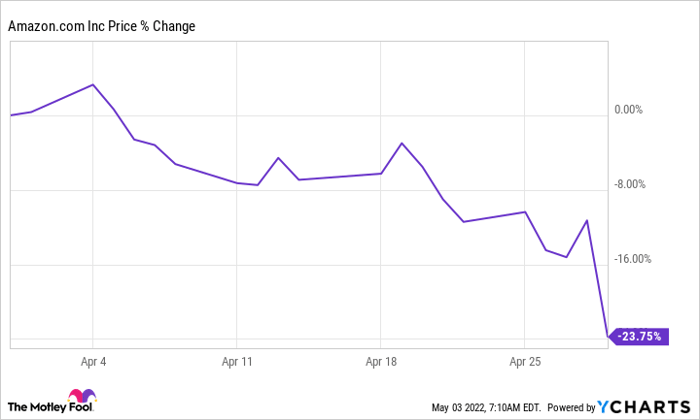
Amazon published Q1 results after the market closed on April 28, delivering results that came in significantly worse than expected. The company posted a loss per share of $7.56 on revenue of $116.4 billion. Sales for the period fell just short of the average analyst estimate, but the average analyst estimate had actually targeted per-share earnings of $8.36 for the period.

Image source: Getty Images.
So what
Amazon's investment in electric vehicle (EV) company Rivian was to blame for its net loss in Q1. The EV specialist's share price has fallen precipitously in recent months, forcing Amazon to adjust the value on its books. The e-commerce and cloud computing leader posted an operating profit of $3.7 billion in the period, but this was still far below the $8.9 billion in operating income it posted in the prior-year quarter.
While overall revenue climbed 7% year over year, the Amazon's results were uneven among segments. Amazon Web Services (AWS) continued to serve up impressive performance and grew sales roughly 36.5% year over year to reach $18.44 billion in sales, and the unit posted an excellent 35.3% operating margin. Sales for the company's international segment, which primarily consists of its online retail business in the region, fell roughly 6% year over year to come in at $28.8 billion. Meanwhile, advertising revenue grew 25% to reach roughly $7.9 billion but fell short of the $8.2 billion in sales targeted by the average analyst estimate.
Now what
Amazon's e-commerce business boomed amid pandemic-driven social-distancing conditions, but it's now seeing that demand catalyst soften. The company is also facing headwinds due to inflation and high shipping costs.
For the second quarter, Amazon is guiding for revenue to be between $116 billion and $121 billion. This target came in significantly below the $125.17 billion in revenue called for by the previous average analyst estimate. The company also guided for operating performance between a loss of $1 billion and income of $3 billion -- a stark shift from the $7.7 billion in operating profit it posted in last year's quarter.
While Amazon's guidance for the current quarter was disappointing, the sell-off for its stock appears overdone. AWS remains incredibly strong, and the company's e-commerce business should deliver strong growth over the long term even though its current performance is disappointing the market. With shares down roughly 35% from the high they hit last year, Amazon stock looks like a strong buy.
10 stocks we like better than Amazon
When our award-winning analyst team has a stock tip, it can pay to listen. After all, the newsletter they have run for over a decade, Motley Fool Stock Advisor, has tripled the market.*
They just revealed what they believe are the ten best stocks for investors to buy right now... and Amazon wasn't one of them! That's right -- they think these 10 stocks are even better buys.
*Stock Advisor returns as of April 7, 2022
John Mackey, CEO of Whole Foods Market, an Amazon subsidiary, is a member of The Motley Fool's board of directors. Keith Noonan has no position in any of the stocks mentioned. The Motley Fool has positions in and recommends Amazon. The Motley Fool has a disclosure policy.
