
Where Will Amazon Be in 10 Years?
Amazon (NASDAQ: AMZN) is the ultimate growth stock. That's not just because it has a ton of room to grow in the huge retail and cloud computing markets, but also because it's constantly working to invent big new businesses from scratch. No other company continuously surprises investors with unexpected value creation from new ventures. So where could Amazon be in 10 years?
Retail and cloud businesses
It's no secret that Amazon's e-commerce business is a juggernaut, and it's only been getting stronger because of the acceleration of e-commerce adoption due to COVID-19. There just aren't a lot of compelling reasons to frequent physical retail stores in a post-COVID world when you can order online from your couch, usually at lower prices, and receive your order in a day or two. That's especially true when Amazon offers such a great customer value proposition.
But what's less appreciated is Amazon's still tiny market share of the global retail market. The global retail market is a massive $25 trillion market. Over the last 12 months, Amazon's e-commerce business had $202 billion of net sales, which is only about a 0.8% share of the retail market. So as much of a juggernaut as Amazon's retail business is, it's still a tiny -- but rapidly growing -- fish in a huge pond.
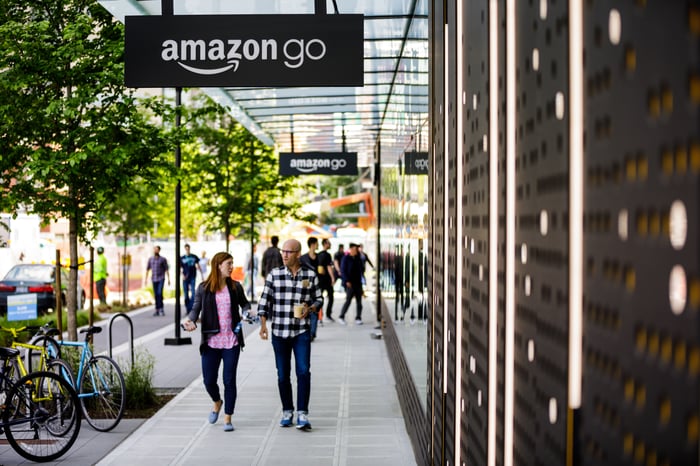
Image source: Amazon.
The same is true with public cloud leader Amazon Web Services (AWS), which also has a tiny market share of a huge market. AWS boss Andy Jassey said late last year that AWS is addressing the $3.7 trillion global enterprise IT market. If that's the case, then AWS's $40 billion of net sales over the last 12 months is only 1.1% of the opportunity.
Known and unknown emerging ventures
The most underappreciated aspect of Amazon is the company's constant work to build additional big new businesses from scratch. The third-party marketplace and AWS were one-time development stage ideas that have grown into wildly successful businesses.
One newer initiative is Amazon's interest in physical retail, specifically technology-enabled grocery stores. The company started out with the Amazon GO convenience stores with "just walk out" technology, where customers scan their phones on the way in, grab items off the shelves, and then just walk out. Amazon's slew of cameras and sensors can tell what the customer left with, and informs the company what to charge the customer's Amazon account.
This year, Amazon has parlayed that technology into Amazon GO Grocery stores, a full-size grocery store version with the same concept. And it's recently launched a different grocery store concept altogether called Fresh, which uses the Amazon Dash Cart and Alexa-based technology to improve the grocery store shopping experience.
Amazon has a huge interest in the grocery segment because grocery stores are a massive $682 billion category in the U.S. alone. That's why the company is developing at least two different concepts in order to learn and optimize its approach. Given Amazon's track record, it won't be surprising if Amazon eventually captures a sizable share of the category.
Amazon is also perfecting its drone delivery capabilities, and recently got approval from the Federal Aviation Administration (FAA) to begin testing its drone delivery program. In the future, this should help Amazon deliver packages to more rural customers more efficiently by saving on last-mile delivery costs.
In addition, the company's rapidly growing advertising business has quickly become the No. 3 online advertiser in the U.S. after Alphabet subsidiary Google and Facebook. Amazon also acquired autonomous car technology company Zoox earlier this year, which could minimize transportation and fulfillment costs in the long term.
These are just a few of the newer initiatives, and there are almost certainly more that we don't know about yet.
Much bigger and more profitable in 10 years
Amazon should be much bigger and more profitable just from the continued growth of the retail and AWS businesses. But it has so many additional irons in the fire that it should have surprising growth coming out of nowhere in the years ahead.
Not all of Amazon's pioneering efforts work. Online auctions, the Fire phone, online travel, and high-end jewelry are a few examples of the company's failures. But failures help the company learn, make adjustments, and change course. For example, the online auctions failure led to the development of the third-party marketplace, which now represents the majority of retail units sold.
Over the next decade, Amazon should grow enormously and could grow to 2% or 3% of global retail sales, 3% of the global enterprise IT opportunity, 25% of the online advertising market, and 5% of the U.S. grocery market. And it would still have a huge runway ahead.
Considering its still low market shares of these big categories, investors should consider the Amazon of 2030 to be just getting started.
10 stocks we like better than Amazon
When investing geniuses David and Tom Gardner have a stock tip, it can pay to listen. After all, the newsletter they have run for over a decade, Motley Fool Stock Advisor, has tripled the market.*
David and Tom just revealed what they believe are the ten best stocks for investors to buy right now... and Amazon wasn't one of them! That's right -- they think these 10 stocks are even better buys.
*Stock Advisor returns as of August 1, 2020
John Mackey, CEO of Whole Foods Market, an Amazon subsidiary, is a member of The Motley Fool's board of directors. Suzanne Frey, an executive at Alphabet, is a member of The Motley Fool's board of directors. Randi Zuckerberg, a former director of market development and spokeswoman for Facebook and sister to its CEO, Mark Zuckerberg, is a member of The Motley Fool's board of directors. Andrew Tseng owns shares of Amazon and Facebook. The Motley Fool owns shares of and recommends Alphabet (A shares), Alphabet (C shares), Amazon, and Facebook and recommends the following options: long January 2022 $1920 calls on Amazon and short January 2022 $1940 calls on Amazon. The Motley Fool has a disclosure policy.
