
USAF Doesn't Want Northrop Grumman's Stealth Drone
Key Points
The U.S. Air Force chose Anduril and General Atomics to produce Collaborative Combat Aircraft for it, rejecting Northrop Grumman's offering.
Northrop Grumman is proceeding to develop its YFQ-48A Talon Blue drone anyway.
A second "increment" of the CCA competition could see Talon Blue compete.
- Motley Fool Issues Rare "Total Conviction" Buy Alert ›
For Northrop Grumman (NYSE: NOC), the bad news arrived in June. The U.S. Air Force had just announced contracts to build new Collaborative Combat Aircraft (CCA), the drone warplanes that will fly in support of piloted fighter jets -- naming two companies as winners.
Northrop Grumman was neither of them.
Missed AI’s "Act 1"? Act 2 Could Be 15x Bigger. Most investors think they missed the AI boat because they didn't buy Nvidia in 2005. But according to our analysts, we’re only at the end of "Act 1"—the R&D phase. "Act 2" is the global rollout. Continue »
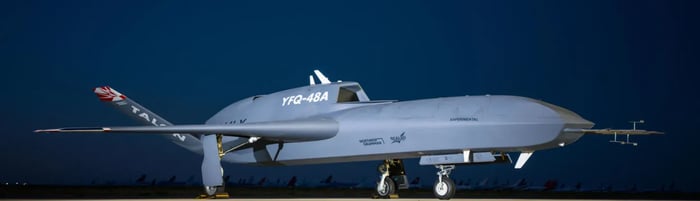
Image source: Northrop Grumman.
Good news for Anduril and General Atomics -- bad news for everyone else
Five companies had entered the Air Force CCA competition: publicly traded Boeing, Lockheed Martin, and Northrop Grumman, and also privately held Anduril and General Atomics. In a somewhat shocking development, though, all of the publicly traded defense companies' designs were rejected. Only privately held General Atomics and Anduril Industries won production contracts for their respective FQ-42 Vengeance and FQ-44 Fury CCA drones.
Northrop Grumman may not be left entirely out in the cold. In a twist, the Air Force awarded contracts for CCA hardware and software separately. Northrop didn't win the hardware contract, but it did make the list for drone software vendors. Other companies on this list include Anduril, General Atomics, and Lockheed Martin from the hardware competition, as well as RTX Corporation and Shield AI. That feels kind of like a consolation prize for Northrop, however. The builder of "the world's first sixth-generation aircraft," the B-21 Stealth Bomber, went head-to-head with a team of U.S. rivals to build the fighter drones that will escort it -- and lost.
But Northop isn't taking the loss sitting down.
Full speed ahead
The U.S. Air Force may not want Northrop Grumman's CCA, but as we learned last week, Northrop Grumman has decided to build one anyway. Dubbed the YFQ-48A Talon Blue, this prototype fighter drone took off for the first time earlier this month.
YFQ-48A Talon Blue is airborne. Its first flight, including taxi, takeoff and landing, was fully autonomous. This is the latest step in our work to make autonomous airpower faster and more affordable to produce. https://t.co/YkA3YGvCdq https://t.co/6g9m41ahqn
-- Northrop Grumman (@NGCNews) October 3, 2026
Based on a Scaled Composites aircraft (Northrop bought Scaled Composites in 2007), Talon Blue runs on Northrop Grumman Prism Mission Autonomy software, presumably the same software Northrop is offering for the CCA program. The aircraft is fixed-wing and powered by a single Pratt & Whitney PW500 turbofan that will give it a 700-mile range -- slightly longer than that of an F-35 stealth fighter. It's believed to measure about 40 feet in length with a 33-foot wingspan.
Northrop also confirms that the drone has an "integrated weapons" bay that will make it stealthier than other drones.
Will the Air Force buy it?
None of this may matter, of course, if Northrop cannot convince the Air Force to buy the drone. Years ago, during the invasions of Afghanistan and Iraq, defense company Textron made a similar effort to build a budget-priced fighter, the Scorpion, on spec. The company sank "many millions of dollars in design and development" into the effort -- but it never found a buyer.
Northrop's Talon Blue may meet a similar fate. But even if it does, that's OK.
Paid for internally, Northrop Grumman characterizes its investment in Project Talon as research and development of "mission-ready autonomous airpower capabilities." The company is probably prepared for the risk that the Air Force doesn't buy its CCA drone, and that it will have to write off the cost as R&D. That could still pay off if the company makes advances in simplifying the design to use fewer, lighter, and less expensive parts, permitting it to manufacture simpler drones faster and at lower cost, for future competitions.
What's next for Northrop Grumman
Speaking of which, there's always the chance Northrop will be able to sell its CCA drone eventually.
Although Northrop didn't win an Air Force contract in Increment 1 of the CCA program, it's already gearing up for a second competition and selecting designs to approve for Increment 2. According to TheAviationist.com, Northrop may submit Talon Blue for that competition.
That said, investing in Northrop solely in the hope that it will win its way into CCA seems like a risky gamble. With its 16 price-to-earnings ratio, skimpy 2.1% dividend yield, and subpar 6.7% growth rate (according to analysts polled by S&P Global Market Intelligence), I suspect you can find better bargains.
Lockheed Martin (NYSE: LMT) remains No. 1 on my list for undervalued defense stocks.
Should you buy stock in Northrop Grumman right now?
Before you buy stock in Northrop Grumman, consider this:
The Motley Fool Stock Advisor analyst team just identified what they believe are the 10 best stocks for investors to buy now… and Northrop Grumman wasn’t one of them. The 10 stocks that made the cut could produce monster returns in the coming years.
Consider when Netflix made this list on December 17, 2004... if you invested $1,000 at the time of our recommendation, you’d have $380,363!* Or when Nvidia made this list on April 15, 2005... if you invested $1,000 at the time of our recommendation, you’d have $1,315,732!*
Now, it’s worth noting Stock Advisor’s total average return is 919% — a market-crushing outperformance compared to 211% for the S&P 500. Don't miss the latest top 10 list, available with Stock Advisor, and join an investing community built by individual investors for individual investors.
*Stock Advisor returns as of October 17, 2026.
Rich Smith has no position in any of the stocks mentioned. The Motley Fool has positions in and recommends Boeing, Lockheed Martin, Northrop Grumman, and RTX. The Motley Fool recommends Textron. The Motley Fool has a disclosure policy.
