
Stocks: What's Driving Tesla?
- Tesla's Q4 earnings were released Wednesday evening and the financials world was abuzz with the idea the numbers were below “consensus expectations”.
- The reality is Tesla has been trending down since November 2021.
- As usual, global supply and demand has changed and Tesla is no longer the only game in town for investors to be interested in.
- Stocks Push Higher on U.S. Economic Resilience
- Should You Buy Li Auto Stock Amid the Slump in Chinese EV Stocks?
- Markets Today: Stocks Climb and Bond Yields Fall on Improved Soft-Landing Prospects
- 2 Bear Call Spread Trade Ideas For This Thursday
There is so much craziness these days that the chatter over Tesla’s (TSLA) latest quarterly earnings simply got lost in the noise. For the record, according to another story on Barchart, Tesla’s Q4 earnings per share (EPS) was $0.71 as compared to “consensus expectations” of $0.74. Additionally, the “company’s revenue in the final months of 2023 totaled $25.17 billion U.S. versus $25.6 billion U.S. that was expected”. As a result of what was reported versus “expectations”, Tesla’s stock dropped nearly 10% Thursday morning, coming in at about $187.00 as of this writing.
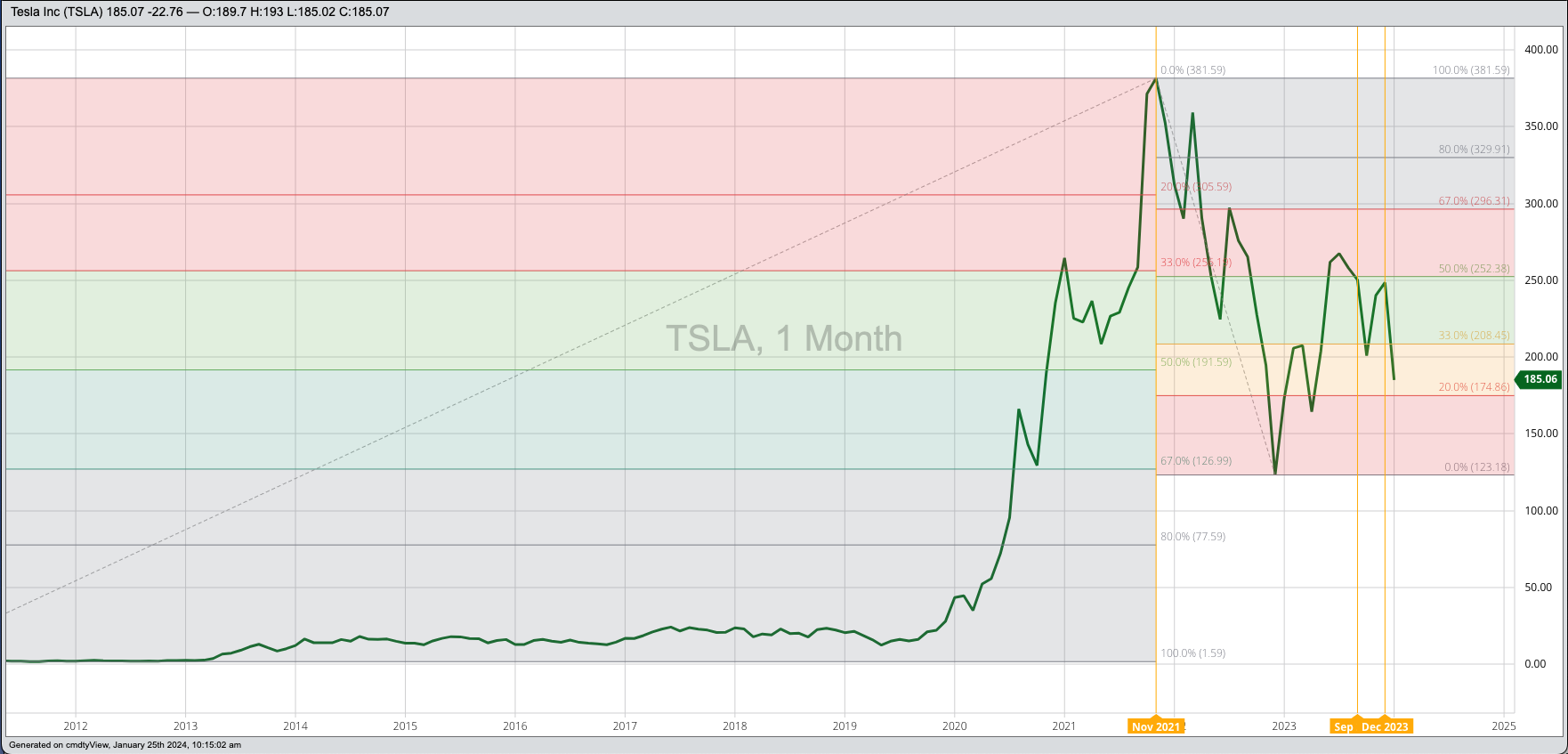
Where to begin? Let’s start with the comparison to “consensus expectations”. As we know from other market sectors, this is a ludicrous measuring tape. We see it all the time with folks who have nothing better to do than play pin-the-tail-on-the-donkey with USDA reports, weekly EIA releases, and countless other made-up numbers including – believe it or not – the Kardashians of the report world weekly crop conditions and progress (grains). In the economic sector, is there anything funnier than listening to talking heads after the release of monthly jobs data, usually with “consensus expectations” missing the reported mark by hundreds of thousands of jobs? Frankly, it is the only reason to watch financial television so be sure to have your popcorn ready when the circus comes around again the morning of Friday, February 2.
Next we have the idea investors are driven by earnings. I’ll put it this way, some may be, but the larger percent of activity tied to earnings reports comes from traders. Unfortunately, most talking heads don’t know the difference between the two. Traders make moves based on the latest headlines and have the attention span of a chihuahua after chugging a couple double-espressos. On the other hand, investors tend to take a long-term view of a company, factoring in such things as innovation, potential growth, and industry evolution. Take a look at the monthly close only chart for Tesla. From December 2013 through October 2019[i] it was largely range bound between $10 and $20. But then it broke out, racing to a high monthly close of $381.59 at the end of November 2021.
What did the company’s earnings do from October 2019 through November 2021? Compared to “consensus estimates” the quarterly numbers were generally higher. However, Tesla’s went on a string of five consecutive quarters, from Q4 2021 through Q4 2022 far outdistancing “consensus estimates”. Yet the stock lost 68% of tis value from the end of November 2021 through the end of December 2022 (Q4 2022). Why?
I’m going to set aside my Rule #5 (It’s the what, not the why.) for a moment, and give you what I, a non-economist (and proud of it), see as the key reason Tesla dropped like a stone: Supply and Demand. I always find it funny when I have to remind talking heads of this, most of them claiming to be an economist of one type or another.
By the end of 2021, Tesla was no longer the only game in town for investors looking to get involved in the electric vehicle (EV) evolution[ii]. It was about this time Mr. Musk himself started talking about competition from Chinese car makers, a theme that persists through the most recent quarterly earnings announcements when Musk said, “The Chinese car companies are the most competitive car companies in the world. So, I think they will have significant success outside of China depending on what kind of tariffs or trade barriers are established”. Given some of Tesla’s earnings were tied to cutting prices to stay competitive with Chinese car companies, I find Mr. Musk’s hint at more tariffs and trade barriers interesting.
But I digress. Again, it is about supply and demand. As 2023 came to an end, the supply of EV was growing globally, keeping up with demand and sending the market price lower per unit. It’s not rocket science, but rather Economics 101.
For those analysts who like to look at things from a technical point of view, there are a couple key prices coming up: The previous low monthly close of $164.31 (April 2023) and the long-term low of $123.18 (December 2022). If one or both of these don’t hold, it tells us more about what investors think of Tesla long-term than a look back at the previous quarter’s earnings.
[i] An interesting story. Roughly the middle of this timeframe my then high school aged son came to me and said we need to buy Tesla, among other stocks I knew nothing about. He had been studying industry trends and writing his own algorithms, and this was one he saw as exploding over time.
[ii] I’ve had folks tell me the EV evolution is over. It will never be as big as what so many make it out to be. However, that isn’t the way the world works. Industries move forward. I’m sure there were folks who said the same thing about horse and buggies as they left the latest flat-earth meetings.
More Stock Market News from Barchart
On the date of publication, Darin Newsom did not have (either directly or indirectly) positions in any of the securities mentioned in this article. All information and data in this article is solely for informational purposes. For more information please view the Barchart Disclosure Policy here.
