
Stock Split Watch: Is Nvidia Next?
Stock splits always create a buzz among investors, even though the split itself doesn't affect the company's value. Think of the total value of a company as a pie: No matter how many pieces you slice it into, it's the same amount of pie. Still, the action can make the stock more approachable for individual investors and increase demand for the stock.
Last year was a banner year for stock splits, with Amazon, Alphabet, and Tesla all executing splits.
This year has been quiet so far, but Nvidia (NASDAQ: NVDA) could soon shake that up because the company has a history of splits, and the stock price has risen nearly 300% over the past year. It performed a 4-for-1 split in 2021. The share price when it announced the plan was just under $600, and it rose to more than $700 by the time the split was executed. It is trading above $450 per share now.
Why would Nvidia split its stock?
First, let's quickly examine the dynamics of a stock split. A company can't just issue an endless number of shares. The number authorized is stated in the company's articles of incorporation and is expanded by votes at shareholder meetings. Stock splits typically must also be approved by the voting shareholders, but they are almost certain to win approval.
Nvidia currently has about 2.5 billion common shares outstanding and is authorized to issue up to 8 billion shares. So the company could execute a 3-for-1 split without increasing the number of authorized shares.
There are several reasons companies split their stock. Tesla, for instance, has said that it likes the price per share to be affordable and approachable for smaller investors. This is a savvy move -- I know I try to support companies where I own stock whenever possible.
In Nvidia's case, the company has an employee stock ownership plan (ESOP) that facilitates employees' purchase of shares and sometimes gives bonuses in stock. As the company stated in 2021, it "believes that the stock price appreciation and the associated reduction in the number of shares of stock provided in equity grants has reduced the perceived attractiveness of employee equity awards..." In other words, folks would rather get 10 shares worth $150 each than three shares worth $500 each -- it's all about perception and psychology.
Why has Nvidia stock gone up so much?
Nvidia's success can be summed up in one word: demand. Its hardware and software that power data centers are so popular that the company literally cannot make enough to satisfy its customers. This gives it massive pricing power and leads to revenue growth (as shown below), huge margins, and soaring profits.
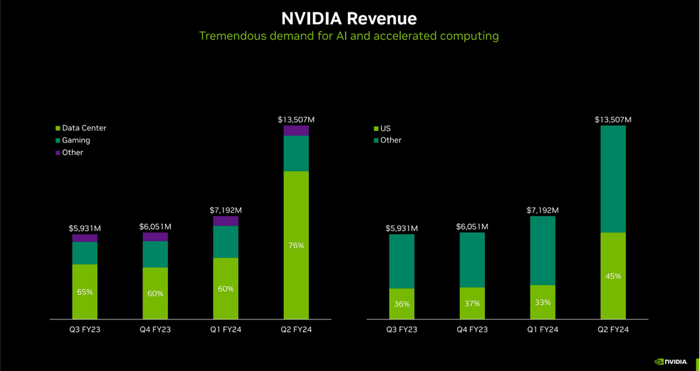
Source: Nvidia
The company's revenue rose 101% year over year last quarter to $13.5 billion on the back of 171% growth in data center sales.
What does pricing power get the company? A better operating margin than chip competitors like Advanced Micro Devices and Intel, sure, but also better than ultra-profitable tech powerhouses like Alphabet and Microsoft, as shown below. It's rare to see hardware specialists operate with wider profit margins than their software cousins, but that's where Nvidia stands today.

NVDA operating margin (quarterly) data by YCharts.
These results have investors flocking to the stock. The demand for data with the ramp-up of artificial intelligence software is projected to grow precipitously for years, benefiting Nvidia. With the share price high now and possibly going much higher, the company could decide that another stock split makes sense soon.
10 stocks we like better than Nvidia
When our analyst team has a stock tip, it can pay to listen. After all, the newsletter they have run for over a decade, Motley Fool Stock Advisor, has tripled the market.*
They just revealed what they believe are the ten best stocks for investors to buy right now... and Nvidia wasn't one of them! That's right -- they think these 10 stocks are even better buys.
*Stock Advisor returns as of October 13, 2023
Suzanne Frey, an executive at Alphabet, is a member of The Motley Fool's board of directors. John Mackey, former CEO of Whole Foods Market, an Amazon subsidiary, is a member of The Motley Fool's board of directors. Bradley Guichard has positions in Alphabet, Amazon.com, and Microsoft and has the following options: long September 2024 $630 calls on Nvidia. The Motley Fool has positions in and recommends Advanced Micro Devices, Alphabet, Amazon.com, Microsoft, Nvidia, and Tesla. The Motley Fool recommends Intel and recommends the following options: long January 2023 $57.50 calls on Intel and long January 2025 $45 calls on Intel. The Motley Fool has a disclosure policy.
