
Stock Split Watch: Is Chipotle Next?
When it comes to stocks with the potential for a stock split, Chipotle Mexican Grill (NYSE: CMG) is one that tops the list. At approximately $1,550 per share, its price potentially places whole shares out of reach for small investors. But does that mean a stock split will happen? And would a split actually boost Chipotle stock? Let's take a closer look.
Stock splits and Chipotle
Undoubtedly, Chipotle's stock price alone makes it a candidate for a stock split. Almost 8,500 stocks trade on the leading U.S. exchanges today. Of those stocks, Chipotle ranks seventh in terms of its nominal price.
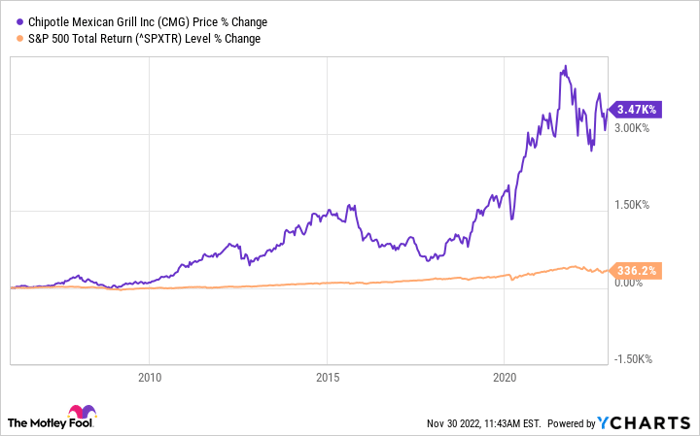
Chipotle shareholders have enjoyed a long but profitable climb to that level. The stock debuted in January 2006. After anticipating an IPO price in the $18 per share to $20 per share range, it closed at $44 per share on its first day of trading. That was just the beginning as the stock has handily outperformed the S&P 500.
However, after nearly 16 years of trading, it has never split its shares. It has also not announced any plans to initiate a split.
Why a split does not necessarily help Chipotle
Still, a stock split would change nothing for Chipotle on the surface. One share valued at $1,550 would hold the same value as 10 at $155 per share, for example.
Not all high-priced stocks split, ultimately. Berkshire Hathaway's A shares have never split despite an approximate $475,000 share price. And for every Amazon and Alphabet that has decided to split its shares, the market offers an AutoZone or Booking Holdings that has maintained its high nominal share prices.
Moreover, the high share price does not change the fact that Chipotle is poised to do just fine. Revenue for the first nine months of 2022 was $6.5 billion. That grew 16% compared with the same period in 2021.
Net income surged 30% to $675 million during the same timeframe. Despite higher inflation, Chipotle kept operating expense growth at 13%, allowing for faster earnings growth.
Furthermore, Chipotle sells for 55 times its earnings. That may seem pricey, considering the average price-to-earnings ratio of 21 for the S&P 500. Still, that multiple is near a low point last seen in the bear market of early 2020. And a split would not affect the earnings multiple as lower share prices mean a proportional reduction in earnings for each share.
How Chipotle can benefit from a split
Nonetheless, Chipotle could benefit from a split indirectly. As mentioned earlier, a lower share price might prompt more small investors to take an interest.
Indeed, investors can buy fractional shares of Chipotle. However, rules for such shares vary by broker, assuming they offer fractional shares at all. And buying such shares may involve fees that do not apply to whole shares.
Higher share prices also tend to lower liquidity. Only about 2,800 Berkshire A shares trade on an average day, well below Amazon's 74 million average daily volume. And since only about 300,000 Chipotle shares exchange hands on an average day, a lower share price would likely boost activity in the stock.
Do not count on a split
Ultimately, Chipotle's management has shown no interest in a split. Thus, interested investors should buy fractional shares or save cash to afford whole shares.
Admittedly, a stock split could boost the restaurant stock on the margins. Nonetheless, the earnings growth rates and comparatively low P/E ratio bode well for investors regardless of Chipotle's nominal stock price. Thus, investors should focus on those factors instead of the stock price.
10 stocks we like better than Chipotle Mexican Grill
When our award-winning analyst team has a stock tip, it can pay to listen. After all, the newsletter they have run for over a decade, Motley Fool Stock Advisor, has tripled the market.*
They just revealed what they believe are the ten best stocks for investors to buy right now... and Chipotle Mexican Grill wasn't one of them! That's right -- they think these 10 stocks are even better buys.
*Stock Advisor returns as of November 7, 2022
John Mackey, CEO of Whole Foods Market, an Amazon subsidiary, is a member of The Motley Fool's board of directors. Suzanne Frey, an executive at Alphabet, is a member of The Motley Fool's board of directors. Will Healy has positions in Berkshire Hathaway. The Motley Fool has positions in and recommends Alphabet, Amazon.com, Berkshire Hathaway, Booking, and Chipotle Mexican Grill. The Motley Fool recommends the following options: long January 2023 $200 calls on Berkshire Hathaway, short January 2023 $200 puts on Berkshire Hathaway, and short January 2023 $265 calls on Berkshire Hathaway. The Motley Fool has a disclosure policy.
