
Stock Split Watch: Is Amazon Next?
When a company splits its stock, it decreases the share price but increases the amount of shares in the market by the same ratio. Stock splits don't affect a company's valuation at all, as its market cap remains unchanged.
And yet, a stock split has sometimes historically catalyzed a stock higher. Why would that be, if the intrinsic value of a company remains unchanged? Well, once the price per share of a stock gets high enough, retail investors without as much investable cash to spare can become priced out. So when a company splits its stock, individual shares become more "affordable" for those without as big a portfolio.
Of course, in recent years, more and more stock brokerages have offered investors the ability to buy fractional shares. That means investors now increasingly have the ability to buy a portion of a share instead of a minimum of one. Still, many still don't have brokerage accounts with this capability, and those with older brokerage accounts may not wish to go through the hassle of transferring their portfolio to one that does.
That means some investors may still be priced out of the stock of Amazon.com (NASDAQ: AMZN), which currently goes for $3,462 per share as of this writing. But could this change in the near future?

Image source: Getty Images.
Recent history says no split is coming
To be sure, Amazon management has not given any indication whatsoever that they are thinking about splitting its stock. In addition, the company hasn't split its stock for over 20 years.
Interestingly, Amazon was an active stock-splitter shortly after it went public in May 1997. In June 1998, just one year after its IPO, Amazon split its stock 2-for-1. That was followed by a 3-for-1 split in January 1999, and another 2-for-1 split in September 1999. What spurred such a rapid progression of stock splits? In all likelihood, it was due to Amazon's skyrocketing share price during the dot-com boom of the late 1990s.
There were few to no brokerages offering fractional shares back then, and Amazon was not generating profits or much cash flow at that time. Therefore, the stock splits were likely a strategy to keep its shares affordable to retail investors and propel the company's market cap higher. Back then, Amazon was more likely to use its stock as currency for acquisitions, so keeping its market cap as high as possible was also of strategic importance.
However, we all know what happened next. Amazon, like all high-powered tech stocks at the time, underwent a severe correction in the dot-com bust, and its stock fell from over $90 per share to below $6 in just two years' time.
Amazon hasn't split its stock since. Why, might one wonder? Perhaps founder and former CEO Jeff Bezos was humbled by seeing the company's share price in the single-digits. Perhaps he decided to court more long-term, buy-and-hold investors in the image of Warren Buffett, who famously has never split Berkshire Hathaway's (NYSE: BRK.A) (NYSE: BRK.B) A-shares, as opposed to more active traders.
In any case, Amazon never split its stock again.
But a new era has begun
As we all know, Jeff Bezos officially retired as full-time CEO this year, even though he will still be on the board and play a key role in high-level decisions. Taking the helm is former AWS head Andy Jassy, who may seek somewhat of a "reset" as he begins his tenure. Whether that could mean splitting the stock is a measure of conjecture, and Bezos could veto that decision. However, a stock split is more likely than it was with Bezos as CEO.
One reason Jassy may wish to split Amazon's stock is that the stock has lagged its big-tech peers for more than a year now.
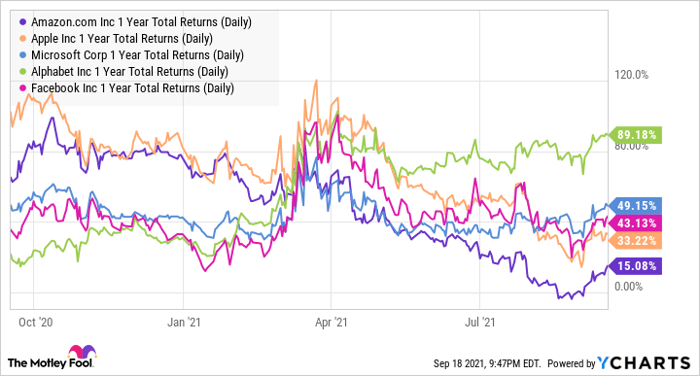
AMZN 1 Year Total Returns (Daily) data by YCharts
Could Amazon's huge price per share be the culprit? It's hard to say. Amazon did outperform in the early days of the pandemic, when nearly doubled in a short amount of time, pushing its share price over $3,000. In any case, Amazon is among the most competitive companies in the world, and I'm sure management has taken notice of the underperformance despite strong earnings results.
Other large-cap tech companies like Apple and Tesla both split their stock on August 31, 2020, and both stocks have done well since the split -- though Apple has slightly lagged the S&P 500 since that time. Another highflyer, Nvidia, also recently split its stock this year on July 20, and is up a whopping 17.7% in just a short amount of time, handily beating the market. While all three have gained, it's impossible to know if their stock splits were directly responsible.
Keep an eye out for an Amazon split, but don't count on it
It's impossible to predict the cadence of stock splits, especially after a 20-plus-year drought for a particular company. Yet a new CEO and lagging share performance could -- with an emphasis on the word could -- spark a change.
Of course, long-term-oriented investors shouldn't necessarily focus on stock splits. Over the long term, a stock will generally reflect the value of the business, no matter the price per share. After a long period of lagging big tech peers, it's also possible Amazon is primed for another run eventually, stock split or not.
10 stocks we like better than Amazon
When our award-winning analyst team has a stock tip, it can pay to listen. After all, the newsletter they have run for over a decade, Motley Fool Stock Advisor, has tripled the market.*
They just revealed what they believe are the ten best stocks for investors to buy right now... and Amazon wasn't one of them! That's right -- they think these 10 stocks are even better buys.
*Stock Advisor returns as of September 17, 2021
John Mackey, CEO of Whole Foods Market, an Amazon subsidiary, is a member of The Motley Fool's board of directors. Billy Duberstein owns shares of Amazon, Apple, and Berkshire Hathaway (B shares). His clients may own shares of the companies mentioned. The Motley Fool owns shares of and recommends Amazon, Apple, Berkshire Hathaway (B shares), Nvidia, and Tesla. The Motley Fool recommends the following options: long January 2022 $1,920 calls on Amazon, long January 2023 $200 calls on Berkshire Hathaway (B shares), long March 2023 $120 calls on Apple, short January 2022 $1,940 calls on Amazon, short January 2023 $200 puts on Berkshire Hathaway (B shares), short January 2023 $265 calls on Berkshire Hathaway (B shares), and short March 2023 $130 calls on Apple. The Motley Fool has a disclosure policy.
