
Nvidia vs. Advanced Micro Devices: Evaluating Revenue Growth Trajectories for These Artificial Intelligence Giants
Key Points
Nvidia currently displays a significantly stronger overall revenue performance, establishing a continuously higher baseline compared to Advanced Micro Devices.
Over the last eight quarters, both companies demonstrated consistent quarter-over-quarter revenue progression, although their respective growth trajectories differ substantially.
Investors should watch whether AMD can begin to narrow this widening revenue gap, or if the divergence continues in upcoming quarters.
- 10 stocks we like better than Nvidia ›
Nvidia: Tracking Extensive Revenue Expansion
Nvidia (NASDAQ:NVDA) primarily generates its revenue by designing and supplying advanced graphics, compute, and networking solutions used heavily across gaming and high-performance computing ecosystems worldwide.
It recently partnered with the Japanese government to launch a national infrastructure factory, while reporting a 72% net income margin for the quarter ended April 26, 2026.
Advanced Micro Devices: Observing Steady Revenue Progression
Advanced Micro Devices (NASDAQ:AMD) primarily earns its revenue by developing high-performance microprocessors, chipsets, and graphics processing units tailored for personal computers, gaming consoles, and server environments.
It recently launched next-generation computing portfolios and secured several large-scale infrastructure commitments, while reporting a 14% net income margin for the quarter ended March 28, 2026.
Why Revenue Matters for Retail Investors
Revenue serves as a foundational metric to help retail investors assess a company's total sales volume and scale. This metric serves as a fundamental baseline measure of overall customer demand and business growth.
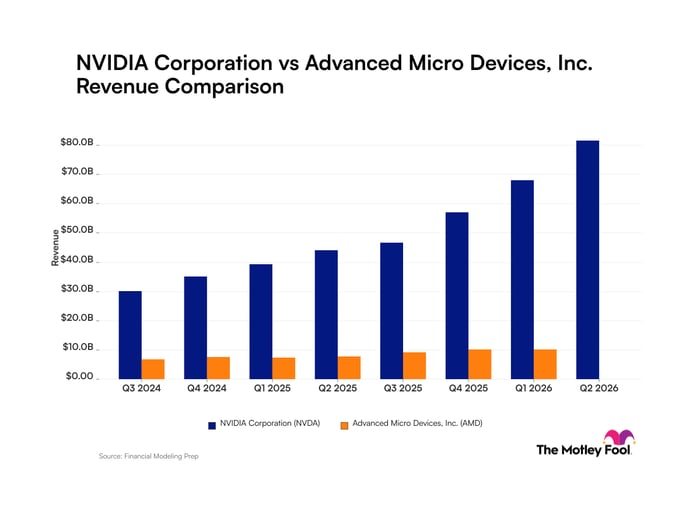
Quarterly Revenue for Nvidia and Advanced Micro Devices
| Quarter (Period End) | Nvidia Revenue | Advanced Micro Devices Revenue |
|---|---|---|
| Q3 2024 | $30.0 billion (period ended July 2024) | $6.8 billion (period ended Sept. 2024) |
| Q4 2024 | $35.1 billion (period ended Oct. 2024) | $7.7 billion (period ended Dec. 2024) |
| Q1 2025 | $39.3 billion (period ended Jan. 2025) | $7.4 billion (period ended March 2025) |
| Q2 2025 | $44.1 billion (period ended April 2025) | $7.7 billion (period ended June 2025) |
| Q3 2025 | $46.7 billion (period ended July 2025) | $9.2 billion (period ended Sept. 2025) |
| Q4 2025 | $57.0 billion (period ended Oct. 2025) | $10.3 billion (period ended Dec. 2025) |
| Q1 2026 | $68.1 billion (period ended Jan. 2026) | $10.3 billion (period ended March 2026) |
| Q2 2026 | $81.6 billion (period ended April 2026) | Not yet reported |
Data source: Company filings. Data as of July 31, 2026.
Foolish Take
Comparing revenue trends between Nvidia and Advanced Micro Devices, rivals in the semiconductor chip market serving the artificial intelligence sector, reveals insights for investors. The large discrepancy between the two demonstrates Nvidia’s dominance of the industry. With the sales gap only widening over time, AMD looks unlikely to catch up to its competitor any time soon.
In fact, while AMD has demonstrated consistent year-over-year sales growth, it’s not on the quarterly basis seen with Nvidia, an impressive accomplishment and a testament to its success in capturing customer demand. That said, AMD stock is up over 120% in 2026 through August 3, while Nvidia shares are up only about 10% in that time.
After repeatedly exceeding Wall Street expectations, Nvidia now has to deliver near-flawless execution to move the needle on its stock price. Its July 16 announcement that it was working with the Japanese government to establish the world’s first national AI infrastructure did little to impact shares.
AMD, meanwhile, is seen as harboring more upside potential. Deals such as this year’s expanded partnership with Facebook parent Meta Platforms point to this potential.
Should you buy stock in Nvidia right now?
Before you buy stock in Nvidia, consider this:
The Motley Fool Stock Advisor analyst team just identified what they believe are the 10 best stocks for investors to buy now… and Nvidia wasn’t one of them. The 10 stocks that made the cut could produce monster returns in the coming years.
Consider when Netflix made this list on December 17, 2004... if you invested $1,000 at the time of our recommendation, you’d have $386,727!* Or when Nvidia made this list on April 15, 2005... if you invested $1,000 at the time of our recommendation, you’d have $1,232,139!*
Now, it’s worth noting Stock Advisor’s total average return is 906% — a market-crushing outperformance compared to 208% for the S&P 500. Don't miss the latest top 10 list, available with Stock Advisor, and join an investing community built by individual investors for individual investors.
*Stock Advisor returns as of August 4, 2026.
Robert Izquierdo has positions in Advanced Micro Devices, Meta Platforms, and Nvidia. The Motley Fool has positions in and recommends Advanced Micro Devices, Meta Platforms, and Nvidia. The Motley Fool has a disclosure policy.
