
Netflix Threw the First Punch -- Studios Responded -- What Will Netflix Do Next?
When Netflix (NASDAQ: NFLX) pioneered the streaming industry more than a decade ago, few could have imagined its impact. Millions of households have canceled their traditional cable and satellite TV subscriptions in favor of streaming services. Over a decade, the shift has cost legacy media companies billions in lost revenue and profits.
The disrupted media companies finally said enough was enough and started launching their own streaming services. As a result, Netflix's subscriber growth has slowed and reversed into negative territory. What's more, Netflix's stock is down a whopping 71% off its high. So now it's Netflix's turn. What will the company do next?
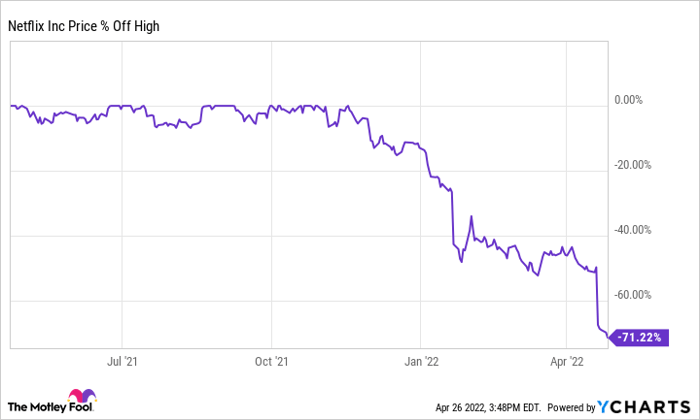
Competition is heating up for Netflix
For more than a decade, Netflix faced limited competition in the streaming content space. Amazon (NASDAQ: AMZN) offered Prime members its video service for free, but other than that, there were few notable contenders. Traditional media companies were hesitant to enter the fray because they feared it would cannibalize revenue from their lucrative cable TV business. For instance, The Walt Disney Company's (NYSE: DIS) segment, which included its cable channels, generated $21.9 billion in revenue in fiscal 2018 and $7.3 billion in operating income. Understandably, it would want to sustain that profitable business for as long as possible.
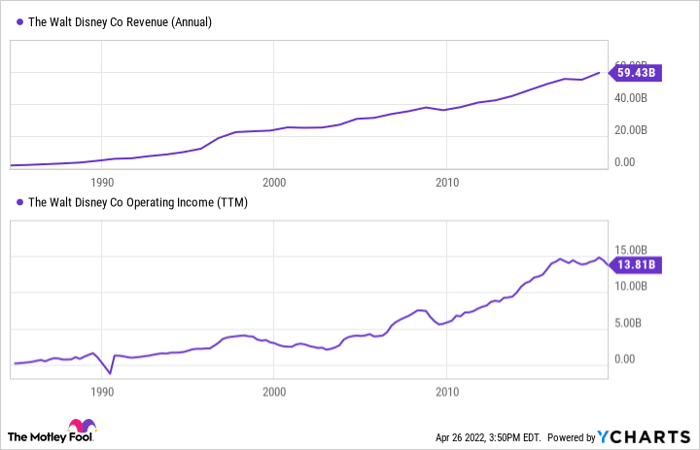
DIS Revenue (Annual) data by YCharts
Nevertheless, in late 2019, Disney had enough of Netflix's unrivaled subscriber growth and launched its flagship service Disney+. The House of Mouse's Disney+ has grown to reach 130 million subscribers but has yet to generate a profit. Several media companies followed Disney's path, and all of a sudden, Netflix faced stiff competition.
In its most recent quarter ended March 31, Netflix reported subscriber losses of 200,000. It was the first time it had not added subs in a quarter in over 10 years. Further, it informed investors to expect the pain will continue in the second quarter when it will lose an estimated 2 million more.

Image source: Getty Images.
How will Netflix respond?
So Netflix threw the first punch disrupting media companies' lucrative source of revenue and profits. The disrupted punched back. Now Netflix, arguably, has to make a move to respond to the encroachment on its business. After all, its stock is getting hammered by the slowing subscriber and revenue figures. One move available to Netflix could be releasing select films on the big screen.
Currently, Netflix releases all films straight to its streaming service, bypassing the big screen completely. That leaves the box office and its billions in revenue open to its competitors, generating revenue and profits that are used against Netflix in the streaming service battle. If nothing else, Netflix's decision to release films in theaters could capture some of the revenue that would otherwise go to rivals. In that way, any revenue Netflix captures from the box office has a double benefit.
Other moves could include further boosting its content budget and undercutting competitors on pricing. However, lowering subscription pricing and increasing content budgets would work to lower revenue and cash flow for Netflix in the short run and perhaps even the long run depending on how competitors respond.
For that reason, investors may prefer Netflix to release films in theaters as a competitive response. It takes sales away from rivals and could have a more direct and positive effect on Netflix's revenue and cash flow.
Admittedly, fierce competition, especially when billions of dollars are at stake, is typically a complex scenario with many smart individuals taking part in the decision-making. Netflix may ultimately decide to do something few could have imagined, or make a noncompetitive response in an effort to de-escalate the rivalries. Regardless, investors should stay tuned.
10 stocks we like better than Netflix
When our award-winning analyst team has a stock tip, it can pay to listen. After all, the newsletter they have run for over a decade, Motley Fool Stock Advisor, has tripled the market.*
They just revealed what they believe are the ten best stocks for investors to buy right now... and Netflix wasn't one of them! That's right -- they think these 10 stocks are even better buys.
*Stock Advisor returns as of April 7, 2022
John Mackey, CEO of Whole Foods Market, an Amazon subsidiary, is a member of The Motley Fool's board of directors. Parkev Tatevosian owns Amazon, Netflix, and Walt Disney. The Motley Fool owns and recommends Amazon, Netflix, and Walt Disney. The Motley Fool recommends the following options: long January 2024 $145 calls on Walt Disney and short January 2024 $155 calls on Walt Disney. The Motley Fool has a disclosure policy.
