
Is Kinder Morgan a Millionaire-Maker Stock?
If you are looking at Kinder Morgan (NYSE: KMI) for the first time, the stock might appear fairly attractive based on its current metrics. You might even think you've found a millionaire-maker stock, as it offers a 4.6% dividend yield, several years' worth of annual dividend increases, and a $5.2 billion backlog of growth investments to exploit.
The problem comes when you look a little further back in the midstream giant's history. Here's why long-term investors will want to tread with caution as they examine Kinder Morgan in hopes of finding an investment that could help make them a millionaire.
Getting to millionaire status requires buying consistent performers
As you look to build a seven-figure portfolio, you can try to bet the house on one or two stocks, but a much better approach is to build a diversified portfolio of good companies that are all performing. Over time you can benefit from the business growth they achieve and, if you reinvest your dividends, you can compound the benefit of owning dividend payers.
This is why investors looking for energy sector exposure might be interested in owning Kinder Morgan and its lofty 4.6% yield. The average energy stock yields just 3.4% today, using the Energy Select Sector SPDR ETF as an industry proxy.

Image source: Getty Images.
Wall Street tends to be forward-looking, which is appropriate, but that doesn't mean investors should forget the past, either. Indeed, as you look at Kinder Morgan today it may appear attractive. It seems like it could be a great addition if you are looking for an energy stock to add some diversification to your portfolio.
But there's a small problem here. Investors who take the past into consideration will see that Kinder Morgan hasn't been a reliable business.
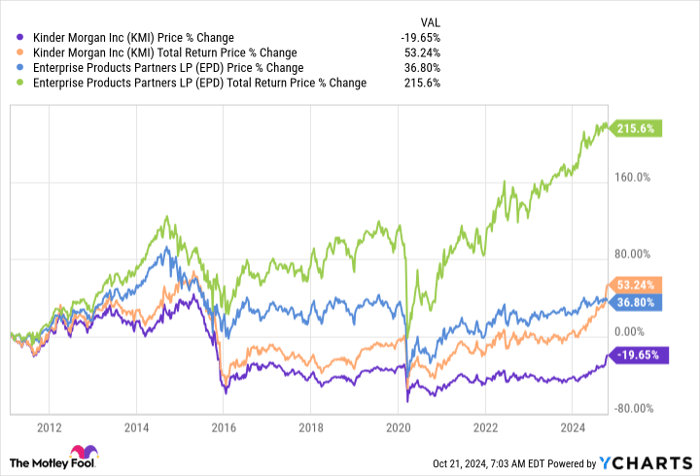
The chart above highlights Kinder Morgan's stock performance and its total return (which assumes the reinvestment of dividends) since its 2011 IPO versus peer Enterprise Products Partners (NYSE: EPD). Notice how much better investors have done with Enterprise over time. There's one very big difference between these two midstream giants.
Enterprise has increased its dividend every year for 26 consecutive years. Kinder Morgan cut its dividend in 2016 and it still isn't back to its pre-cut levels. And neither is Kinder Morgan's stock price.
What went wrong at Kinder Morgan
Kinder Morgan's decision to cut its dividend in 2016 was the right move for the company. And it was the right move for the company to slow down its dividend growth in 2020. So, from a business perspective, Kinder Morgan didn't really do anything wrong.
The problem is that Kinder Morgan was telling investors that it was going to raise its dividend by as much as 10% in 2016. In fact, it was telling them that as late as Oct. 21, 2015. The dividend cut was announced on Dec. 8, 2015. Dividend investors who took management at its word would have been sideswiped by the outcome here.
In an effort to woo investors back to the stock, Kinder Morgan laid out an aggressive plan for dividend growth that included a 25% dividend hike in 2020. That move would have brought the dividend up to $1.25 per share per year. The coronavirus pandemic upended that plan, but, even now that the world has gotten used to dealing with COVID-19, the dividend still isn't up to the promised $1.25-per-year target. And, notably, the stock price remains well below where it was prior to the 2016 dividend cut.

It is important to repeat that Kinder Morgan has done what's right for its business. The problem is that it has made bold promises and fallen short, with dividend investors taking the hit each time. Trusting a company that hasn't lived up to its promises probably isn't the best way to build a millionaire-size portfolio no matter how well-positioned the stock may look right now.
Buyer beware with Kinder Morgan
If you are looking to build a reliable portfolio filled with high yields you can compound via dividend reinvestment, you will probably want to look at alternatives to Kinder Morgan. One attractive option is peer Enterprise Products Partners, which yields around 7.2% right now. But the real story here is that history suggests you can't trust Kinder Morgan to live up to its promises, and that appears to have had a very big impact on its stock price.
Don’t miss this second chance at a potentially lucrative opportunity
Ever feel like you missed the boat in buying the most successful stocks? Then you’ll want to hear this.
On rare occasions, our expert team of analysts issues a “Double Down” stock recommendation for companies that they think are about to pop. If you’re worried you’ve already missed your chance to invest, now is the best time to buy before it’s too late. And the numbers speak for themselves:
- Amazon: if you invested $1,000 when we doubled down in 2010, you’d have $21,365!*
- Apple: if you invested $1,000 when we doubled down in 2008, you’d have $44,619!*
- Netflix: if you invested $1,000 when we doubled down in 2004, you’d have $412,148!*
Right now, we’re issuing “Double Down” alerts for three incredible companies, and there may not be another chance like this anytime soon.
*Stock Advisor returns as of October 21, 2024
Reuben Gregg Brewer has no position in any of the stocks mentioned. The Motley Fool has positions in and recommends Kinder Morgan. The Motley Fool recommends Enterprise Products Partners. The Motley Fool has a disclosure policy.
