
Is Roku a Safe Stock?
Roku (NASDAQ: ROKU) is generally seen as a high-octane growth stock. In many ways, this is a value investor's worst nightmare.
The media-streaming technology expert's stock skyrocketed as much as 723% higher during the COVID-19 lockdown phase. That surge was followed by an equally dramatic plunge, and Roku currently trades 90% below last year's all-time highs.
Roku isn't always profitable, but when it is, shares are changing hands at nosebleed-inducing price-to-earnings (P/E) ratios. Even its price-to-sales (P/S) ratio often sits in double-digit territory -- a rare feat that long-term growth phenomenons like Netflix (NASDAQ: NFLX) only rarely reached and Apple (NASDAQ: AAPL) never did:
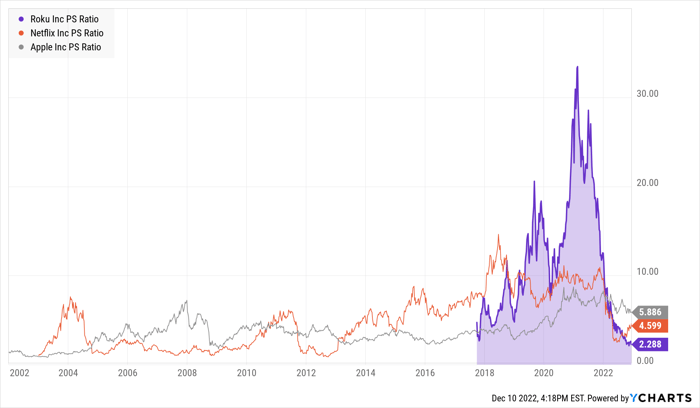
ROKU PS Ratio data by YCharts
Yet, I keep telling you that Roku is one of the best stocks to buy today, and it's not unusual to see more Roku shares added to my own brokerage accounts.
What gives? If Roku stock really is a great buy today, why does the stock chart look like one of those hypermodern roller coasters that sometimes send you straight down?
Is Roku really a safe stock to buy and hold right now?
Why is Roku so cheap right now?
Let's look at why Roku's shares have fallen so hard in recent months.
Disappointing financial results are certainly part of the story. Roku has missed three of Wall Street's consensus revenue estimates in the last five quarters, along with a miss and one in-line earnings result in the same period. For a company that tends to beat analyst targets by double-digit percentages on the top line and triple-digits on the bottom line, that counts as a dark age.
Roku arrived in this unpleasant position due to macroeconomic pressures. In last month's third-quarterearnings call CEO Anthony Wood boiled it down to three key issues:
"Advertisers pulled back on spending, consumers were further pressured by inflation and overall economic uncertainty remained high," Wood said. "We expect these conditions will continue and are likely to worsen in Q4."
The company is taking action to address the challenging industry environment. Roku has halted a multi-year hiring spree and actually cut 200 jobs in recent months, aiming to slow down the growth of its ongoing operating expenses. But it's easy to see the job cuts as a sign of weakness, so that announcement didn't lift Roku's stock price at all.
We've seen this movie before
The thing is, Roku is one of those companies that lay out their business plan for all to see, and then people misunderstand them anyway.
The same thing has happened to Netflix many times, such as when the shift from DVD mailers to digital video streams was seen as a consumer-unfriendly cash grab. Netflix's stock is up more than 3,000% since executing that genius strategy shift (in an admittedly clumsy way).
Apple isn't immune to this effect, either. Remember when iPhone sales dipped in 2016, triggering a 13% share price drop over the next two weeks? The wheels were surely coming off Apple's cash machine right there. Or maybe not. The huge price cut is just a forgettable blip on Apple's stock chart in retrospect, and share prices have soared more than 500% higher after that speed bump.
Roku stands at a similar crossroads today.
The media-streaming sector is still in its infancy. Linear TV services continue to own the airwaves and eyeball hours around the world, and streaming services have a lot of work left to take over that industry. Roku is one of the most obvious winners in that long-term revolution, as a service-agnostic provider of user-friendly streaming platforms.
And when you place Roku in the context of the current macroeconomic struggles, the company already looks like a winner. Roku is adding new users hand over fist, the top-line growth may have slowed down but Roku's sales are still soaring, and it seems obvious that this platform is winning market share amid the crisis of shrinking digital advertising budgets.
I'm serious. Platform revenues, which include the company's ad-based operations, saw 15% year-over-year growth in the third quarter. However, at the same time, the scatter ad market (on-the-spot ad sales rather than long-term marketing campaigns) saw a 38% downtick in total sales:
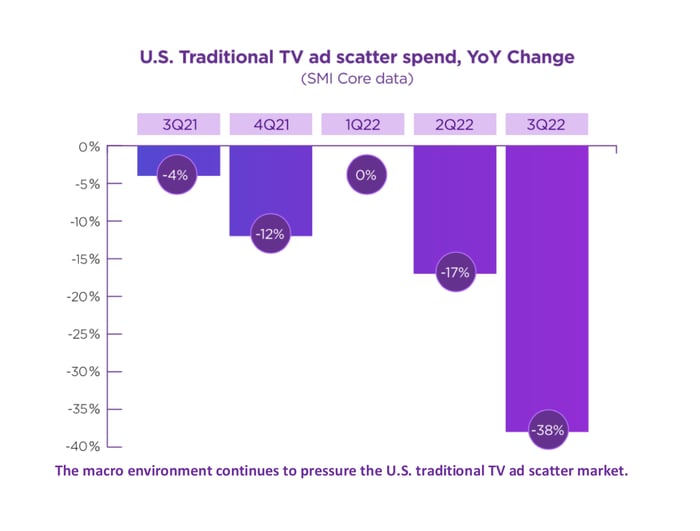
Image source: Roku SEC filings.
We are looking at a leader in its industry, aiming for massive long-term growth and delivering robust results along the way. But the stock is priced as if Roku's entire business were running into a brick wall, with a P/S ratio all the way down to 2.3. So I can forgive Roku's stock for being volatile and I don't mind the occasional slowdown during an era of historically significant economic challenges.
So yes, I truly believe that Roku is a safe stock to buy now and hold for a long time. Ten years from now, I think we'll look back at this year's brutal dip in Roku's stock chart as a temporary buying opportunity, much like the Qwikster dip was for Netflix in 2011. I bought more Netflix stock that year and I'm buying more Roku stock in 2022.
And I highly recommend that you do the same. You can come back and thank me in 2032.
10 stocks we like even better than Roku
When our award-winning analyst team has a stock tip, it can pay to listen. After all, the newsletter they have run for over a decade, Motley Fool Stock Advisor, has tripled the market.*
They just revealed what they believe are the ten best stocks for investors to buy right now... and Roku wasn't one of them! That's right -- they think these 10 stocks are even better buys.
*Stock Advisor returns as of December 1, 2022
Anders Bylund has positions in Netflix and Roku. The Motley Fool has positions in and recommends Apple, Netflix, and Roku. The Motley Fool recommends the following options: long March 2023 $120 calls on Apple and short March 2023 $130 calls on Apple. The Motley Fool has a disclosure policy.
