
Is Nvidia Stock Too Expensive?
Nvidia (NASDAQ: NVDA) share prices reached an all-time (split-adjusted) high of $346 in November after reporting another blockbuster quarter of earnings. But the expectation that the Federal Reserve will raise benchmark interest rates several times in 2022 has put some downward pressure on the high valuations of many growth and tech stocks.
Even after Nvidia's 36% share price trim, it still trades at a lofty price-to-earnings ratio of 70. But regardless of where interest rates go in the near term, Nvidia's valuation can be justified by the robust demand it is experiencing. In its fiscal 2022 third quarter (which ended Oct. 31), the graphics processing unit (GPU) specialist reported adjusted earnings growth of 60% year over year, driven by gains across its data center and gaming segments.

Image source: Getty Images.
However, what's most important is the long-term sustainability of Nvidia's growth. The continued expansion of the data center industry will be key to that, since it's the company's fastest-growing and highest-margin business. The good news is that there is plenty of evidence that points to several years of growth ahead for this segment, though there could be bumps along the way.
Opportunities and risks
When it comes to high-powered graphics processors, Nvidia is a supplier of choice for the leading cloud computing providers, which need that hardware to give their data centers the processing power they require. Demand on that front has fueled rapid growth for Nvidia over the last four years. Through the first nine months of its fiscal 2022, data center revenue rose 53% year over year, and is on pace to overtake gaming as the company's largest revenue source in the not-too-distant future.
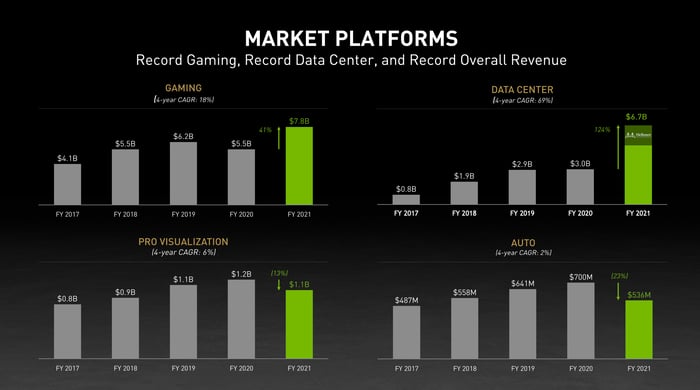
Image source: Nvidia.
Sales growth for that segment is showing no signs of slowing, but its recent growth streak has not been smooth. In Nvidia's fiscal 2020 Q1, which ended April 28, 2019, total revenue dropped 31% year over year due to a slowdown in spending by enterprise and hyperscale customers (i.e., large tech companies that own and operate data centers).
During that tumultuous year for Nvidia, management continued to emphasize the massive opportunity it saw to sell more GPUs to cloud providers to power natural language processing, photo enhancements, and artificial intelligence systems, which require tremendous processing power. These areas are still driving Nvidia's growth, but investors should note that sometimes there are periods when capital spending for these advanced computing systems can slow. That's one reason to be cautious when Nvidia shares trade at a relatively high valuation.
However, these near-term blips shouldn't scare investors away from buying during those inevitable dips in the stock price. Nvidia can grow for a long time based on the continued build-out of data center capacity that will be needed to process and store all the data the world is consuming.
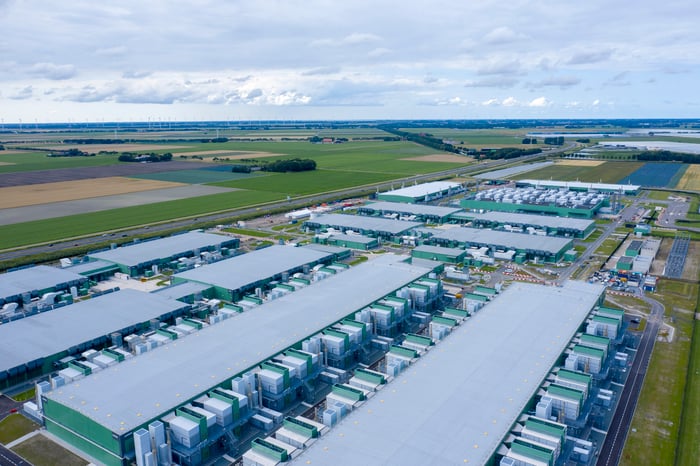
Image source: Getty Images.
Watch big tech's next move
The leading cloud providers are still planning to spend billions of dollars annually to build more high-tech infrastructure, which is an indicator of future demand for Nvidia's data center computing systems.
Microsoft previously said it was planning to build 50 to 100 new data centers every year "for the foreseeable future." The software giant has over 60 data center regions around the world and added 15 new regions in its fiscal 2021 (which ended June 30).
Meanwhile, Facebook parent Meta Platforms said during its third-quarterearnings callthat it will increase spending on servers, data centers, and network infrastructure by at least 52% in 2022 to $29 billion.
In fact, Nvidia just announced that Meta will use 16,000 A100 GPUs to power its new artificial intelligence supercomputer. Nvidia said that project is expected to be "the largest customer installation of Nvidia DGX A100 systems" to date.
This dovetails with a report from Synergy Research that shows data center capacity continuing to grow at a good clip. In a November press release, Synergy stated, "We also see a very healthy pipeline of hyperscale data centers being planned, developed or fitted out, supporting our strong five-year growth forecasts."
Buy Nvidia on the dip
The fundamental trend driving Nvidia's revenue growth is the increasing consumption of data. The amount of data created, captured, copied, and consumed worldwide is growing at a fast rate. It's expected to reach well over 100 zettabytes in the next decade, according to Statista. That's up from 2 zettabytes in 2010. (To put this in more familiar terms, 1 zettabyte is equal to 1 trillion gigabytes.)
Given all that, buying Nvidia during market dips might not be a bad idea. There could be more bumps in the road, but Nvidia has the capacity to keep growing its data center revenue for years. Even its $346 high share price from November could look like a bargain a decade from now.
10 stocks we like better than Nvidia
When our award-winning analyst team has a stock tip, it can pay to listen. After all, the newsletter they have run for over a decade, Motley Fool Stock Advisor, has tripled the market.*
They just revealed what they believe are the ten best stocks for investors to buy right now... and Nvidia wasn't one of them! That's right -- they think these 10 stocks are even better buys.
*Stock Advisor returns as of January 10, 2022
Teresa Kersten, an employee of LinkedIn, a Microsoft subsidiary, is a member of The Motley Fool's board of directors. Randi Zuckerberg, a former director of market development and spokeswoman for Facebook and sister to Meta Platforms CEO Mark Zuckerberg, is a member of The Motley Fool's board of directors. John Ballard owns Microsoft. The Motley Fool owns and recommends Meta Platforms, Inc., Microsoft, and Nvidia. The Motley Fool has a disclosure policy.
