
Is Netflix Stock Undervalued?
Netflix's (NASDAQ: NFLX) fall from grace as an investment has been incredible. After nearly closing at $700 last November, Netflix shares are down 75% from their all-time high.
That's a dramatic fall, but is it warranted? Also, is the stock undervalued? Let's dive in and see if an investment in Netflix is worth your money.
What caused the fall?
Back in November 2021, the hype of pandemic-driven stocks reached its peak. As the world opened up, these stocks lost their appeal. Most high-flyers were overvalued then, so their shares sold off hard in response.
To make matters worse, rising inflation triggered the Federal Reserve to raise interest rates. This move further diminished the market's appetite for risk, hammering growth stocks like Netflix.
To top things off, Netflix fell from the ranks of growth companies. In its first-quarter results, Netflix revealed it had lost paying subscribers in every region except for Latin America, for a total loss of 200,000 subscribers. Making matters worse, Netflix projected it would lose a whopping 2 million subscribers in Q2.
These factors, combined with a growing competitive landscape, created the perfect storm to sink Netflix's stock.
However, is there value among the wreckage?
Is Netflix undervalued?
While once a high-flyer, Netflix's stock has reached a price-to-earnings (P/E) ratio that at a little more than 16 is cheaper than the broader market.
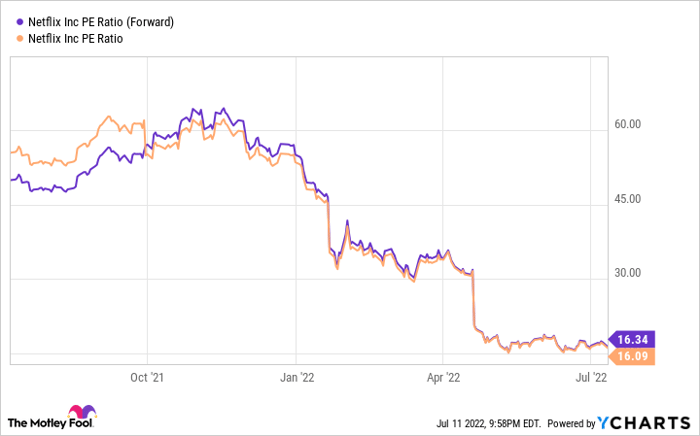
NFLX PE Ratio (Forward) data by YCharts.
For comparison, the average P/E of companies in the S&P 500 is about 19.5. This chart displays projected forward earnings (which would factor in the earnings drop from future subscriber loss) and trailing earnings, meaning Wall Street analysts aren't expecting too much of an earnings impact.
This sentiment echoes Netflix's projections, as it is still forecasting mid- to high-single-digit revenue growth with a 19% to 20% full-year operating margin. This operating margin is roughly the same as as in 2021, so Netflix is shrugging off any revenue lost from a falling subscriber count.
What's next for Netflix?
Netflix is rolling out two new ways to increase its revenue.
First, Netflix plans to launch an ad-supported tier. While this was initially thought to be a multiyear process, the bleeding of subscribers accelerated this project timeline to the end of this year. With a cheaper, ad-supported tier, Netflix hopes to win back some of the customers it lost, although this revenue stream won't completely replace the revenue stream of a full tier subscription. This cheaper offering will also resonate worldwide, as consumers are more cash-strapped in markets outside the U.S.
While the first idea didn't upset anyone, Netflix's second idea did. Netflix wants to crack down on password sharing. At first, the company was alright with this because it widened its reach. Now the company believes it's time to monetize these extra households, which it estimates to be more than 100 million versus the 222 million paid memberships. Even if half of these 100 million freeloaders sign up for a cheaper tier, Netflix's revenue will be significantly boosted. Netflix has already been running trials of this program in a few Latin American countries but will eventually roll this out to global markets.

Image source: Getty Images.
Netflix's path forward is relatively simple (although hard to achieve): Stop the customer bleeding and find a way to generate more revenue through an ad tier and password sharing. Balancing these three tasks is by no means easy but achievable. Netflix's rocket-ship growth days are likely behind it, but the company still believes it can achieve long-term double-digit growth.
At a little more than 16 times earnings, you can purchase Netflix's stock cheaper than staples like Home Depot (18 times earnings) or Coca-Cola (26 times earnings). While Netflix's turnaround will be complex, it's hard to ignore a value like this.
Netflix is in prime shape to deliver steady growth. Although it has some short-term headwinds blowing against it, Netflix shareholders can still maintain a positive outlook due to its undervalued status.
10 stocks we like better than Netflix
When our award-winning analyst team has a stock tip, it can pay to listen. After all, the newsletter they have run for over a decade, Motley Fool Stock Advisor, has tripled the market.*
They just revealed what they believe are the ten best stocks for investors to buy right now... and Netflix wasn't one of them! That's right -- they think these 10 stocks are even better buys.
*Stock Advisor returns as of June 2, 2022
Keithen Drury has positions in Home Depot. The Motley Fool has positions in and recommends Home Depot and Netflix. The Motley Fool recommends the following options: long January 2024 $47.50 calls on Coca-Cola. The Motley Fool has a disclosure policy.
