
Is Micron Too Cheap to Ignore?
The market has beaten down the semiconductor sector over the past several months, as supply chain issues strain the industry's ability to keep up with demand. With shares of the top semiconductor players undervalued, here's why Micron Technology (NASDAQ: MU) may be too cheap to ignore.
Micron makes memory chips – DRAM and NAND flash memory to be specific. These are the chips that store data in various ways, allowing computers to juggle the complex processing tasks that are handled by the "smarter" chips that actually do the computations necessary to make computers and servers run.
While Micron trails its competitors Samsung (OTC: SSNLF) and SK Hynix (OTC: HXSCL) in terms of market share, it has positioned itself as a top brand in terms of quality. Based on data from TrendForce, Micron's DRAM market share was 22.9% in Q4 2021. That's just behind the 27.2% of SK Hynix, and roughly half the 44% of market leader Samsung. Micron's DRAM chips use roughly 20% less energy than competitor chips, which gives Micron a small boost in pricing power, but more importantly makes the company's chips more environmentally friendlys. Consumers' growing push for sustainability could give Micron an additional edge in terms of market share.
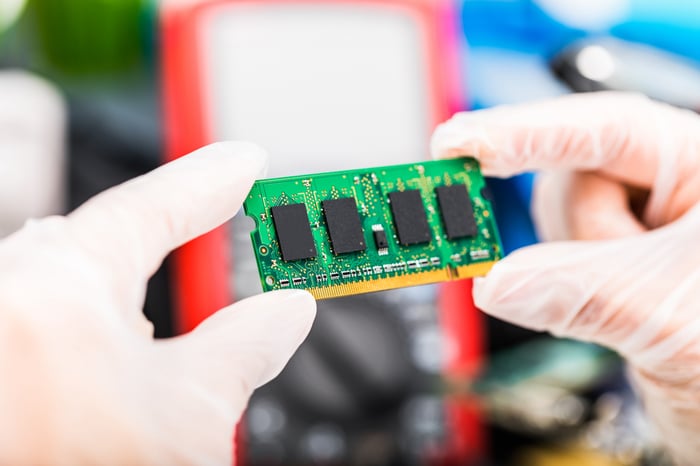
Image source: Getty Images.
Micron's current financial picture
In the second fiscal quarter of 2022 Micron derived 73% of its revenue from DRAM chips and 25% from NAND chips. Those two segments also saw year-over-year revenue increases of 29% and 19%, respectively.
Micron should benefit long-term from the increased need for memory in smartphones and computers, as well as growing demand from automakers, data centers, 5G infrastructure, and artificial intelligence applications. To highlight that growth, global consulting firm McKinsey recently released a report which projects a $1 trillion valuation for the semiconductor industry by 2030, up from $600 billion in 2021.
Micron is taking several steps to capitalize on this growth, starting with a stronger focus on memory and storage innovations for the data center market. While PC sales have been slowing, demand from data centers has been growing strongly, and that growth is expected to continue as trends like cloud computing and artificial intelligence strengthen. In March, Micron announced the world's first vertically integrated 176-layer NAND solid-state drive (SSD) for the data center. These data centers need to transmit information with as little delay, or latency, as possible. With latencies of under 2ms – 50 times faster than the blink of an eye – these SSDs further position Micron as a leader in data center memory.
In an interview with Barron's, Sumit Sadana, Micron's chief business officer and acting CFO, said Micron's largest opportunity comes from the automotive sector, with electric vehicles already using up to 15 times more memory chips than gas-powered cars. Sadana said the growing shift to EVs will provide "an incredibly powerful tailwind for years to come."
Micron's future potential
Unfortunately, many investors see memory chips as a commodity -- tech's version of soybeans and live hogs. This means Micron shares trade at low P/E and P/S ratios compared with the broader semiconductor industry –- a potentially shortsighted view.
Because markets are always forward-looking, Micron looks cheaper than its peers in the semiconductor industry, despite its strong growth prospects in the coming five to 10 years. As of May 3, Micron shares have a forward P/E for 2023 around 6. Compare that with Advanced Micro Devices (NASDAQ: AMD) around 22 or Nvidia (NASDAQ: NVDA) near 34, and Micron looks quite favorable longer-term.
Micron also matches up well with Nvidia and AMD in terms of its financials. It's got nearly double AMD's revenues, but its market cap is half that of AMD and less than one-fifth of Nvidia's. Micron's net margins are significantly better than AMD's, and compare favorably with Nvidia's.
Micron will host an Investor Day on May 12, 2022, to further discuss its plans and strategies. When you consider the company's strong growth prospects, technological lead, and healthy financials, its shares may be more affordable than they look.
10 stocks we like better than Micron Technology
When our award-winning analyst team has a stock tip, it can pay to listen. After all, the newsletter they have run for over a decade, Motley Fool Stock Advisor, has tripled the market.*
They just revealed what they believe are the ten best stocks for investors to buy right now... and Micron Technology wasn't one of them! That's right -- they think these 10 stocks are even better buys.
*Stock Advisor returns as of April 7, 2022
Fool contributor Steven Walters owns shares of Advanced Micro Devices and Nvidia. The Motley Fool has positions in and recommends Advanced Micro Devices and Nvidia. The Motley Fool has a disclosure policy.
