
Is Amazon Stock Recession-Proof?
Amazon's (NASDAQ: AMZN) accomplishments in retailing and cloud computing have made it one of the most successful consumer discretionary stocks in history. At a market cap approaching $1.6 trillion, it lags behind only Apple (NASDAQ: AAPL) and Microsoft (NASDAQ: MSFT) in this financial measure.
Of course, the economy has changed significantly since the COVID-19 pandemic began. The mass shutdowns led to a 33% contraction in the gross domestic product in the second quarter. Such downturns often lead to a significant loss in business for retailers such as Amazon.
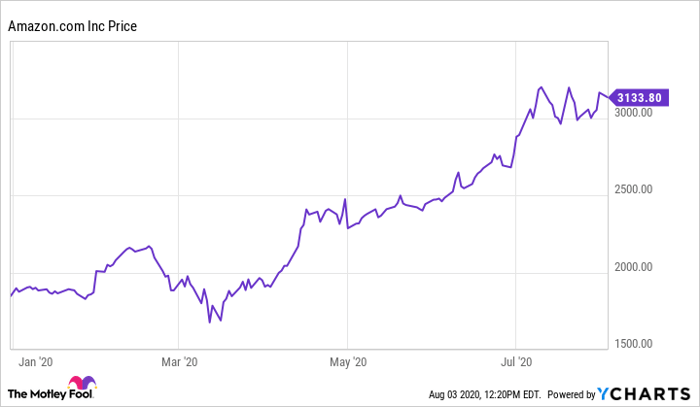
Nonetheless, Amazon stock continues to log new record highs. Amazon may offer some measure of recession resistance. Still, examining whether one should call the company "recession-proof" involves looking at how much influence the pandemic has actually wielded over the company's performance.
Amazon's retail business
Amazon has become best-known to consumers for pioneering and then domineering the e-commerce front. At one point, Amazon stoked fears of a "retail takeover," and companies such as Walmart (NYSE: WMT) and Costco (NASDAQ: COST) suffered for a time. Although these two companies and other large retailers have found ways to stay competitive, Amazon remains influential.
In the second quarter, Amazon brought in domestic and international net sales of more than $78.1 billion combined. That is an increase of nearly 42% year over year. It is also more than double the growth rate reported in the second quarter of 2019.
Admittedly, the pandemic likely played a significant role in this sales increase. Since fear of COVID-19 has led to fewer outings for most people, Amazon has become a natural destination for shoppers staying home. On theearnings call CFO Brian Olsavsky cited "strong early demand" for consumables to explain the increase. Olsavsky also singled out online grocery sales, which tripled year over year.

Image source: Getty Images
Amazon Web Services and the current economy
Still, for all of the focus on retail, Amazon Web Services (AWS) is arguably the jewel of the company. Amazon led the way in cloud computing when it started AWS in 2006. The cloud spawned a new niche sector in the technology industry.
This has helped Amazon maintain its market lead. According to Canalys, Amazon accounted for more than 32% of cloud infrastructure spending in 2019. This is nearly double the market share of its largest competitor in this space, Microsoft Azure.
AWS has long made up the majority of the company's profits. The operating income of AWS in the second quarter -- just under $3.36 billion -- was about 57% of the operating income earned by the company overall. Second-quarter net sales of just over $10.8 billion only make up a small fraction of the retail net sales figures. Nonetheless, this is an increase of almost 29% from year-ago levels.
COVID-19 also appears to have hastened growth. As more workers leave the office in favor of safer work-from-home options, cloud computing has only become more essential amid the pandemic.
Is Amazon recession-proof or just pandemic-proof?
Indeed, Amazon should have a profitable future. However, much of its current growth relates to the nature of the coronavirus downturn rather than the recession it has sparked. On the retail side, a recession unrelated to a pandemic would not have necessarily driven more shoppers online. Moreover, it likely would not have shifted more work to the cloud.
For these reasons, the next recession has the definite potential to affect Amazon negatively. But keep in mind that, despite the severity of this downturn, a 33% reduction in GDP means that 67% of the economic activity remains.
On the retail side, Amazon sells the consumer staples that will remain in demand regardless of the overall economy. Also, since AWS provides infrastructure services, it will remain the backbone of parts of the tech industry in both good times and bad.
In the end, the company should remain recession-proof long term. Nonetheless, investors should probably temper performance expectations in future downturns.
10 stocks we like better than Amazon
When investing geniuses David and Tom Gardner have a stock tip, it can pay to listen. After all, the newsletter they have run for over a decade, Motley Fool Stock Advisor, has tripled the market.*
David and Tom just revealed what they believe are the ten best stocks for investors to buy right now... and Amazon wasn't one of them! That's right -- they think these 10 stocks are even better buys.
*Stock Advisor returns as of June 2, 2020
John Mackey, CEO of Whole Foods Market, an Amazon subsidiary, is a member of The Motley Fool's board of directors. Teresa Kersten, an employee of LinkedIn, a Microsoft subsidiary, is a member of The Motley Fool's board of directors. Will Healy has no position in any of the stocks mentioned. The Motley Fool owns shares of and recommends Amazon, Apple, and Microsoft. The Motley Fool recommends Costco Wholesale and recommends the following options: long January 2022 $1920 calls on Amazon, short January 2022 $1940 calls on Amazon, long January 2021 $85 calls on Microsoft, and short January 2021 $115 calls on Microsoft. The Motley Fool has a disclosure policy.
