The Instrument of Truth: How Volatility Reveals Market Reality
Make Friends & Make Things with Friends
Apologies for the aphorism, but this one has captured my attention for longer than Killers of the Flower Moon (runtime 206 minutes). I typically recoil at these clever sayings masquerading as timeless truth. I associate them with tacky wall décor and toxic positivity.
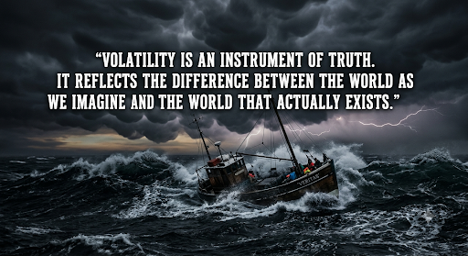
Maybe ”everything happens for a reason”…but I doubt it. In my view, volatility is the great equalizer. As Chris Cole, while at Artemis Capital, put it years ago, “Volatility is no different in markets than it is in life. Volatility is an instrument of truth. Regardless of how it’s measured, it reflects the difference between the world as we imagine it to be and the world that actually exists.”
Source: Gemini
Sticky
The idea of making friends and making things with friends has stuck with me for a couple of reasons. Jake Nickell, founder of Threadless, explained his approach to business in those terms. In the podcast I listened to, he went on to explain that path in more concrete terms.
Initially, my mind went to my nearly 12-year-old son. He’s starting middle school at the end of the month. The teenage years are a potential inflection point for decision making (risk taking). One’s friend group will have outsized influence on the type of trouble that could be encountered.
To be clear, I want my child to understand that we’re surrounded by risk. Success in life is often tethered to your ability to assess, manage, and learn from uncertainty. Developing and refining a positive feedback loop is key.
Middle school aged kids (boys in particular) think about risk very differently than professional options users, but the influence clearly extends to more developed domains. In considering my professional career, it’s abundantly clear how influential some colleagues have been on my continued development.
Options
Optionality also surrounds us in everyday life. There’s an abundance of choice as to how we spend our finite time and resources. We’re all going to “expire” at some point. (Assuming Peter Thiel, Bryan Johnson, and others’ efforts may only extend lifespans).
In that framework, time (duration) becomes the unknown variable. In derivative markets, duration is known, but volatility is “implied” and changes dynamically.
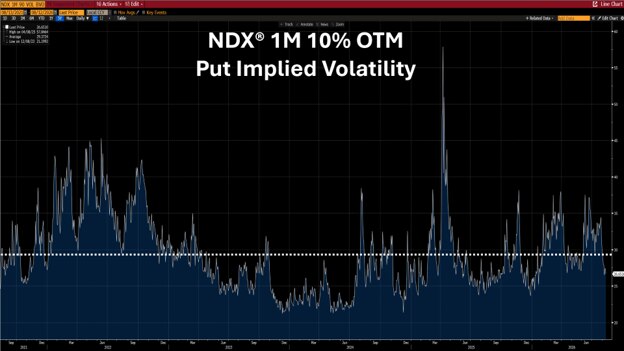
Nasdaq-100 Index® (NDX®) implied volatility has been declining consistently since July 29 when the NDX found support. What’s potentially most notable is how much cheaper 1-month downside (protection) has become over the past two weeks.
In volatility terms, the 10% out-of-the-money (OTM) options moved from 34.5% IV to 26.7% IV. It’s the lowest implied volatility for 10% OTM puts since late January of this year. The average implied volatility for those options on both a 1 and 5-year lookback is 29.5%.
Source: Bloomberg
Could the IV for 10% downside cheapen?
Yes, of course, but there’s arguably more risk in selling that exposure than owning it – all else equal. On a relative value basis, the decline in NDX downside is also intriguing.
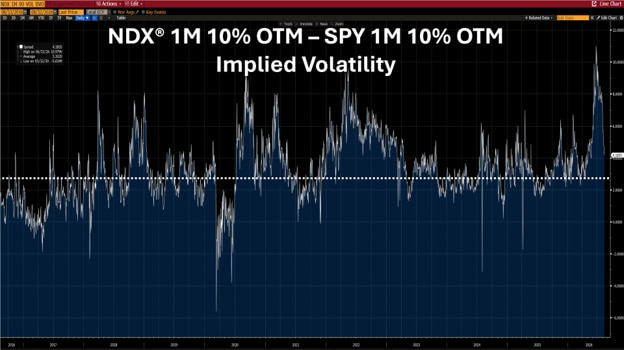
The visual below plots NDX 1M 10% OTM options minus the same options in the S&P 500 (SPY). You’ll notice that NDX downside is effectively always at a premium (in vol terms) to S&P downside. Over the past decade, it’s about a 3.3 vol point spread (average).
On June 23, that relationship widened to 11 volatility points. That was the most significant premium in decades. The only other comparable points occurred in early September of 2020 and in mid-May of 2022.
Source: Bloomberg
Implications
The implications of the recent price and implied volatility action in the large cap growth equity index world are debatable. Over the next two weeks, the markets will grapple with the daily flow of data, the ongoing tensions in the Middle East, as well as NVDA earnings and the Jackson Hole symposium.
In the near term, the path of least resistance for NDX appears to be higher. There’s potential resistance around 30k and at old highs just above 30.5k. Does that mean NDX implied volatility will keep falling? Maybe so, maybe not.
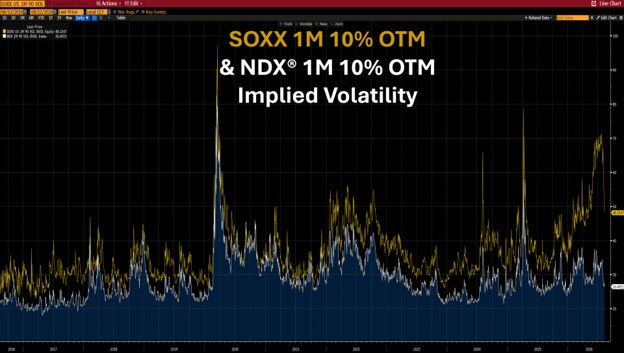
I’ll keep an eye on the semiconductor sector volatility as a possible leading indicator. SOXX downside vol has declined from over 70% to below 50%.
Source: Bloomberg
Making Things with Friends
This summer, my son made memories with friends on baseball diamonds across the Midwest. Over the same time frame, Nasdaq’s Chicago-based options team expanded to include some new friends. They have become fast contributors and I’m incredibly excited to highlight the things we’re able to build together in the coming weeks and months.
It’s impossible to fully understand the complexities of the world (and markets) around us. Data helps reconcile the world as we imagine it and the one that exists. As the Nasdaq-100 Index® continues to grow, so too will the demand for tools to manage that risk.
Our group is dedicated to evaluating the dynamics influencing the benchmark for the 21st century.
Keep coming back.