
How to Buy This Tech Dip For 9%-14% Yields
First, investors flock to AI! Now, the herd is running from anything to do with technology!
The result? A rare bargain window in big tech names.
The tech sector came within a hair of falling into bear-market territory earlier this month, and it's closing in on the -20% threshold yet again. Nvidia rightfully gets much of the blame--the S&P 500's now-former top component has parted ways with $2 trillion in market cap (and its CEO). But other mega-cap tech names such as Micron (MU), Intel (INTC) and Dell (DELL) have been bleeding freely, too.
However, in the process, the S&P 500's information technology sector has fallen to a forward price-to-earnings (P/E) ratio of 17.6. That's tech's lowest valuation since the COVID depths and an extremely rare instance where it's trading more cheaply than the broader index (18.3). Semiconductor stocks are straight-up steals, trading for just 12 times profit estimates.
There's just one tiny detail standing between us and a bargain shopping spree in the technology sector:
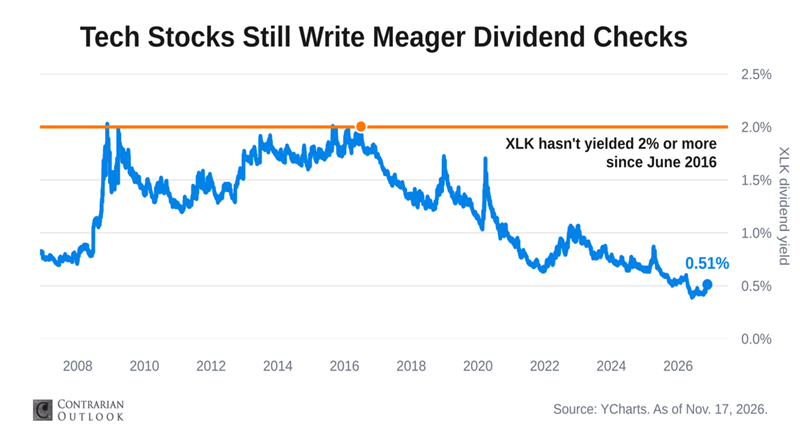
If we try to catch individual knives or even buy the whole sector through a plain-vanilla ETF, our income haul will be either nothing or close to it.
That's where closed-end funds (CEFs) come in.
CEFs do things differently, turning even the chintziest of payers into sizable and often reliable income. Better still? They're structured in such a way that we can sometimes buy these funds for less than their assets are worth, and now is one of those times.
That means we're getting a double discount on tech ... while collecting a fat 9.5% to 14.3%.
Let's take a look.
Powerlaw Corp. (PWRL)
Distribution Rate: 9.1%
One of the newest CEFs on the market is also one of the most unorthodox, offering us exposure to tech that we simply can't get from mutual funds and ETFs. Namely, privately owned tech.
Powerlaw Corp. (PWRL) says its goal is "identifying consequential companies before they become obvious, gaining access on sensible terms and turning private-market value into potential outcomes for public-market investors." Its holdings list is a who's who of every IPO-watcher's wish list--so much so, in fact, that Powerlaw uses its holdings list as marketing material:

Top holding Space Exploration Technologies (SPCX), which accounts for 20% of assets, represents what can drive Powerlaw higher: growth through private rounds followed by a big IPO pop. On the other hand, events like SPCX's post-IPO cooldown, and OpenAI trimming its target valuation and funding goals, weigh PWRL down.
When Powerlaw launched in May, it didn't offer a distribution. That's uncommon among closed-end funds, but not unheard of--fellow private-tech CEF Destiny Tech100 (DXYZ) doesn't pay one, either. However, PWRL recently popped up on our income radar in a big way by initiating a retirement-income staple--a monthly distribution program--and making its first payment near the end of October. The plan is to pay out 6% of its net asset value (NAV), but it currently yields a whopping 9.1%.
That difference brings us to Powerlaw's big issue since coming public:
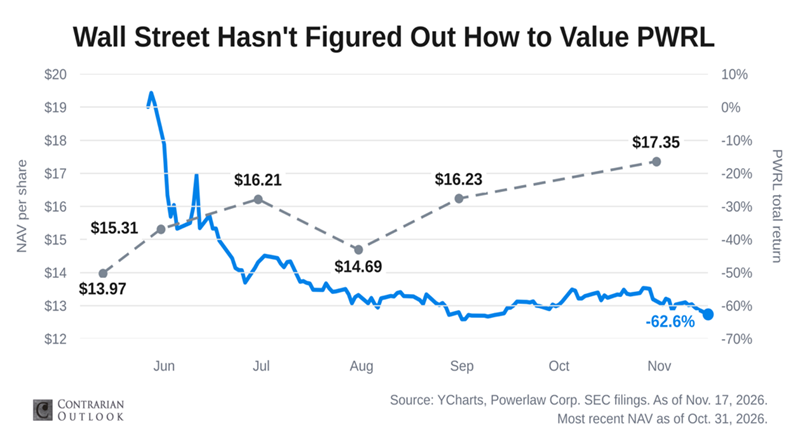
Powerlaw currently trades for a wild 30% discount to NAV, so we're buying those private-tech assets for 70 cents on the dollar. That might sound like a screaming deal, and in many other closed-end funds, it would be. But CEF discounts are relative; they can perpetually trade for far less than they're worth.
To PWRL's credit, its actual net asset value has been growing. And it's possible, looking at the chart, that the action since August reflects Powerlaw's NAV settling into its range. But it might be too early to tell. And to make our job more difficult, whereas most CEFs report net asset values daily, Powerlaw only issues its NAV monthly (and its September NAV will be delayed each year because of the company's annual audit process).
So, buyer beware: While Powerlaw is a fascinating fund that turns private tech into large monthly distributions, it's also more opaque than most other tech CEFs.
Eaton Vance Enhanced Equity Income Fund II (EOS)
Distribution Rate: 10.1%
If we want to play in the public markets, the Eaton Vance Enhanced Equity Income Fund II (EOS) offers us a lot of technology exposure despite not explicitly being a tech fund.
Manager Douglas Rogers is simply looking for companies with above-average growth prospects and financial strength. It just so happens that growth and tech go hand in hand, so that's what we get here.
This Eaton Vance portfolio is a tight 45 stocks. It's 55% weighted to tech, including a full third split among just three stocks: Nvidia (NVDA), Apple (AAPL) and Microsoft (MSFT). We get another 14% in tech-adjacent communication services companies, and another 6% in Amazon (AMZN), which is technically in the consumer discretionary sector, but who are we trying to kid? All told, we're actually looking at about 75% exposure across technology-esque stocks.
If it were held within an ETF wrapper, we'd expect a portfolio like this to pay about 1%. But CEFs can use all sorts of tricks to juice tech stocks for a lot more income.
EOS has a managed monthly distribution, virtually all of which is made up of capital gains distributions. Some of that is siphoned from its positions' returns, but some of that is income generated by trading covered calls.
By selling calls against its position, EOS sacrifices potential upside in exchange for more price stability and very high income from the options premiums. And for most of its history, EOS has delivered exactly the kind of performance we'd expect out of a growth portfolio capped by the covered-call strategy: better lows but muted highs.
This is a perfect stance if we're expecting volatility or an outright downturn--Eaton Vance's fund has held up well against the Vanguard Growth ETF (VUG) in this latest downturn, for instance.
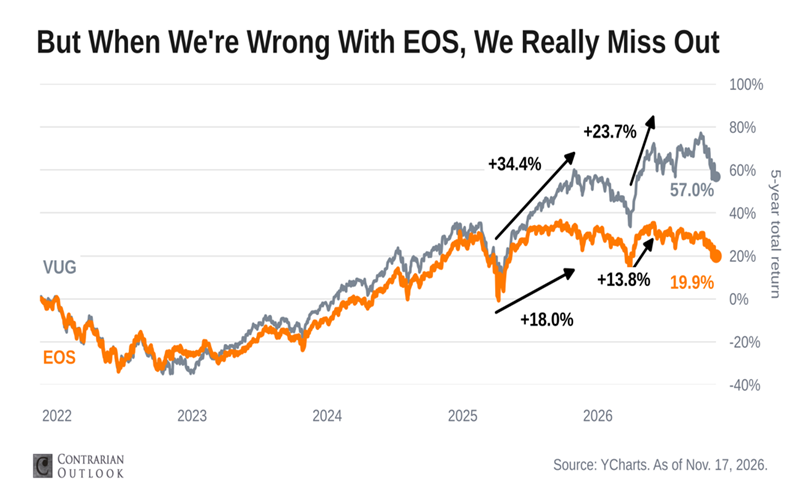
Those still looking to get defensive with EOS do have a big valuation advantage right now. The fund is trading at a 12% discount to NAV that's not just generous on a nominal basis, but much lower than its five-year average discount of just 3%.
BlackRock Science and Technology Term Trust (BSTZ)
Distribution Rate: 14.3%
BlackRock Science and Technology Term Trust (BSTZ) is a purer tech fund than EOS and delivers some of the private-tech exposure that we get with PWRL.
Co-managers Tony Kim and Reid Menge own more than 80 companies "selected for their rapid and sustainable growth potential from the development, advancement and use of science and/or technology." Right now, that translates into an 85% weight to tech, 10% to the industrial sector and the remainder scattered across a few other sectors. Top holdings include the likes of Micron, Nvidia and SpaceX, as well as privately traded Databricks and newly-public Anthropic (ANT).
While the fund struggled compared to the vanilla tech benchmark, the Technology Select Sector SPDR ETF (XLK), in its first few years, it has come into its own since 2024.
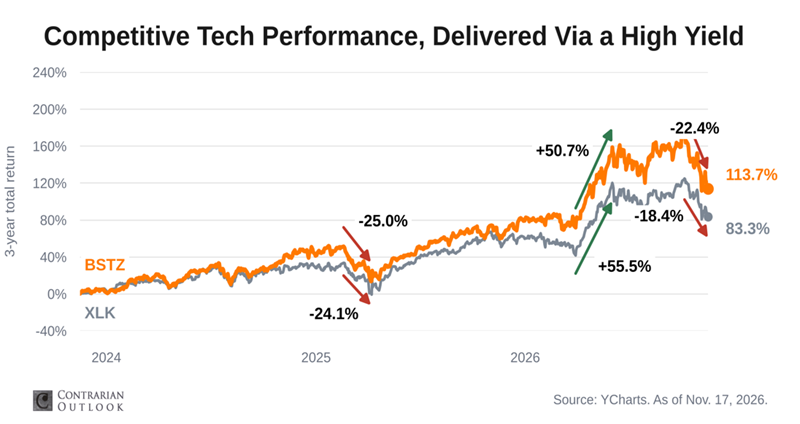
The distribution itself is generous, but we can't always expect the full 14%. The regular payout comes out to about 8%, and the remaining 6%-plus is from a massive special distribution paid in September. These are sporadic--we didn't get them from 2022-24--and the 2021 and 2025 specials were both smaller than the extra 2026 payment.
Pricing could be a little better right now, too. While BSTZ trades at a 7% discount, that's actually narrower than its five-year average of 12%.
This Life-Changing 12% Dividend Is in the Bargain Bin
These CEFs aren't the only massive paydays that have been unfairly cast aside.
One of my favorite funds has made a rare trip into deep-value territory. It pays a fat 12%, it pays us monthly, and it's not nearly as volatile as these touchy tech funds.
Better yet? This already-outsized payout is growing--up 8% in the last five years, with two special dividends thrown in:
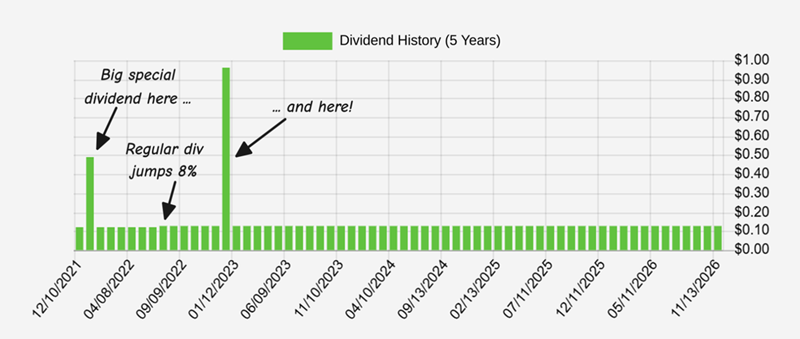
This ignored income play trades at a discount of nearly 6%. That doesn't sound like a lot, but this fund has only been marked down this much a handful of times during its existence.
The last time that happened--in late 2023--the discount vanished in less than two weeks.
I'm urging my readers to take a close look at this one now, while we can still do so for 94 cents on the dollar. I don't want you to miss out. Click here and I'll lay out my research for you and give you a Special Report revealing this 12%-payer's name and ticker.
Further PWRL Research:
