
Here's Why Amazon's Stock Split Isn't a Big Deal
When it rains, it pours. Amazon.com (NASDAQ: AMZN) just announced a 20-for-1 stock split, just one month after Alphabet's (NASDAQ: GOOG) (NASDAQ: GOOGL) 20-for-1 split. If this move came as a surprise, I'm afraid you haven't been paying attention. Personally, I've been expecting Amazon to split its skyrocketing stock since the summer of 2020.
All that being said, Amazon could very well have waited a few more years before pulling the trigger on a splashy stock split. You see, it's just an exercise in mathematics that really doesn't make a difference to most investors. Here's why.
Amazon's stock-splitting history
The e-commerce and cloud computing giant's chronicle of earlier stock splits is fairly short, and you have to go back a long way to find the most recent instance:
|
Date |
Stock-Split Ratio |
Split-Adjusted Stock Price Before the Split |
|---|---|---|
|
6/2/1998 |
2-for-1 |
$85.63 |
|
1/5/1999 |
3-for-1 |
$373.50 |
|
9/1/1999 |
2-for-1 |
$120.13 |
|
6/3/2022 |
20-for-1 |
$2,785.58 |
Data from Amazon and Yahoo Finance. The share price for the 2022 split is the closing price on March 9, the day of the announcement.
Amazon kept a close watch on its share prices at the end of the last millennium. The company issued three stock splits in a span of 15 months, adding up to a 12-for-1 ratio. At the time, management had an obsession with keeping the stock near or below $100 per share.
Of course, the splits were done in a period of skyrocketing stock prices. Amazon's total market value was just $2.1 billion at the start of this run, soaring all the way to $20.2 billion in September 1999.
And then the dot-com bubble popped.
Amazon's stock crashed hard and stayed down for many years. The company didn't have much reason to issue stock splits until nearly eight years later, when the stock finally recovered and exceeded its late 1999 prices again:
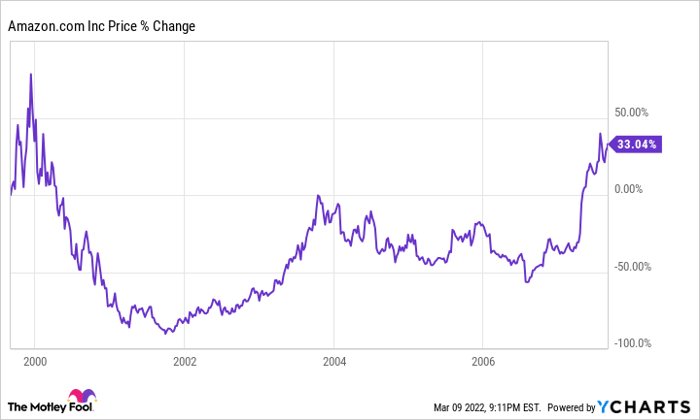
In the meantime, Amazon's stock had dropped as low as $5.51 per share in the darkest days of 2001. Without the stock splits of yesteryear, the price could have been as high as $66.12 at the bottom, staying far away from the dreaded penny-stock label. If Amazon's leadership wasn't too keen on revisiting those ultra-low share prices in the next downturn, you really can't blame them. So here's Amazon's next stock split, nearly 23 years later. Assuming that the stock doesn't move too far in the next three months, the stock price will drop back to roughly $140 per share -- roughly in line with that old hundred-dollar target.

You can cut that pie in four pieces or 20. Either way, you still have the same amount of delicious pizza. The same idea works for stocks, too. Image source: Getty Images.
Why wait when you can buy a fraction of an Amazon share today?
And of course, none of this matters much. Thousand-dollar price tags are less of a problem than they used to be, now that most brokerages will let investors with limited budgets buy fractional shares. If you only have $140 to invest, and you don't want to wait until the stock split takes effect, your broker will probably let you buy 5% of an Amazon share today for the same price.
This is a fairly new concept, first introduced by Interactive Brokers (NASDAQ: IBKR) two years ago, but the brokerage industry as a whole is slowly following suit. Therefore, even retail investors with very limited investing budgets can pick up ownership of high-priced stocks like Amazon or Alphabet nowadays. The need to keep those share prices in check is fading fast.
Then again, it won't hurt anyone when Amazon cuts its stock up into 20 times as many slices, each one worth one-twentieth of the old stub. So I suppose it makes some kind of sense to kick the share price down to a more intuitive level while generating some short-lived investor buzz around the move.
What's next?
The news pushed Amazon's shares more than 6% higher in Wednesday's after-hours trading. That's a short-lived shot of adrenaline, not a sustainable boost to Amazon's market value.
Remember, nothing about Amazon's business prospects changed here, except that the company also announced a $10 billion stock buyback program at the same time. And even then, $10 billion amounts to just 0.7% of the stock's total market value -- a rounding error in Amazon's enormous footprint on Wall Street.
So if you had your eye on some Amazon shares (or some fraction of a share) before this announcement, don't let the stock split change your thinking. Amazon is the same incredible cash machine that it was yesterday, and the market value hasn't really changed. A 6% jump is neither here nor there in the long run, and Amazon's stock price is still roughly 20% below last summer's all-time highs.
10 stocks we like better than Amazon
When our award-winning analyst team has a stock tip, it can pay to listen. After all, the newsletter they have run for over a decade, Motley Fool Stock Advisor, has tripled the market.*
They just revealed what they believe are the ten best stocks for investors to buy right now... and Amazon wasn't one of them! That's right -- they think these 10 stocks are even better buys.
*Stock Advisor returns as of March 3, 2022
John Mackey, CEO of Whole Foods Market, an Amazon subsidiary, is a member of The Motley Fool's board of directors. Suzanne Frey, an executive at Alphabet, is a member of The Motley Fool's board of directors. Anders Bylund owns Alphabet (A shares) and Amazon. The Motley Fool owns and recommends Alphabet (A shares) and Amazon. The Motley Fool recommends Alphabet (C shares) and Interactive Brokers. The Motley Fool has a disclosure policy.
