
ChatETP: August 2026
August Highlights
- Cryptocurrency ETFs had their largest inflows of the year with over $5B in in flows.
- Semiconductors and technology continue to become less popular with retail audiences.
- New filings include FutureSport ETFs which seek to track the performance of NHL teams.
The State of the U.S. Market
Despite continued strength in equities, investors appeared increasingly focused on diversification in August. Cryptocurrency ETFs once again led all major categories, posting strong performance alongside healthy organic growth as institutional adoption and inflows into digital asset products remained robust. Technology funds also delivered solid returns, though organic growth was more muted than other leading categories, suggesting some investors may have been taking profits following the sector's strong run earlier in the year.
Meanwhile, healthcare, money market, and physical commodity exposures saw a combination of positive returns and net inflows, indicating investors continued adding defensive and diversification-oriented allocations while remaining invested in risk assets.
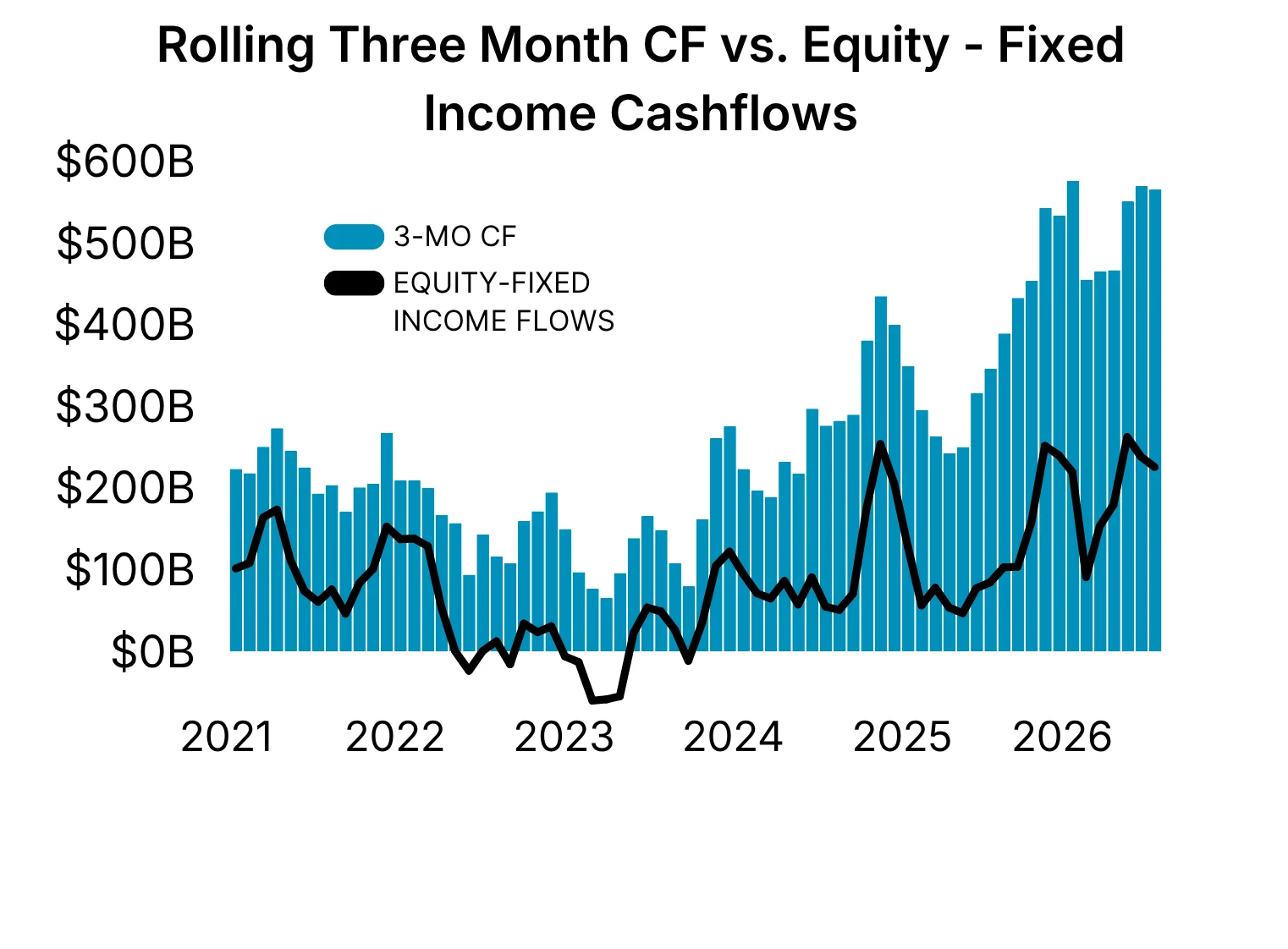

The chart below highlights this trend, with rolling three-month cashflows into fixed income products reaching new highs. Combined with continued allocations to money market funds, these trends suggest investors entered September maintaining a constructive outlook while increasing portfolio resilience amid elevated valuations and ongoing macroeconomic uncertainty.
While investors continued allocating to growth-oriented areas of the market, strong bond inflows suggest many are supplementing equity exposure with income-producing and defensive allocations, reinforcing the broader diversification trend observed throughout August. At the same time, overall ETF cashflows continued to accelerate, with rolling three-month inflows reaching record highs as investors deployed capital across a broad range of asset classes.
We’re Gonna Make It? Crypto Flows and Performance Surge

After a difficult stretch for digital assets earlier this year, crypto-focused ETPs staged a meaningful rebound in August. Strong performance across Bitcoin, Ethereum, and several alternative digital assets was accompanied by a return of positive fund flows, suggesting investors are becoming more comfortable re-entering the space. Bitcoin remained the primary driver of both returns and asset gathering, though Ethereum also contributed meaningfully to the recovery. The improvement marks a notable shift from the outflows and weaker performance experienced throughout much of 2026. While crypto ETP flows remain well below the peaks seen in 2025, August's resurgence suggests investor demand may be stabilizing as digital assets regain momentum. Whether this proves to be a sustained trend or a temporary rebound remains to be seen, but August represented one of the strongest months for both crypto performance and fund flows so far this year.
Sector Investors Rotate from Financials and Tech

After leading much of the market's advance throughout 2026, technology and financials experienced a reversal in August as investors rotated capital toward other areas of the market. Financials, which had been among the strongest-performing sectors earlier in the year, saw the largest pullback, while technology also recorded negative flows despite continuing to benefit from long-term enthusiasm surrounding artificial intelligence and digital infrastructure.
Notably, this weakness was not reflected in the broader equity market. Broad market ETFs, which maintain significant exposure to large-cap technology companies, continued to attract substantial inflows and delivered strong performance during the month. This suggests investors were not abandoning the technology theme altogether, but rather shifting away from concentrated sector bets in favor of broader equity exposure.
The U.S. Retail Report
August was a month of re-risking and continued rotation, but with a sharper edge than July. After a first half of the year defined by retail's conviction in the AI-industrial complex, self-directed investors spent August funding an entirely different trade: selling large-cap growth, trimming semiconductors for a second straight month, and moving decisively into hard assets, value, and biotech. Gold was the month's defining move, with precious metals’ share of retail net buying leaping from 0.7% to 5.8%. Here are some of the key takeaways for August:
Gold Glitters and Real Assets Rally
Precious metals net buying jumped from $192M to $1.47B into a 17.3% monthly return. The increase was corroborated across the real-asset complex, with basic/technology materials, industrial metals and agriculture all with double digit increases. This was likely an inflation-persistence trade rather than a growth scare, though retail expressed it almost exclusively through gold.
Retail Climbs the AI Stack
Semiconductors were trimmed for a second straight month, with net buying down $917M and its share falling 7.7% to 4.4%, as an AI-safety shock hit the chip complex. But the capital stayed in the theme with cybersecurity posting its best month of 2026 at $69.7M. Compute & data, technology infrastructure and AI all swung positive, and broad technology posted $415M of net buying. The wider market cashflow in semiconductors dropped $26.8B while retail still bought roughly $1.1B, reads as decelerating dip-buying and rotation rather than capitulation.
Biotech Posts Its Largest Bounce in 2026
Net buying flipped from an $82M outflow to $171M of buying with retail share moving from -0.3% to +0.7% into a 23.7% monthly return. This was also backed up by $1.2B of total market cashflow. Corroboration across the sector, with healthcare technology and specialized healthcare (up 10.6% and 5.8%, respectively) points to a real re-rating. After eight months of the risk going almost entirely to the AI-industrial complex, biotech continues as one of the destinations for self directed investors’ dollars.

New Kids on the Block

U.S. New Filings and Launches
Issuers continue looking for novel ways to create exposure within ETFs. The most recent example is a spate of products passively tracking FutureSports Indexes which aim to quantify the success of NHL teams. The funds use futures on the indexes that are provided by CME. If these products are approved by the SEC, which is currently debating ‘novel’ ETFs, they will be the most popular product class in November.
Income continues to be very popular, and the method of getting income is continuing to diversify. Direxion filed for the Direxion Nasdaq Step Up Income Autocallable ETF as well as several other autocallables and there were over a dozen covered call and option income products.
Autocallables Have an Excellent Debut Year
Since the Calamos Autocallable Income ETF (CAIE) launched in mid-2025, the autocallable ETF category has steadily gained momentum, with 36 products launched globally and more than $5 billion in assets under management. To put that growth into perspective, single-stock ETFs accumulated roughly $3 billion globally by 2023, one year after their introduction. Similar to the evolution of leveraged products, autocallable structures are already being applied across both broad equity and thematic exposures. In May, GraniteShares filed for the Autocallable DRAM ETF, highlighting issuers' willingness to pair the wrapper with increasingly targeted investment themes. We will likely see the structure expand into single-stock exposures in the coming years.


Disclaimer:
Information set forth in this communication contains forward-looking statements that involve a number of risks and uncertainties. Nasdaq cautions readers that any forward-looking information is not a guarantee of future performance and that actual results could differ materially from those contained in the forward-looking information. Forward-looking statements can be identified by words such as “will,” “believe” and other words and terms of similar meaning. Forward-looking statements involve a number of risks, uncertainties or other factors beyond Nasdaq’s control. These risks and uncertainties are detailed in Nasdaq’s filings with the U.S. Securities and Exchange Commission, including its annual reports on Form 10-K and quarterly reports on Form 10-Q which are available on Nasdaq’s investor relations website athttp://ir.nasdaq.com and the SEC’s website at www.sec.gov. Nasdaq undertakes no obligation to publicly update anyforward-looking statement, whether as a result of new information, future events or otherwise.
Nasdaq® is a trademark of Nasdaq, Inc. The information contained above is provided for informational and educational purposes only, and nothing contained herein should be construed as investment advice, either on behalf of a particular security or an overall investment strategy. Neither Nasdaq, Inc. nor any of its affiliates makes any recommendation to buy or sell any security or any representation about the financial condition of any company. Statements regarding Nasdaq-listed companies or Nasdaq proprietary indexes are not guarantees of future performance. Actual results may differ materially from those expressed or implied. Past performance is not indicative of future results. Investors should undertake their own due diligence and carefully evaluate companies before investing. ADVICE FROM A SECURITIES PROFESSIONAL IS STRONGLY ADVISED.
© 2026. Nasdaq, Inc. All Rights Reserved.