
Down 65%, Is This Cloud Provider a Screaming Buy?
The public cloud services industry is expanding fast. Gartner estimates that spending will grow another 20% in 2022, bringing it to more than $490 billion globally. The industry is dominated by a few major players that cater to large corporations with mammoth checkbooks.
But what about small and medium-sized businesses (SMBs) and individual developers? These entities are making the switch to the cloud (and millions of new SMBs are created each year) and need a service provider that specializes in their needs. This is exactly the niche that DigitalOcean (NYSE: DOCN) serves.
As the chart shows, Amazon Web Services (AWS), Microsoft Azure, and Alphabet's Google Cloud dominate the infrastructure-as-a-service (IaaS) market.
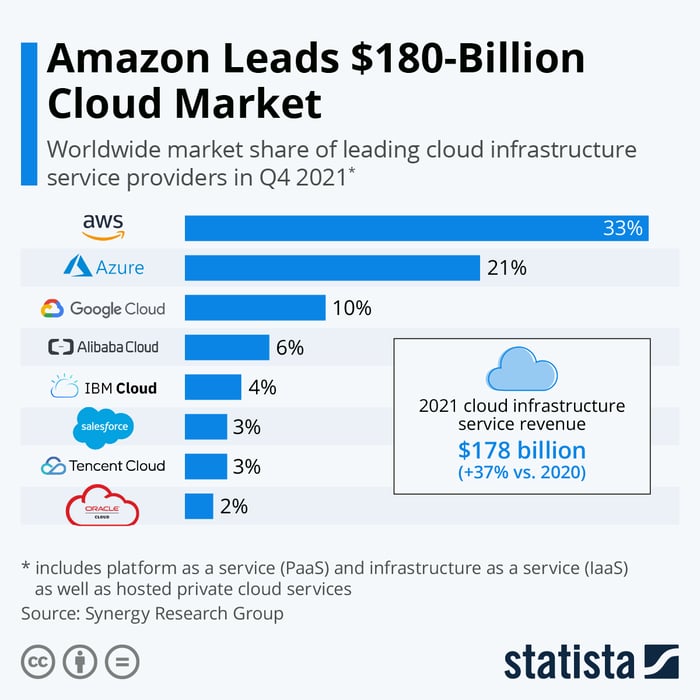
Data source: Statista.
With these companies eating up so much of the market, what is the best way for DigitalOcean to compete? The best way is to not compete at all. Or, at least, not directly.
This is what makes DigitalOcean's strategy so successful. It focuses on SMBs, those with less than 500 employees, offering simple pricing models, ease of use, and excellent customer service.
Monetizing a massive customer pool accelerates sales growth
Ten years ago, DigitalOcean was a fledgling start-up with just 6,000 users. Fast-forward to today, and the company boasts 623,000 total customers. Of these, only 102,000 pay more than $50 per month.
This leaves 521,000 smaller customers that DigitalOcean needs to monetize. It's a giant pool, but it's a difficult proposition to run a profitable company on hundreds of thousands of tiny customers.
Here is the key. The majority of DigitalOcean's customers that spend more than $500 per month on its services today were small customers when they first signed up. DigitalOcean is successfully retaining, monetizing, and meeting these users' growing needs, and it leads to revenue growth.
This is evident from the rising net dollar retention rate. This rate measures a company's efficiency in monetizing customers over time. A rate above 100% indicates success. DigitalOcean has increased this ratio over the years and reported a 117% rate in Q1 2022.
Accelerating sales growth shows how the increased net dollar retention rate affects results. DigitalOcean's revenue rose 35% in 2021 after 25% growth the year before, as seen in the chart.
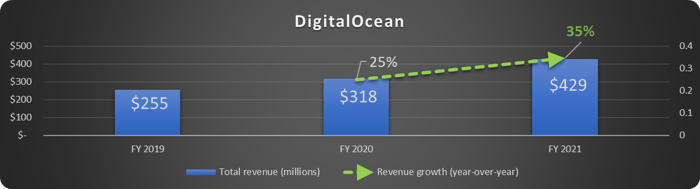
Data source: DigitalOcean. Chart by author.
If the company can maintain this growth rate, it will have more than $1 billion in sales in 2024.
Is DigitalOcean stock overvalued?
DigitalOcean went public in March 2021 -- just in time to catch the growth stock wave, which pushed many stocks to extreme valuations. It was fun while it lasted, but the reversion has been unpleasant.
This doesn't mean that all is lost, however. On the contrary, as discussed, DigitalOcean is thriving.
Unlike many companies after the 2000 tech bubble burst, companies like DigitalOcean are not in imminent danger of going out of business. DigitalOcean had $1.6 billion in current assets and only $62.5 million in current liabilities on its balance sheet at the end of the last quarter.
The stock has fallen more than 65% from its highs, and the company now has a market cap of $4.2 billion, or 7.7 times forward sales. Investors should still exercise caution in the growth stock market. More than 10% of the company's stock float is sold short, which means many are expecting the decline to continue. However, if the company continues to execute, investors with long time horizons may want to dip their toes in this ocean soon.
10 stocks we like better than DigitalOcean Holdings, Inc.
When our award-winning analyst team has a stock tip, it can pay to listen. After all, the newsletter they have run for over a decade, Motley Fool Stock Advisor, has tripled the market.*
They just revealed what they believe are the ten best stocks for investors to buy right now... and DigitalOcean Holdings, Inc. wasn't one of them! That's right -- they think these 10 stocks are even better buys.
*Stock Advisor returns as of June 2, 2022
Suzanne Frey, an executive at Alphabet, is a member of The Motley Fool’s board of directors. John Mackey, CEO of Whole Foods Market, an Amazon subsidiary, is a member of The Motley Fool’s board of directors. Bradley Guichard has positions in Alphabet (C shares), Amazon, and Microsoft and has the following options: long January 2024 $100 calls on DigitalOcean Holdings, Inc. and short July 2022 $135 calls on Amazon. The Motley Fool has positions in and recommends Alphabet (A shares), Alphabet (C shares), Amazon, DigitalOcean Holdings, Inc., Microsoft, Salesforce, Inc., and Tencent Holdings. The Motley Fool recommends Gartner. The Motley Fool has a disclosure policy.
