
Does AI Help or Hurt Amazon Stock?
Analysts increasingly consider Amazon (NASDAQ: AMZN) an artificial intelligence (AI)-driven stock for good reason. Since Amazon Web Services (AWS) remains a critical cloud services provider, it holds a competitive advantage in AI deployments.
However, AI has become a significant concern for both its e-commerce and advertising businesses. With consumers using AI to find desired products, they can easily bypass some Amazon platforms. Knowing this, investors may need more clarity on whether AI helps or hurts the company.
The case for Amazon AI
As most tech investors know, Amazon continues to lead the cloud computing industry. It holds almost as much market share as the second and third leading providers, Microsoft's Azure and Alphabet's Google Cloud, combined.
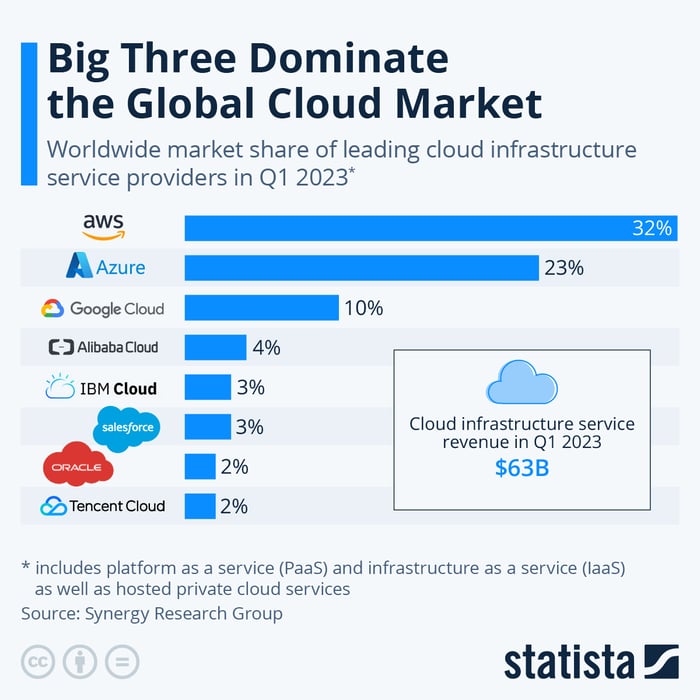
By extension, this makes it a key AI stock. Its machine learning (ML) tools help customers create applications using generative AI. It can also help solve numerous business problems, for instance, extracting data automatically, powering personalized recommendations, or offering ML-generated predictions without code.
With these offerings, more than 100,000 AWS customers use AI and ML technologies. The company also reports up to a 10-fold improvement in the productivity of data scientists. Moreover, with the help of AI, AWS accounted for over $5.1 billion in operating income for Amazon. In contrast, its two e-commerce segments each posted a slight operating loss, meaning AI plays a critical role in Amazon's profitability.
Still, its emphasis on AI on the AWS side of the business does not make Amazon's ML focus in e-commerce any less critical. The company claims Amazon.com "could not grow its business" without ML. Amazon deploys ML to improve customer experiences and enhance the speed and quality of its logistics network, showing that AI touches virtually every part of the company in some form.
Amazon's AI-based challenges
Unfortunately, Amazon.com, which accounts for the overwhelming majority of the company's revenue, could be hurt by that same technology. Before the rise of AI, Amazon relied on a search advantage reinforced by the prominence of the website. This likely boosted Amazon's sales as search engines would often direct customers to Amazon.com when they did not turn to the site on their own.
However, AI could circumvent that search process. Microsoft co-founder Bill Gates recently theorized at a Goldman Sachs event that AI would become a sort of "personal agent," meaning that its users may "never go to Amazon again." Time will tell whether Gates' theory comes true, but Amazon faces the danger that more users will bypass its site.
Investors must also consider how such behavioral changes will affect the company's digital ad business. In the first quarter of 2023, ad sales accounted for $9.5 billion, or 7% of the company's revenue. While that business has grown rapidly in recent quarters, it could slow down or even decline if fewer customers visit Amazon's site.
Does AI benefit Amazon on balance?
In the end, AI looks like a net benefit to Amazon. While its e-commerce arm could suffer, retailing has served as more of a loss leader for the company as it supports its website and name recognition.
Admittedly, an AI-driven decline in its digital advertising business could bring a significant hit to Amazon's revenue. But as long as AWS remains the company's only profit center, the benefits of AI probably outweigh the drawbacks.
Find out why Amazon.com is one of the 10 best stocks to buy now
Our analyst team has spent more than a decade beating the market. After all, the newsletter they have run for over a decade, Motley Fool Stock Advisor, has tripled the market.*
They just revealed their ten top stock picks for investors to buy right now. Amazon.com is on the list -- but there are nine others you may be overlooking.
Click here to get access to the full list!
*Stock Advisor returns as of June 12, 2023
Suzanne Frey, an executive at Alphabet, is a member of The Motley Fool's board of directors. John Mackey, former CEO of Whole Foods Market, an Amazon subsidiary, is a member of The Motley Fool's board of directors. Will Healy has no position in any of the stocks mentioned. The Motley Fool has positions in and recommends Alphabet, Amazon.com, Goldman Sachs Group, and Microsoft. The Motley Fool has a disclosure policy.
