
Could Micron Technology Become the Next Nvidia?
Micron Technology (NASDAQ: MU) is one of the leading suppliers of memory chips used in data centers, mobile devices, and personal computers. Growing demand for additional memory and storage capacity sent the stock up about 290% over the last decade, but the stock has been flat over the last few years.
At the end of September, Micron reported another quarter of falling revenue, as it continues to struggle with weak demand environment and lower selling prices.
That said, the stock is up 37% year to date, despite Micron reporting an earnings per share (EPS) loss of $5.34 for the fiscal year ending Aug. 31. Investors understand Micron is navigating the usual ups and downs of the industry, where imbalances in supply and demand for memory products can cause uneven financial performance.
Investors are bullish on Micron's opportunity to supply greater memory capacity to cloud servers for artificial intelligence (AI) workloads. The adoption of AI technology has leading graphics-chip supplier Nvidia's (NASDAQ: NVDA) revenue soaring this year, resulting in the chipmaker's stock hitting record highs. The same data centers buying Nvidia's high-powered processors to train AI models will also need more memory bandwidth to transmit massive amounts of data at faster speeds.
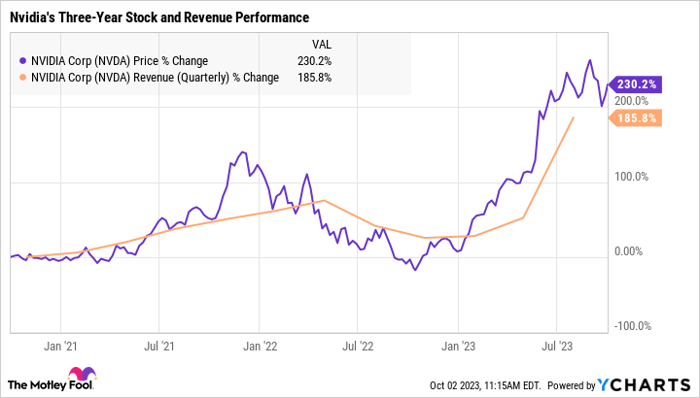
Over the last 10 years, Nvidia stock rocketed 11,000%. Is the AI market about to take the lid off memory chip demand and send Micron stock higher?
Micron expects a return to profitable growth
The International Data Corporation estimates that spending on AI-centric systems, including hardware, software, and services, will grow 27% annually through 2026 to reach $300 billion. McKinsey & Co. has estimated that about 40% to 50% of the value of the AI market will flow to semiconductor companies, which includes Micron.
There's evidence that AI demand is already percolating in the memory chip market. In July, Micron's competitor SK Hynix said it has clear visibility into AI demand from its clients into next year.
Micron is seeing the same trend. In the recent earnings report, management noted that traditional server demand "remains lackluster," but demand for AI use cases "has been strong."
Strong AI demand could lift Micron out of its slump next year. Management noted the excess chip supply in the data center market will "likely normalize in early calendar 2024."
AI workloads require more memory and storage capacity than traditional computing needs. Training computers to think like a human requires fast data retrieval, which should lead to growing demand for Micron. This will also fuel growing demand across the business.
For example, about one-third of the smartphones sold today are using more quantities of dynamic random access memory (DRAM) and NAND flash memory than a year ago. Mobile makes up a small part of Micron's revenue, but compute and networking, including data centers and AI servers, is the company's largest revenue source.
| Segment | Fiscal 2022 | Fiscal 2023 | YoY Decline |
|---|---|---|---|
| Compute and networking | $13.7 billion | $5.7 billion | (58%) |
| Mobile | $7.2 billion | $3.6 billion | (50%) |
| Embedded | $5.2 billion | $3.6 billion | (31%) |
| Storage | $4.5 billion | $2.5 billion | (44%) |
Data source: Micron Technology. Micron's fiscal year ends in August. YoY = year over year.
Differences between Micron and Nvidia
Micron is well positioned for a recovery, so this is a good time to consider buying shares. But I wouldn't expect Nvidia-like returns for a few reasons.
- Unlike Nvidia in GPUs, Micron does not dominate the market for DRAM and NAND products. There are several suppliers that compete with Micron, including Samsung, SK Hynix and Western Digital.
- Adding to the first point, the frequent shifts in selling prices are another headwind. Because solid-state drives and DRAM chips are basically the same no matter which company makes them, this industry is notorious for swings in supply that cause lumpy revenue. Micron may never grow its revenue nearly as fast as Nvidia.
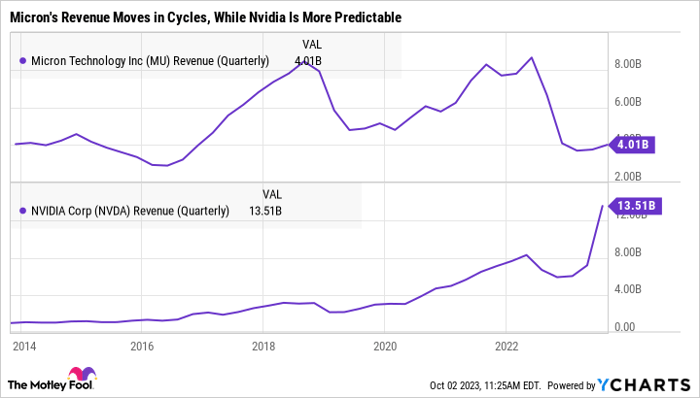
Data by YCharts.
Despite these disadvantages, Micron stock has still delivered market-beating returns to shareholders over the last 10 years and matched the market's return over the last five years. Over many years, the growth in the amount of memory capacity overcomes the near-term swings in pricing to allow for higher peaks in revenue. Before the recent downturn, Micron's revenue had tripled from fiscal 2013 through fiscal 2022.
The key is to buy the stock when chip selling prices are down. This usually causes a lower stock price and provides more value to investors that can lead to better returns.
The stock's upside potential
Management expects a return to normalized profit levels by calendar 2025. The current Wall Street estimate has EPS reaching $8.26 by fiscal 2026. By applying Micron's typical price-to-earnings ratio of about 15 to future earnings estimates, the stock could trade at $124, or nearly double the current share price.
The company's long-term outlook is for bit demand to grow at a mid-teens rate in DRAM and grow in the low 20s percentage range in NAND. For what it's worth, Wall Street anticipates revenue will reach more than $33 billion by fiscal 2026, or more than double Micron's fiscal 2023 total.
The stock might not deliver Nvidia-like returns, but it should continue to outperform the market averages.
10 stocks we like better than Micron Technology
When our analyst team has a stock tip, it can pay to listen. After all, the newsletter they have run for over a decade, Motley Fool Stock Advisor, has tripled the market.*
They just revealed what they believe are the ten best stocks for investors to buy right now... and Micron Technology wasn't one of them! That's right -- they think these 10 stocks are even better buys.
*Stock Advisor returns as of September 25, 2023
John Ballard has positions in Nvidia. The Motley Fool has positions in and recommends Nvidia. The Motley Fool has a disclosure policy.
