
Could Buying Brookfield Renewable Today Set You Up for Life?
Key Points
Many investors insist on owning stocks with enormous potential for gains, dismissing the risk that, in most cases, those big gains will never be realized.
Ironically, slow, steady cash payments that compound over time can yield better net returns than most growth stocks.
Brookfield Renewable’s most bullish feature is that it’s being built to serve one very specific purpose.
- 10 stocks we like better than Brookfield Renewable ›
Most investors are looking for life-changing stocks. Too many investors, however, go about it the wrong way, taking oversized risks on tickers that might soar, but likely won't. Ironically, slow and steady often proves a more rewarding approach than proverbially "going for broke."
To this end, anyone looking to establish a bright distant future may want to consider taking a stake in boring ol' Brookfield Renewable (NYSE: BEPC) (NYSE: BEP) now.
Missed Nvidia in 2009? This Rare Signal Is Flashing Again. In 2009, a "Double Down" signal flashed for a little-known chipmaker called Nvidia. For the first time in years, that same "Total Conviction" signal is flashing for a company 1/100th the size of Nvidia. Continue »
What's Brookfield Renewable?
It's not exactly a household name. In fact, there's a good chance you've never even heard of it. Don't let that deter you, though. This stock checks a lot of boxes that most investors look for.
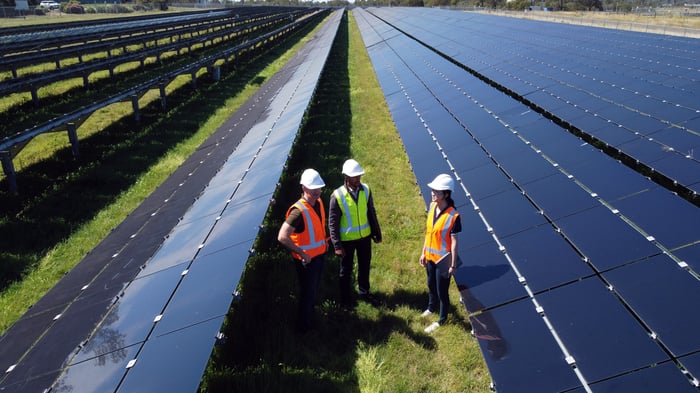
Image source: Getty Images.
Exciting entertainment isn't one of them, mind you. In an environment where buying and selling high-profile stocks like Nvidia, Apple, or Space Exploration Technologies is practically treated like a hobby, Brookfield Renewable is comparatively boring. As the name suggests, it holds a portfolio of privately owned renewable energy ventures like hydroelectric power plants, wind farms, and solar power facilities.
Reliable marketability isn't what makes this name such a compelling prospect, however. Brookfield's edge lies in how it's built and what it's built to do. This organization's managers aim to buy and hold energy-related assets that generate consistent -- and consistently growing -- cash flow that's used to fund dividend payments.
The irony? This seemingly conservative approach may prove more rewarding for patient shareholders than the average growth stock might. Factoring in its targeted annual cash-payment growth of 5% to 9%, management targets total net average annual returns of 12% to 15%.
Crunching the numbers
Given what we've seen so far, there's every reason to believe Brookfield Renewable can meet these targets indefinitely. Despite the current economic headwinds, last quarter's per-share operating bottom line was up 11% year over year, capping off a 12-month stretch of roughly the same rate of profit growth. It's a testament not just to the growing demand for electricity, but also to Brookfield's management team's ability to pick the right projects capable of delivering it.
Perhaps more important, a steady average annual return of 12% -- the lower end of Brookfield's long-term target -- could lead to shockingly bigger total returns than the S&P 500's average annual net return of 10%. A $10,000 investment in an S&P 500 index fund made today would be worth nearly $175,000 in 10 years' time, assuming you reinvested any dividends dished out in the meantime. At 12% per year, though, a $10,000 investment made today would be worth just under $300,000 in 30 years' time.
Connect the dots. The seemingly little things turn into pretty big deals when allowed to compound over time. The key is simply letting them, by leaving things alone.
Safe enough to make a long-term commitment
Brookfield's growth targets aren't guarantees, of course. And past performance is no guarantee of future results.
The underlying premise holds water, though. Certainty reduces risk, allowing managers -- as well as investors -- to make bolder commitments to opportunities with solid long-term potential. That's why a position in Brookfield Partners could indeed set you up for life, even if it doesn't look or feel like the sort of explosive winner most people are usually hoping to find.
Should you buy stock in Brookfield Renewable right now?
Before you buy stock in Brookfield Renewable, consider this:
The Motley Fool Stock Advisor analyst team just identified what they believe are the 10 best stocks for investors to buy now… and Brookfield Renewable wasn’t one of them. The 10 stocks that made the cut could produce monster returns in the coming years.
Consider when Netflix made this list on December 17, 2004... if you invested $1,000 at the time of our recommendation, you’d have $414,015!* Or when Nvidia made this list on April 15, 2005... if you invested $1,000 at the time of our recommendation, you’d have $1,385,459!*
Now, it’s worth noting Stock Advisor’s total average return is 960% — a market-crushing outperformance compared to 213% for the S&P 500. Don't miss the latest top 10 list, available with Stock Advisor, and join an investing community built by individual investors for individual investors.
*Stock Advisor returns as of September 10, 2026.
James Brumley has no position in any of the stocks mentioned. The Motley Fool has positions in and recommends Apple and Nvidia. The Motley Fool recommends Brookfield Renewable. The Motley Fool has a disclosure policy.
