
Better Buy: Nio vs. Rivian Stock
The electric vehicle (EV) hype is far from over. You only have to see the stunning rally in VinFast Auto in the days following its initial public offering (IPO) in mid-August.
VinFast Auto's rally brings back memories of Rivian Automotive's (NASDAQ: RIVN) hot 2021 debut. Rivian stock, however, crashed soon after and is now down a jaw-dropping 77% from its listing date in November 2021. Remarkably, another EV stock that has faced a similar fate to Rivian is Nio (NYSE: NIO), which has fallen almost 75% since late 2021.
Both Rivian and Nio stocks, however, have rebounded of late and have gained more than 45% each in just the past three months, as of this writing. That makes both EV stocks worth your attention now, but which among the two is a better buy today?
The bull case for Nio
Nio's deliveries took a hit this year as the company transitioned all its models to a new second-generation platform. Its deliveries in the second quarter, for example, fell 6% year over year. But if you look at month-by-month data, it is evident that Nio's deliveries are picking up. July, in fact, was a record delivery month for the Chinese EV maker, with its second-generation ES6 SUV contributing nearly 50% to July deliveries. The ES6 has been Nio's top-selling car in recent years.
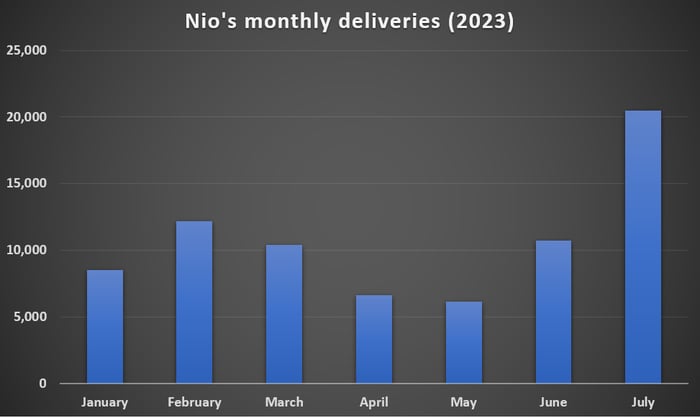
Data source: Nio. Chart by author.
Nio's sales should start to rise once it begins deliveries of its mid-sized coupe SUV EC6 and completes the full switchover of all products to its second-generation platform by September. Aside from the ES6 and EC6, Nio currently has three more SUV models, two sedan models, and a recently launched tourer.
Management expects to deliver 55,000 to 57,000 cars in the third quarter, which is more than twice its Q2 deliveries. More importantly, management expects Nio's gross margin to rebound to double digits in Q3.
That could be a big catalyst for Nio stock, since the EV maker's gross margins have declined rapidly in recent months because of lower deliveries and a greater mix of low-priced cars like the ES6. In Q2, Nio barely scraped through with a gross margin of 1%, a sharp decline from the 13% margin it reported in the year-ago quarter.
Nio has yet to turn a profit, but it has delivered more than 360,000 cars across its life and is generating billions in revenue -- it generated $1.25 billion in total revenue in Q2. Nio also has a strong foothold in China despite stiff competition. At its latest Q2 earnings call, Nio said it owned a 59% share in the Chinese premium pure-play EV market priced above 300,000 RMB (roughly $41,000). With Nio projecting a much stronger second half of the year, it looks like an opportune time to buy the stock.
The bull case for Rivian
When Rivian debuted in the U.S. in 2021, it already had an order for 100,000 electric delivery vans (EDV) from e-commerce giant Amazon, and net preorders for 71,000 EVs between its R1T pickup truck and R1S SUV. However, Rivian failed to ramp up production, and by February 2022, it guided for 2022 production of only 25,000 EVs against a capacity of 50,000 units because of supply constraints.
Rivian eventually fell short of that target as well. It produced 24,337 EVs and delivered only 20,332 units in the year. Rivian also burned cash rapidly throughout the year.
But things appear to be turning around for the EV maker -- it expects to produce 52,000 EVs this year, having just upgraded its previous guidance of 50,000 EVs.
In the first half of 2023, Rivian produced and delivered 23,387 and 20,586 EVs, respectively, and its revenue surged nearly 70% sequentially to $1.1 billion in the second quarter. Rivian's gross profit per vehicle in Q2 also improved by nearly $35,000 quarter over quarter after the launch of its in-house Enduro motor unit and lithium iron phosphate battery packs.
In Q2, Rivian's R1S SUV production also surpassed R1T pickup truck production for the first time. Almost 70% of the total R1 units produced in Q2 were R1S models. If the trend continues, it could eventually mean better profits for the company, since the R1S is more profitable than the R1T. Rivian also adopted the North American Charging Standard last quarter to give its customers access to Tesla's supercharger network.
The second quarter, therefore, was meaningful in many ways and has given investors a good reason to consider buying Rivian at current prices.
The better stock to buy
There are pretty compelling arguments in favor of both Nio and Rivian right now, but two things matter: Valuation and path to profitability. Nio stock is a lot cheaper than Rivian in terms of price-to-sales ratio.
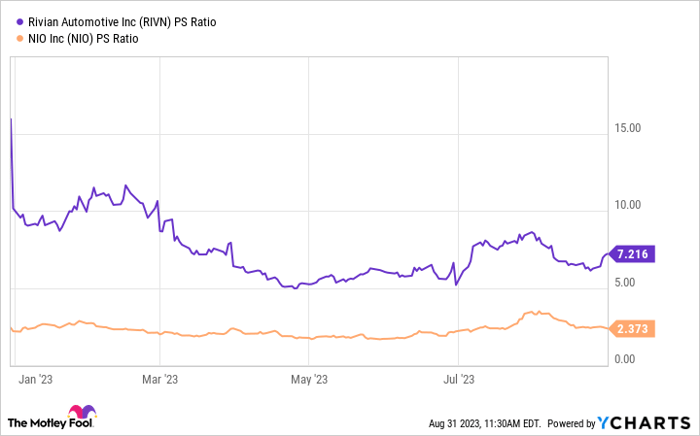
RIVN PS Ratio data by YCharts
Nio also stands out when it comes to gross margins. Gross margin reflects business efficiency and is the first step toward profitability. Nio was already reporting double-digit gross margins before they started to drop in recent quarters. As I mentioned earlier, though, Nio expects its gross margin to rebound as the year progresses. Rivian's gross margin, meanwhile, is improving but was still a negative 37% in its last quarter.
Given these two aspects and Nio's delivery projections for the third quarter, I think it's a great time to consider buying Nio stock.
10 stocks we like better than Nio
When our analyst team has a stock tip, it can pay to listen. After all, the newsletter they have run for over a decade, Motley Fool Stock Advisor, has tripled the market.*
They just revealed what they believe are the ten best stocks for investors to buy right now... and Nio wasn't one of them! That's right -- they think these 10 stocks are even better buys.
*Stock Advisor returns as of August 28, 2023
John Mackey, former CEO of Whole Foods Market, an Amazon subsidiary, is a member of The Motley Fool's board of directors. Neha Chamaria has no position in any of the stocks mentioned. The Motley Fool has positions in and recommends Amazon.com, Nio, and Tesla. The Motley Fool has a disclosure policy.
