
Better Buy: Nvidia vs. AMD
High-flying semiconductor stocks Nvidia (NASDAQ: NVDA) and Advanced Micro Devices (NASDAQ: AMD) are down in the dumps so far this year as investors have sold off richly valued tech stocks amid rising interest rates, surging inflation, and concerns about the health of the semiconductor market after a couple of years of terrific growth.
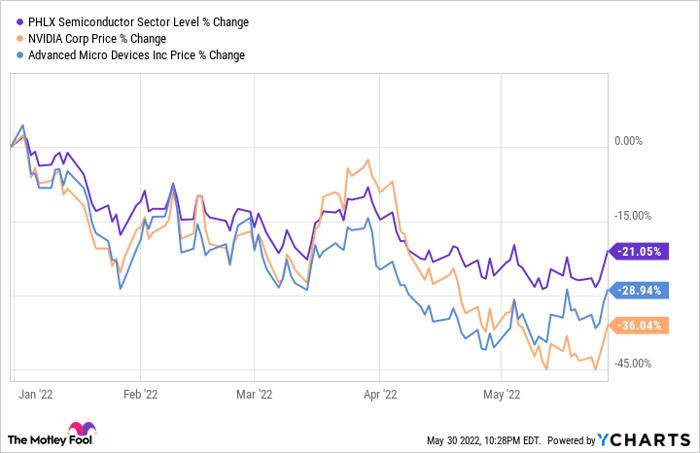
But it is worth noting that both companies have been growing at a tremendous pace, and they are unlikely to run out of momentum thanks to the fast-growing markets that they serve. But which one of these two tech stocks looks like the better place for investors be putting their money now? Let's find out.
The case for Nvidia
The graphics card specialist released solid results for the first quarter of fiscal 2023 -- the three months ended May 1 -- on May 25. The company posted record revenue in the gaming and the data center businesses, which together produced nearly 89% of its top line.
Nvidia's total revenue was up 46% year over year to $8.3 billion last quarter, while adjusted earnings popped 49% year over year to $1.36 per share. More importantly, Nvidia expects to report solid growth in the current quarter despite anticipating a $500 million hit to the top line on account of lost sales in Russia and COVID-19 lockdowns in China.
The chipmaker expects $8.1 billion in revenue in fiscal Q2, which would translate into a 24% year-over-year increase. The non-GAAP (adjusted) gross margin is expected to land at 67.1%, which would be better than last year's 66.7%. So, Nvidia seems set to sustain its hot growth streak despite adversity, which points toward the resilience of its business model and the health of the markets that it is serving.
The video gaming business, for instance, should spring to life later this year once Nvidia launches cards based on a new architecture. The company reported gaming revenue of $3.62 billion last quarter, up 31% year over year and 6% sequentially. However, it anticipates a sequential decline in gaming revenue this quarter due to what CFO Colette Kress, during the quarterly conference call with analysts, called "softness in parts of Europe related to the war in the Ukraine and parts of China due to the COVID lockdowns."
But with only a third of Nvidia's installed base of gamers using its RTX series graphics cards, which provide a massive jump in performance over older GTX series cards while adding features such as ray tracing and resolution upscaling, the company is sitting on a massive upgrade cycle. What's more, the gaming GPU (graphics processing unit) market is expected to clock 14% annual growth through 2026, according to Mordor Intelligence. Nvidia is in a solid position to make the most of this growth as it controlled 77% of the gaming GPU market at the end of 2021, according to Jon Peddie Research.

Image source: Getty Images.
Meanwhile, the data center market should continue to be a boon for Nvidia and the company's move to enter the server CPU space is likely to unlock a multibillion-dollar opportunity. Not surprisingly, analysts are upbeat about Nvidia's prospects and are expecting 32% annual earnings growth from the company for the next five years.
The case for Advanced Micro Devices
AMD is also benefiting from the video gaming and the data center markets, but it has additional catalysts in the bag. For instance, AMD's semi-custom chips are used in video gaming consoles from Microsoft, Sony, and Valve, while the company also makes processors for computers and laptops. These are in addition to GPUs and CPUs for data centers. Additionally, AMD has entered the market for field-programmable gate arrays (FPGAs) -- which are in healthy demand from data center customers -- with the acquisition of Xilinx.
These multiple growth drivers are the reason AMD has been seeing outstanding growth. The company's first-quarter 2022 revenue was up 71% year over year to $5.89 billion, including the contribution from Xilinx. On an organic basis, AMD reported 55% revenue growth over the prior-year period as the demand for its server processors, semi-custom chips, and client processors remained healthy.
AMD's earnings were up 117% year over year to $1.13 per share in the first quarter, including the contribution from Xilinx. The company is now anticipating 60% revenue growth in 2022 as compared with its earlier expectation of a 31% increase. Management credits the upgraded guidance to the completion of the Xilinx acquisition, as well as a strong showing from the semi-custom and server businesses.
The size of the end markets that AMD is tapping should ensure impressive growth over the long run, especially considering that it is gaining share in key areas. For instance, AMD's share of the growing server CPU market is expected to increase to closer to 35% in the long run, as per Bank of America estimates.
Sales of gaming consoles are also expected to increase 15% annually through 2026, according to Mordor Intelligence, giving AMD opportinity to grow.
All this supports analyst estimates for AMD to have nearly 33% annual earnings growth for the next five years, which is almost the same as the forecast for Nvidia.
The verdict
Both AMD and Nvidia are expected to clock impressive growth in the long run. However, valuation makes AMD a better bet than Nvidia.
AMD is trading at 38 times earnings and 6.9 times sales. Nvidia, on the other hand, is expensive at 50 times earnings and 16 times sales.
10 stocks we like better than Nvidia
When our award-winning analyst team has a stock tip, it can pay to listen. After all, the newsletter they have run for over a decade, Motley Fool Stock Advisor, has tripled the market.*
They just revealed what they believe are the ten best stocks for investors to buy right now... and Nvidia wasn't one of them! That's right -- they think these 10 stocks are even better buys.
*Stock Advisor returns as of April 27, 2022
Harsh Chauhan has no positions in any of the stocks mentioned. Bank of America is an advertising partner of The Ascent, a Motley Fool company. The Motley Fool has positions in and recommends Advanced Micro Devices, Microsoft, and Nvidia. The Motley Fool has a disclosure policy.
