
Antitrust Regulators Are Circling Apple
Last week, the European Commission announced that it was formally opening antitrust investigations into Apple (NASDAQ: AAPL) regarding its App Store rules, as well as Apple Pay practices. This week, news broke that U.S. regulators and state attorneys general might be preparing to do likewise, even as Apple finally made some minor concessions to address some -- but not all -- of the criticisms.
The antitrust risks that the Mac maker faces continue to mount.
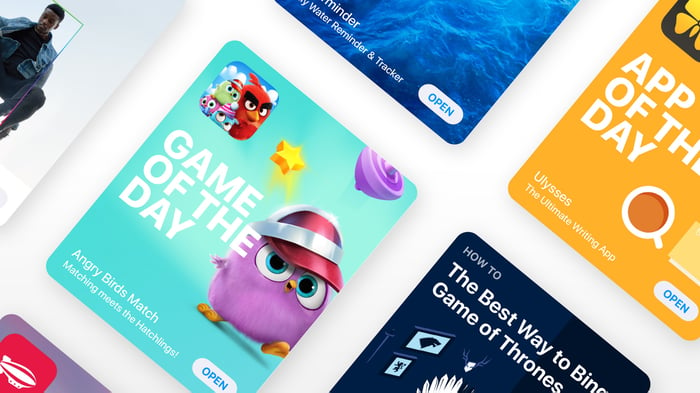
Image source: Apple.
The App Store is too powerful
Politico reports that the Department of Justice and a handful of state attorneys general are getting ready to launch an antitrust probe into the Cupertino tech giant. At issue -- as usual -- are Apple's App Store policies, which third-party developers and companies have long argued are oppressive, hurt competition, and are applied inconsistently.
The news comes in the wake of a controversy this month over email app Hey, where Apple rejected the app for not offering an in-app subscription option that would give Apple a 30% cut of revenue and add to its paid subscription count. It's a complicated situation but helped fuel more criticism while raising awareness of how challenging it can be to navigate Apple's byzantine rules.
Apple requires any app that offers a paid service to integrate the company's payment system, earning it a cut. However, there is an exemption for a category that Apple refers to as "reader apps," which allow users to access content or paid content subscriptions. Examples of reader apps would include popular streaming services like Netflix or Spotify, as well as things like newspaper apps or cloud storage, among others. Critics argue that this distinction is arbitrary.
Developers sued Apple a year ago over allegations that the App Store represents an unlawful monopoly on app distribution within iOS, and the lack of competition in app distribution forces developers to pay Apple's hefty fees. These concerns do not apply to competing mobile platform Android, which supports alternative ways for users to install apps.
It's unclear how many state prosecutors are involved in the potential investigation. A former antitrust official told the outlet that restrictions might only be justifiable if "they are absolutely essential to benefit consumers." It's worth noting that Apple has made that exact argument on numerous occasions before, including as recently as late last year. In a response to the House Judiciary Committee in November, Apple maintained that many of its policies are designed for security and privacy purposes in order to benefit users.
Apple recently tried to deflect criticism by highlighting how much mobile commerce it facilitates -- an estimated $519 billion last year. The vast majority of that total ($413 billion) came from physical goods and services, which are also exempt from Apple's revenue-sharing.
The booming services business, which has generated $50 billion in revenue over the past year, has been a core part of Apple's investing thesis in recent years. That momentum could be derailed if the tech giant finds itself in a protracted legal battle with lawmakers and antitrust regulators, particularly if the company is forced to change its App Store policies.
10 stocks we like better than Apple
When investing geniuses David and Tom Gardner have a stock tip, it can pay to listen. After all, the newsletter they have run for over a decade, Motley Fool Stock Advisor, has tripled the market.*
David and Tom just revealed what they believe are the ten best stocks for investors to buy right now... and Apple wasn't one of them! That's right -- they think these 10 stocks are even better buys.
*Stock Advisor returns as of June 2, 2020
Evan Niu, CFA owns shares of Apple, Netflix, and Spotify Technology. The Motley Fool owns shares of and recommends Apple, Netflix, and Spotify Technology. The Motley Fool has a disclosure policy.
