
Amazon.com Partners With Everyone But SpaceX
"Amazon Selects Blue Origin's New Glenn for up to 27 Project Kuiper Constellation Launches."
That's how the headline read on Blue Origin's press release last week. And I have to admit -- when I saw it, my immediate reaction was just: "Well, of course they did!"
Jeff Bezos may no longer serve as Amazon's CEO, but data from S&P Global Market Intelligence confirm that he remains executive chairman of both Amazon.com (NASDAQ: AMZN) and Blue Origin. It makes total sense that, when picking a company to launch the 3,236 satellites that will make up Amazon's "Project Kuiper" satellite internet constellation, Bezos would pick his other company -- Blue Origin -- to do the launch work.
So of course he picked Blue Origin. But what about this other press release -- the one that Amazon itself put out?
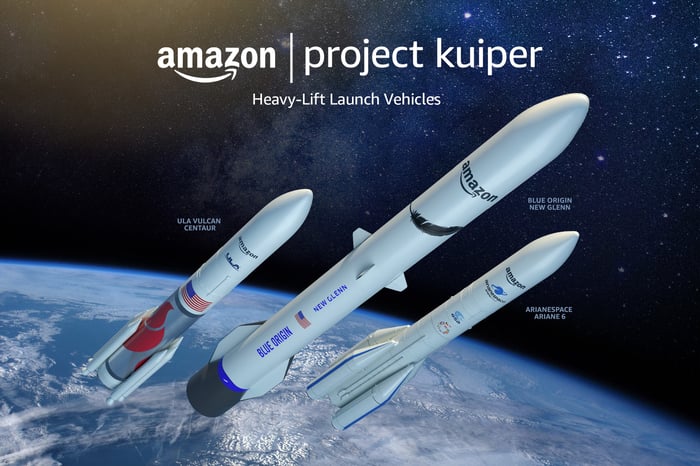
Image source: Amazon.
What the other press release said
Turns out Amazon isn't buying just "27 rocket launches." It's buying 92 rocket launches over a period of five years (and at an estimated $10 billion in cost). Amazon is also buying from a whole array of launch providers. In addition to Blue Origin, Amazon shared that:
- It will fly 47 times with United Launch Alliance, the Boeing (NYSE: BA) and Lockheed Martin (NYSE: LMT) joint venture. Amazon will use ULA's current Atlas V launch vehicle for the first nine launches. Then it will switch to ULA's new Vulcan Centaur rocket (for which Blue Origin is building the engines) for the last 38 launches.
- 18 launches will go to Airbus (OTC: EADSY) subsidiary Arianespace, flying the new Ariane 6 rocket.
- Finally, Amazon will fly at least 12 times with Blue Origin's New Glenn rocket. Amazon is also taking out "options" for 15 more New Glenn launches, resulting in the headline total of "up to 27 Project Kuiper Constellation Launches."
Add it up: 9 + 38 + 18 + 12 + 15 = 92. And actually, make that 93 -- because preceding all of the above will be a single rocket launch with rocket start-up ABL Space Systems, carrying Amazon's first two test satellites, KuiperSat-1 and KuiperSat-2, into orbit.
Project Kuiper timeline
When will we start seeing all these rocket launches happen?
"We still have lots of work ahead," hedges Amazon Devices & Services Senior Vice President Dave Limp, declining to give an exact date. But the ABL launch that kicks off the whole shebang is scheduled for the fourth quarter of 2022, so logically, the other 92 launches probably can't begin before 2023 at the earliest.
There's even some question about whether 2023 is doable.
Why not? Out of all the rockets that Amazon tapped to carry its satellites, only one is actually flying today: ULA's venerable Atlas V. Ariane 6, on the other hand, Vulcan Centaur, ABL's RS1 rocket, and even Blue Origin's own New Glenn rocket are all still "paper rockets." None of them has ever flown to space before.
Iffy explanations...
Given that all of these rockets are equally unready for prime time, you might wonder: Why doesn't Jeff Bezos launch more (or all) of his Amazon satellites atop his own Blue Origin rockets? Wouldn't that keep more money "in the family," so to speak, and be more profitable for both Amazon and Blue Origin?
According to Amazon's Vice President of Technology for Project Kuiper Rajeev Badyal, "securing launch capacity from multiple providers has been a key part of our strategy from day one." Many providers ensure that Amazon will have many options to choose from, and "supports competitive long-term pricing for Amazon, producing cost savings that we can pass on to our customers."
And to an extent that makes sense. I mean, everybody likes low prices, right?
But here's the thing: One rocket company that's notably absent from Amazon's list is SpaceX, which famously offers the lowest prices on Earth for space launch. Granted, renting rockets from a soon-to-be competitor in satellite internet might not be Amazon's first choice. But faced with a similar situation last month, competitor OneWeb wasted no time hiring SpaceX as its launch provider, after its former partner Roscosmos reneged on a contract.
If Amazon truly seeks the best prices so that it can "pass on ... savings ... to our customers," then it would make sense for Amazon, too, to sign up with SpaceX -- except for one thing.
...and ulterior motives
The company getting the bulk of Amazon's business -- giant defense contractor ULA -- is also a key customer of Blue Origin, which has contracted to build the engines for ULA's Vulcan Centaur. Unfortunately, Blue Origin is behind schedule on delivering those engines. As a result, it's basically Blue Origin's fault that Vulcan Centaur cannot yet carry Amazon's satellites.
I think you can see why that would cause some strain in relations among Amazon, Blue Origin, and ULA. If Amazon were now to give too much business to Blue Origin -- instead of to ULA -- at best it'd be adding insult to injury. At worst ... it might raise suspicions that Blue Origin was intentionally stalling on delivering engines to ULA.
Viewed from this perspective, it's easy to see why Bezos, Amazon, and Blue Origin might be very motivated to throw some business ULA's way, and try to keep their partner happy. This might not be the best move for Amazon, which will pay higher prices to launch its satellites. It might not be the best news for Amazon's future internet customers, to whom those high prices will get passed on as higher rates.
But from the perspective of business realpolitik, Amazon's decision actually makes a lot of sense.
10 stocks we like better than Amazon
When our award-winning analyst team has a stock tip, it can pay to listen. After all, the newsletter they have run for over a decade, Motley Fool Stock Advisor, has tripled the market.*
They just revealed what they believe are the ten best stocks for investors to buy right now... and Amazon wasn't one of them! That's right -- they think these 10 stocks are even better buys.
*Stock Advisor returns as of April 7, 2022
John Mackey, CEO of Whole Foods Market, an Amazon subsidiary, is a member of The Motley Fool's board of directors. Rich Smith has no position in any of the stocks mentioned. The Motley Fool owns and recommends Amazon. The Motley Fool recommends Lockheed Martin. The Motley Fool has a disclosure policy.
